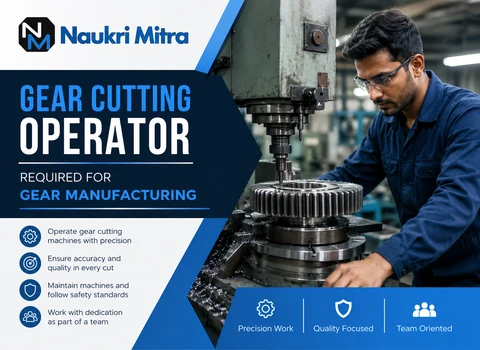
Understanding the Role of a Gear Cutting Operator in Modern Manufacturing
Gear manufacturing is a backbone activity of India's engineering and automotive supply chain, and skilled hands are needed to keep it running smoothly. A Gear Cutting Operator operates specialized machines that shape metal blanks into precision gears for vehicles, industrial equipment, pumps, and gearboxes. This is a hands-on, detail-oriented job suited for people who enjoy working with machines and take pride in producing accurate, repeatable results.
Why Manufacturing Units Hire for This Position
Gears are critical components that transmit motion and power in machinery, and even a small error in tooth profile or dimensions can cause an entire assembly to fail. Companies recruit trained operators because gear cutting demands patience, technical understanding, and a steady hand. As industrial output grows across Gujarat and other manufacturing hubs, demand for operators skilled in operating gear hobbing, shaping, and grinding machines continues to rise.
A Typical Day on the Shop Floor
Work usually begins with checking the job card or production schedule for the day. The operator collects raw blanks, verifies material specifications, and sets up the machine according to the gear drawing. Once the setup is checked, cutting begins, and the operator monitors the process closely, checking tooth profile, pitch, and surface finish at regular intervals. At the end of a batch, finished gears are inspected, recorded, and moved to the next process such as heat treatment or deburring.
Core Responsibilities of the Position
- Reading and interpreting engineering drawings to understand gear specifications
- Setting up and operating gear hobbing, shaping, or gear grinding machines
- Selecting correct cutting tools, speeds, and feed rates for different materials
- Measuring finished components using gauges, micrometers, and gear tooth vernier calipers
- Identifying defects such as burrs, incorrect pitch, or dimensional errors
- Maintaining daily production and quality records
- Performing basic machine cleaning and preventive checks
Industries and Work Locations
Gear cutting operators typically work in tool rooms, precision machine shops, and gear manufacturing plants that supply components to the automobile, agricultural equipment, textile machinery, and general engineering sectors. In Rajkot, Gujarat, a region known for its strong engineering and casting industries, such roles are commonly found in component manufacturing units serving both domestic and export markets.
Machines, Tools, and Measuring Instruments Used
The role involves working with gear hobbing machines, gear shaping machines, and sometimes EDM (Electrical Discharge Machining) equipment for complex tool and die work. Measuring instruments such as vernier calipers, micrometers, dial gauges, and gear-tooth calipers are used to verify accuracy. Familiarity with reading engineering drawings and understanding tolerances is essential to daily work.
Skills That Make an Operator Successful
Beyond machine operation, this job rewards attention to detail, mechanical aptitude, and the ability to stay focused during repetitive tasks. Basic mathematical skills help in calculating gear ratios, module sizes, and feed rates. Operators who can troubleshoot minor machine issues on their own tend to be more valued on the shop floor, since this reduces downtime during production runs.
Educational Background and Training Preferred
Employers often prefer candidates with relevant machining or tool room training. Depending on the complexity of the work, an ITI qualification in a machining-related trade, a Diploma in Mechanical or Tool and Die Engineering, or equivalent vocational training may be considered suitable. Practical exposure to EDM machines, engineering drawings, and precision measuring instruments is often valued as much as formal education, so freshers with strong workshop training can also find opportunities here.
Physical Demands and Working Environment
This is a full-time position that involves standing for extended periods, lifting moderate loads, and working close to moving machine parts. The workshop environment includes machine noise, cutting fluids, and metal dust, so operators need physical stamina and comfort working in an industrial setting. Depending on the production schedule, shift work may be required.
Safety Practices and Protective Equipment
Safety is taken seriously in gear manufacturing units due to the presence of rotating machinery and sharp metal edges. Operators are generally expected to use safety glasses, hand gloves suited for machine work, safety shoes, and hearing protection where noise levels are high. Following lockout procedures before maintenance and keeping the work area free of oil spills are common safety habits on the shop floor.
Common Challenges and Practical Tips
New operators sometimes find it challenging to maintain consistent accuracy over long production runs or to diagnose why a batch of gears exhibits dimensional drift. Regularly calibrating measuring instruments, keeping cutting tools sharp, and double-checking the first few pieces of every batch can prevent larger quality issues later. Building a habit of clear documentation also helps when handing over work between shifts.
Career Growth Within Gear Manufacturing
With experience, a Gear Cutting Operator can progress toward roles such as senior machine operator, quality inspector, or CNC gear machine programmer as manufacturing units adopt more advanced technology. Operators who develop strong knowledge of tool room practices and precision measurement often move into supervisory or setup specialist roles over time, making this a career with genuine long-term potential in the engineering sector.
Salary and Employee Benefits
This position is based in Rajkot, Gujarat, India, and offers a full-time monthly salary of ₹30,500. Depending on the employer, additional benefits may include overtime pay, Provident Fund (PF), Employee State Insurance (ESI), bonuses, uniforms, and transport or canteen facilities. These benefits vary by company and are not guaranteed, but they are common practices across many manufacturing units in the region.