📚 Table of Contents
- Introduction
- Real Worker Experiences in Manufacturing
- Why Adaptability Matters Most
- Making Automation Easy to Understand
- Addressing Worker Concerns
- Relatable Examples
- Straightforward Insights Without Jargon
- Key Skills / Tools / Insights
- Career Growth / Future Scope
- Step-by-Step Guide / How to Start
- Conclusion + Call-to-Action
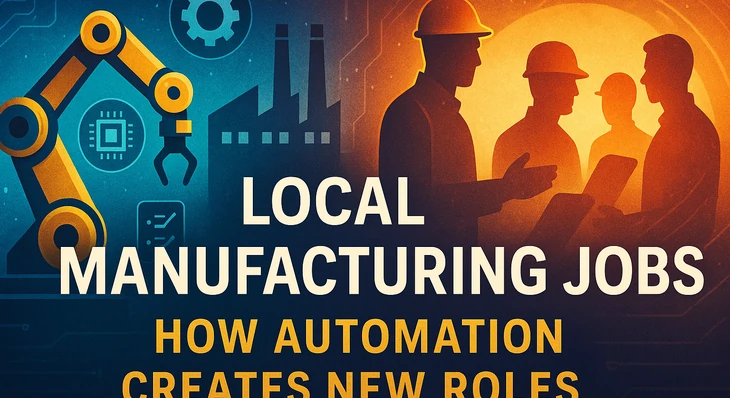
Local Manufacturing Jobs: How Automation Creates New Roles
Introduction
Have you noticed how factories around us are changing so fast? Machines are taking on more tasks than ever, which makes many people wonder: what’s left for us? The truth is, local manufacturing jobs aren’t disappearing — they’re transforming. Thanks to automation, new career paths are opening up that didn’t exist a decade ago. This shift isn’t about machines replacing people; it’s about people adapting, learning, and stepping into better opportunities. In this wave of change, workers are facing challenges such as acquiring new skills, staying relevant, and keeping pace with the evolving industrial workforce trends. At the same time, digital transformation in factories is prompting companies to reassess their hiring, training, and talent development strategies. So, while automation may appear intimidating from the outside, it’s actually creating space for more meaningful and high-value roles. Key benefits automation brings include:- New and emerging roles across industries
- Safer and less physically demanding work environments
- Clearer career advancement opportunities through upskilling
Real Worker Experiences in Manufacturing
Picture a mid-sized auto-parts factory in a local town. Ten years ago, most tasks were manual, including assembling, packing, and inspecting. Today, robots handle repetitive lifting, while people oversee the systems, check quality, and troubleshoot issues. This isn’t just about fewer jobs — it’s about different ones. One worker, Ravi, started on the assembly line but later transitioned to maintaining advanced production systems. He didn’t lose his job when automation arrived; he upgraded his skills. The factory invested in vocational training programs to help workers like Ravi move into precision engineering roles and supervisory positions. This story reflects a broader reality: manufacturing innovation isn’t eliminating jobs; it’s reshaping them.Why Adaptability Matters Most
Ever wondered why some workers thrive in this new environment while others struggle? The difference often comes down to adaptability. When technological disruption hits the industry, those willing to learn have the upper hand. But let’s be clear: does everyone have to become a computer programmer? Not at all. Many of the roles being created focus on human-robot collaboration, where workers guide machines, solve problems, and make judgment calls. Some are technical, but others need critical thinking and a willingness to upskill. So, the real question is: Are you ready to adapt when the next shift arrives?Making Automation Easy to Understand
Look, it’s not rocket science. You don’t need to know everything about automation or robotics to find your place in this change. You need to stay curious and keep learning. Factories are introducing innovative systems, but they still need people to run them. That means opportunities are growing, not shrinking.Addressing Worker Concerns
It’s natural to feel anxious when you hear about robots in factories. The fear of job loss is real, and so is the stress of learning new skills. But you’re not alone. Many workers feel the same doubts and confusion. The good news? Companies are investing heavily in upskilling their manufacturing workforce because they recognize that their employees matter. Adapting to automation doesn’t mean replacing workers — it means giving them a stronger role in the future. Factories need skilled teams that can meet modern demands and push innovation forward. Sustainable manufacturing careers are built on the idea that people and machines can work together to grow stronger.Relatable Examples
Think of it like school. Remember when calculators were first introduced? Students worried that teachers would stop valuing math skills. However, calculators became tools to solve larger problems. That’s precisely how automation works in factories today. Workers are still essential; they’re just focusing on higher-value tasks. Another example? Imagine a daily workplace scenario: instead of carrying heavy loads, workers now program a machine to do the work for them. This frees them up to ensure quality and safety, which leads to local employment growth. And just like in exams, preparation matters — vocational training programs are the “study guides” that give workers the confidence to succeed.Straightforward Insights Without Jargon
Here, you’ll dive into real opportunities without unnecessary buzzwords. We’re not here to throw jargon at you — the goal is clarity. Every story, every example here is meant to give you practical insight into where the future of work is heading and how you can be part of it.Key Skills / Tools / Insights
When it comes to thriving in local manufacturing jobs influenced by automation, specific skills stand out. First, the ability to work alongside machines is critical — this is where human-robot collaboration comes into play. Second, workers who understand advanced production systems are in high demand. Third, those who can spot opportunities in manufacturing innovation will always have an edge. At Naukri Mitra, we track the top skills global employers look for. These often include:- Problem-solving and analytical thinking
- Knowledge of Industry 4.0 job creation trends
- Technical know-how for precision engineering roles
- Adaptability for workforce adaptation to automation
- Awareness of digital manufacturing careers
- Openness to reskilling programs
Career Growth / Future Scope
What does the future look like? Simply put, it’s promising. Automation is not closing doors but creating long-term paths for career development. Local manufacturing jobs with automation influence will demand bright, adaptable talent. Workers ready to embrace digital transformation in factories will find themselves leading the way. Roles tied to sustainable manufacturing careers and skilled trades demand are expected to grow steadily. According to the World Economic Forum, automation is projected to create 97 million new roles by 2025. Insights from platforms like Naukri Mitra indicate that companies are actively seeking talent that combines technical expertise with problem-solving skills. In India, manufacturing upskilling programs have increased employability by nearly 40%, according to a NASSCOM report. Common new positions include:- Quality Control Supervisor
- Robotics Maintenance Technician
- Automation Coordinator
- Smart Factory Operator
- Blue-collar tech jobs with advanced tools
Step-by-Step Guide / How to Start
So, how do you actually begin this journey? Here’s a simple path you can follow:- Identify your interest – Do you lean toward technical work, problem-solving, or supervisory roles?
- Explore vocational training programs – These short, practical courses build confidence and prepare you for real factory scenarios.
- Learn about Industry 4.0 job creation – Stay updated on trends in automation and smart factories.
- Seek real-world exposure – Internships or apprenticeships let you practice human-robot collaboration firsthand.
- Upgrade step by step – Keep adding small skills over time instead of trying to learn everything at once.