
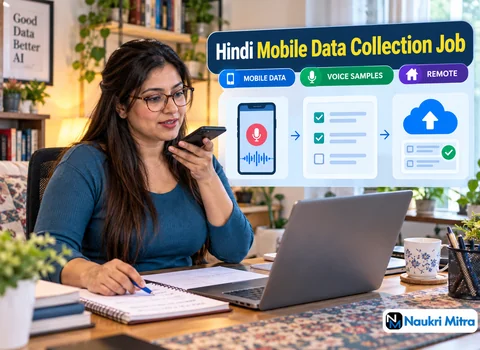
The card on your phone screen is short. At the top sits one Hindi sentence, perhaps something like "कल सुबह बाज़ार में सब्ज़ियाँ सस्ती थीं". Under it, a grey line of text says: sit in a quiet room, keep the phone a hand's width from your mouth. Then a large red record button, and below that a small play icon with the note "listen before you upload". That one card is most of what online hindi mobile data collection jobs look like from day to day. This role is part-time, fully remote, open to Hindi speakers in any country, and pays $8 per hour USD. Neither a degree nor any past work experience is asked for.
Voice assistants, speech-to-text tools and image recognition systems learn from real human input. A model that must understand Hindi spoken in Bhopal, Patna or a Delhi bus queue can only learn from people who speak that way. In plain terms, the hindi mobile data collection job description is this: you supply that input, one small task at a time, through a project app on your Android phone. Some tasks take under a minute; a short spoken story may take a few. Nobody asks you to sell anything or call anyone.
The most common task is a scripted prompt: a sentence, a number, or a short command such as "रोशनी बंद करो". You read it exactly as written, at normal speed, in the voice you use with family. Projects do not want a newsreader accent, because ordinary people will later talk to these systems.
A few habits help a great deal:
Some projects ask for unscripted speech, such as "describe how you make tea at home". There is no wrong answer, only a topic and a time limit. Speak as you would to a friend; small hesitations are normal.
Photo tasks are the other half of this role: a steel tumbler on a table, a pair of chappals, a shop signboard in your street. Instructions often specify angle, lighting or distance.
There are firm limits. Never photograph a person without that person's clear consent, and follow the project rule even if they agree. Never photograph Aadhaar cards, PAN cards, bank papers, prescriptions, screens showing messages, or anything with a name, address or phone number visible. If a picture accidentally catches a face or a document in the background, retake it.
That small play button matters more than the red one. Listen to each recording with earphones before you upload. Ask yourself three plain questions: can every word be heard, is there a fan, pressure cooker, television or traffic sound behind your voice, and did the clip cut off the first or last word?
Reviewers check samples too, and repeated noisy uploads can lead to rejected tasks or removal from a project. For photos, check focus and framing, and that nothing private slipped in. Then upload within the deadline shown in the app.
Before any genuine project starts, you will see a consent form. Many people tap "I agree" in two seconds. Please do not. It tells you what happens to your voice and pictures.
Look for answers to these points:
If the form is missing, vague, or written only in a language you cannot follow, ask questions before recording. A real project will answer patiently.
This listing asks for an Android smartphone with a good microphone and camera. Keep free storage for the app and a steady connection for uploads.
The quiet room is a requirement, not a nice extra. A small bedroom with the door shut, curtains drawn and the ceiling fan switched off usually works better than a large hall with hard floors. Cushions and mattresses absorb echo.
The core hindi mobile data collection skills are simple: clear spoken Hindi, comfortable reading of Devanagari, basic app use such as granting microphone permission, and patience with exact instructions. That is why these are genuine hindi mobile data collection jobs for freshers and students.
The hindi mobile data collection salary per hour in this role is $8 USD. That is a time-based rate for the hours you actually spend on tasks, and it suits people who want part time hindi mobile data collection jobs alongside study, family duties or another job. Weekly hours are not guaranteed: a project might flood the app with prompts one month and go almost silent the next.
Not every project pays by the hour. Many speech data projects pay per task or per approved recording, so earnings depend on how many clips pass review. Before you start any project, check the method, the payment schedule and whether rejected work is paid. You will also be using your own phone and data pack.
Several organisations work in speech and image data. Karya runs a phone app designed for Indian language data work, and OneForma lists recording and collection tasks for many languages. Appen and Shaip also run speech data projects. Naming them is purely illustrative, and what each one has open shifts constantly.
To join voice recording projects from mobile, you usually create a profile on the platform's official website or its Play Store app, add your languages, dialect and region, and may take a short qualification task, which is normal. If accepted, tasks appear in your app.
For freelance hindi mobile data collection jobs, a hindi mobile data collection resume can be one short line: languages spoken, home region, the phone you use, and any earlier recording or survey work. No paid hindi mobile data collection course or certificate is needed.
People often mix up these two jobs. In data collection, you are the source. You speak, you photograph, and the app sends your raw material. In Hindi transcription, someone else's audio is already recorded, and your job is to listen and type exactly what was said, often with tags for noise, pauses or English words.
Transcription needs fast Hindi typing and usually a laptop. Collection needs a clear voice, a quiet room and a phone. Many people start with collection and later try transcription or review tasks.
Genuine hindi mobile data collection work from home exists, and so do fake offers that copy its language. A few rules protect you every time:
If something feels wrong, stop and ask someone you trust. When you are ready, apply to this role with your Hindi details and your phone model, and expect clear instructions before your first task.