
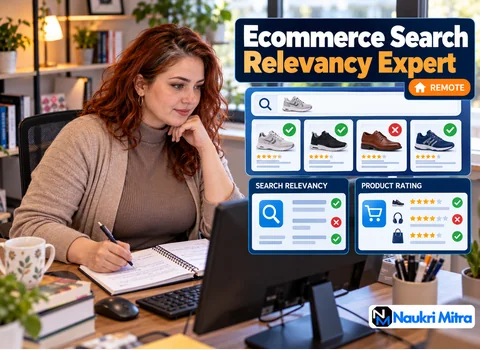
A shopper searches for "men's running shoes size 10 wide". The first result is a men's road running shoe, offered in size 10 with a wide-fit option clearly listed on the product page. The second is the same model in a women's version, size 10, which looks almost identical in the thumbnail and is completely wrong for this person. The third is a pack of shoe deodoriser sachets. Deciding which of those deserves a top rating, which only looks right, and which should never have appeared, many times a day, is what online ecommerce search relevancy expert jobs come down to. This ecommerce search relevancy expert work from home role is part-time, has no country restriction, and is paid at $15 USD per hour. No degree is required, but you must pass a qualification exam before you see live tasks.
Every task starts with the shopper's words, and most rating mistakes start there too. A query like "headphones" is broad: many products are reasonable answers, and a decent pair of wired earbuds is still a useful result. A query like "noise cancelling over-ear headphones under budget for travel" is specific, and each extra word narrows what counts as a match.
You learn to separate the parts of a query. Is there a brand? If someone searches for one brand of phone case, a near-identical case from another maker is a weaker answer, however good it is. Are there attributes such as colour, size, material, capacity or model number? Is there a gender or age group, like "girls' school shoes" or "baby bottle 0-6 months"? Is a quantity implied, as in "AA batteries 24 pack"? Misspelt queries are usually rated against their most plausible meaning.
Once you know the intent, you check each result against it. The title is the first clue, but sellers stuff titles with keywords, so a title that mentions "iPhone 15" might belong to a case, a cable or a screen protector. You open the details, read the bullet points and specifications, and look at the images. A photo often settles what the text avoids, such as whether a "set" really holds four pieces.
Compatibility errors catch new raters most often, which is why careful reading tops the list of ecommerce search relevancy expert skills. A printer cartridge that fits a neighbouring model number, a laptop battery for the previous generation, a replacement filter for a different vacuum: all of these look relevant at a glance and fail the shopper completely.
Projects use their own scales, so the labels you see will vary. In general terms, there is a top grade for an exact match, a middle range for products that are related or partly satisfy the query, and a bottom grade for results with no real connection. Some scales separate an acceptable substitute from a mere accessory.
The guidelines document defines each grade with examples, and your score should always be one you could defend by pointing to a line in it. Personal taste does not count: a brand you dislike still earns the top grade if it matches every attribute.
Alongside the relevance score, you mark results that need a different kind of attention. Typical flags cover offensive or adult content appearing for an ordinary query, listings that seem misleading (a photo of one item and a title describing another), pages that fail to load or show in the wrong language, and items that look unsafe or restricted. Projects explain which flags exist and when to use them, and over-flagging is treated as an error just like missing a real problem.
The work happens in a browser-based rating tool. A task usually shows the query, a product or a short list of products, the scale, any flag boxes and sometimes a comment field. Many projects set an expected time per task, and the tool may track how long you spend. Rushing produces careless scores, and constant overruns get noticed too.
A sensible rhythm is to read the query once, decide the intent before scrolling, then check each product for the one or two details that matter most. When a task is genuinely unclear, most tools let you skip it or leave a note, and that is better than guessing.
Your ratings are checked, and this is the part of the ecommerce search relevancy expert job description people tend to underestimate. Some tasks have known answers and are mixed in without warning; others are reviewed by senior raters or compared with how other people scored the same item. Over time this builds a quality score, and projects expect it to stay consistent. A good stretch followed by careless days will show. Read audit feedback and find the guideline section behind each correction. Falling accuracy can mean fewer tasks or removal, so steady care beats speed.
Live work only opens once you clear a test written around the project guidelines. Expect questions on the rules plus practical rating of sample queries. Some projects allow a retake; many do not, so treat the first attempt seriously.
Preparation is mostly reading. Go through the guidelines slowly, more than once, and make your own short notes on the grade definitions and flags. Then practise on real shopping sites: type a few queries of your own, look at what comes back, and decide what grade each product would earn and why. Watch edge cases such as bundles and refurbished items. Projects do not insist on any paid course or ecommerce search relevancy expert certification; the exam is the test that counts. Asked how to become an ecommerce search relevancy expert, most experienced raters give the same reply: study, practise, pass.
Part time ecommerce search relevancy expert jobs suit people who can give a few hours each week reliably. Some projects set a weekly minimum and a maximum, and the amount of work on offer can change from week to week. You need a desktop or laptop computer, an up-to-date browser and dependable broadband or mobile data. Phones and tablets are usually not accepted for rating tools. Some projects require a particular browser or location check, so read the setup instructions first. A quiet place to concentrate makes a real difference to accuracy.
General search engine evaluators judge web pages for informational queries: is this article trustworthy, does this page answer the question, is the site reputable. An ecommerce rater works inside a catalogue. The questions are narrower and more concrete: does this exact product match the size, model, gender, brand and quantity the shopper asked for. People who have done one often adapt well to the other, but the guidelines are different and each needs its own study.
Because no degree or prior rating experience is asked for, this is one of the more realistic ecommerce search relevancy expert jobs for freshers and for anyone who shops online often and reads carefully. On an ecommerce search relevancy expert resume, mention strong English reading, any work with product data, retail or customer support, and specific examples of following detailed written rules. Screening rarely looks like a classic interview; the qualification exam usually does that job, though some screens ask how you would rate an ambiguous query or handle a listing whose photo contradicts its title.
The work is real. TELUS Digital and Appen, to name two, run search and relevance rating programmes, and similar freelance ecommerce search relevancy expert jobs appear on other platforms too. It is also project-based. Hours, pay rates and task availability vary, projects can pause or end, and nothing guarantees a set income. Treat any demand for money as the end of the conversation: a joining charge, a registration payment or a fee to release tasks or earnings all mark an offer as false.