Aon expects Indian companies to raise salaries by 9.1% in 2027, almost unchanged from 9% in 2026, while attrition climbed to 18%. Here is the sector-wise picture and what it means for your appraisal.

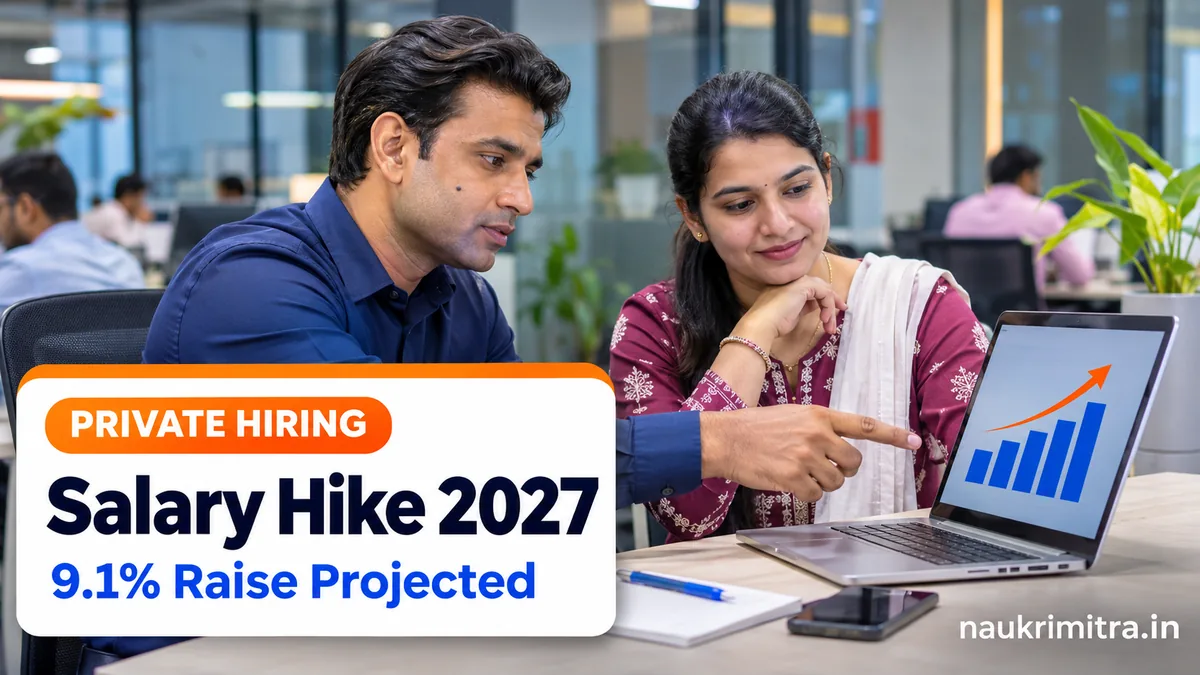
Indian employers plan to raise pay by an average of 9.1% in 2027, according to the salary hike 2027 Aon survey released on 14 October 2026. That is barely above the 9% actual increase companies gave in 2026. The same study, which covered more than 1,200 organisations, found that attrition rose to 18% in 2026, higher than in both 2024 and 2025.
For most private-sector staff, the next appraisal round is only a few months away, and these numbers will shape what HR teams put on the table. This explainer sets out what Aon found, which sectors are paying more or less, what the new Wage Code changes, and how an employee can use the data without expecting more than it promises.
| Item | Details |
|---|---|
| Report | Annual Salary Increase and Turnover Survey for India 2026-27 (33rd edition) |
| Published by | Aon plc, Talent Solutions India |
| Release date | 14 October 2026, New Delhi |
| Coverage | More than 1,200 organisations across 45 industries |
| Projected average hike for 2027 | 9.1% |
| Actual average hike in 2026 | 9% |
| Attrition in 2026 | 18% (16.2% in 2025, 17.1% in 2024) |
| Highest projected sector, 2027 | NBFCs, 10.1% |
| Lowest projected sector, 2027 | Technology consulting and services, 6.6% |
| Who it applies to | Private employers in the sample; not government pay |
What the salary hike 2027 Aon survey projects for India Inc
Aon expects India Inc to raise salaries by an average of 9.1% in 2027. The figure comes from the firm's annual salary increase and turnover survey for India, now in its 33rd year, and was released in New Delhi on 14 October 2026. You can read the full statement in Aon's official press release.
For comparison, the actual average increase companies paid in 2026 was 9%. The 2027 budget is therefore higher by just 0.1 percentage point.
How many companies did Aon survey?
The study covers more than 1,200 organisations across 45 industries. Companies report planned and actual increments, and Aon works out averages for each sector and for the country as a whole.
The India salary increment 2027 projection Aon has published is a budget average. It is not a promise to any one employee, and some people will get much less or much more than 9.1%.
Does the report compare India with other countries?
The India release does not give pay figures for other countries, so we have not added any here. Aon runs separate studies in other markets, and any cross-country ranking needs the same year and method to be fair.
Sector wise salary hike 2027 India table
Non-banking financial companies lead the 2027 projections, with energy and real estate close behind. Sector data is the most shared part of the salary hike 2027 Aon survey. The table lists only the sector figures we could confirm in Aon's release or in more than one news report on the survey.
| Sector | Projected hike, 2027 | Where the figure is from |
|---|---|---|
| Non-banking financial companies (NBFCs) | 10.1% | Aon release |
| Energy | 9.9% | News reports on the survey |
| Real estate and infrastructure | 9.8% | News reports on the survey |
| All sectors (average) | 9.1% | Aon release |
| Banking | 8.5% | As reported in coverage of the survey |
| Technology consulting and services | 6.6% | Aon release |
NBFC salary hike 2027 highest sector at 10.1%
NBFCs are the only sector in the confirmed list that crosses the 10% mark. Aon does not explain the gap sector by sector. Our reading is that these lenders keep competing for staff in sales, credit and collections, and a higher budget helps them hold on to people.
Real estate and infrastructure paid the highest actual increase in 2026, at 10.3%, according to Aon. For 2027 the sector is projected at 9.8%, a little lower than last year but still above the national average. The energy sector sits between the two at 9.9%.
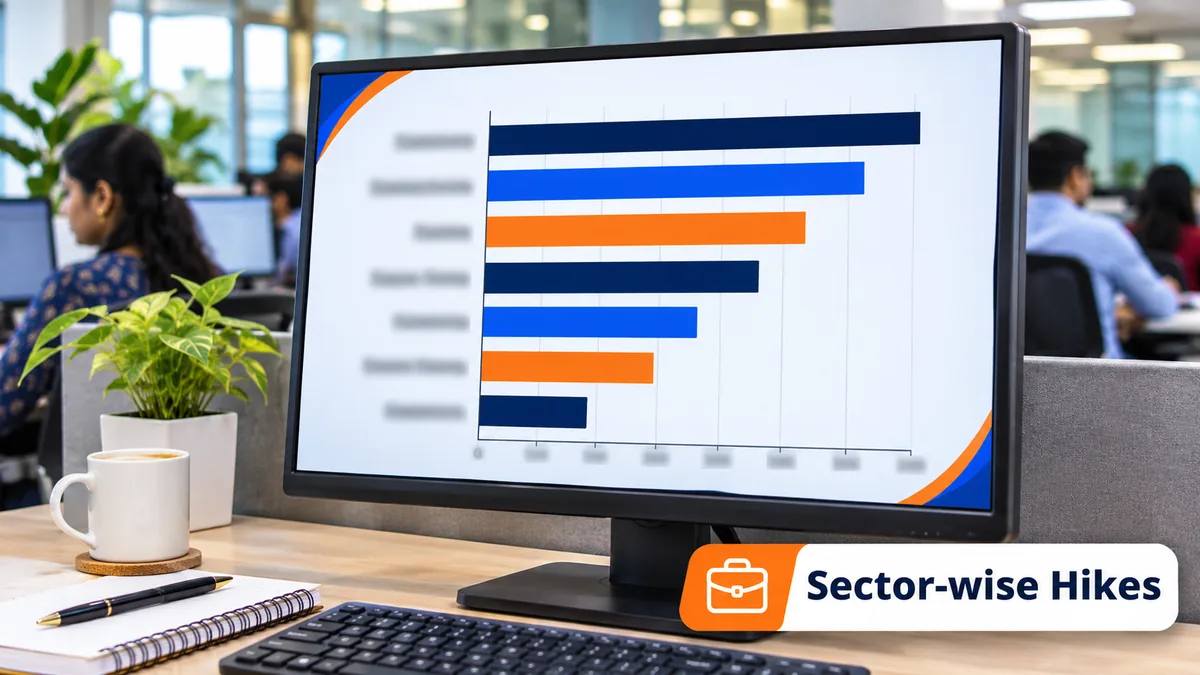
Technology services and banking sit at the bottom of the pay table
Technology consulting and services firms are projected to give the smallest increase in 2027, at 6.6%. Banking is expected to stay below the average too, at 8.5% according to reports on the survey.
IT sector salary hike 2027 forecast stays at 6.6%
The 6.6% projection for IT services is the same as the sector's actual increase in 2026, which was also the lowest of any sector that year. For the lakhs of people who work in large IT services companies, this points to a second straight year of raises well below the national average.
Aon's release does not give a reason for the gap. Large IT firms have been careful with hiring and pay for some time, and the shift towards AI tools in project delivery adds to that caution. The same survey shows, however, that people with AI, machine learning and data science skills are earning a growing premium.
Why banking trails NBFCs
Banks and NBFCs both lend money, yet banking is projected about 1.6 percentage points lower. Some coverage also mentioned chemicals among the slower sectors, but we could not confirm the exact chemicals figure in Aon's release, so it is left out of our table.
Attrition back at 18% after a calmer 2025
Overall attrition in India rose to 18% in 2026, reversing the dip seen a year earlier. More people left their jobs in 2026 than in either of the two previous years covered by the report.
Attrition rate India 2026 Aon report: the three-year trend
| Year | Attrition rate | Change |
|---|---|---|
| 2024 | 17.1% | Base year in this comparison |
| 2025 | 16.2% | Down 0.9 percentage point |
| 2026 | 18% | Up 1.8 percentage points |
A rise from 16.2% to 18% means that, out of every 100 employees, nearly two more left their company in 2026 than in 2025. The headline number counts all exits. The release figures we checked do not split it into resignations and layoffs, so it would be wrong to read the whole rise as people quitting for better offers.
Even so, higher attrition usually puts pressure on employers. Replacing a trained worker costs money and time, which is why talent retention features so strongly in this year's findings. When more people are leaving, companies tend to protect pay for the roles that are hardest to fill rather than raise everyone's salary equally.
Why companies are keeping 2027 salary budgets flat
Employers are holding budgets steady because they feel reasonably confident about growth but still face real cost pressures. The message of the salary hike 2027 Aon survey is one of balance, not of a pay boom.
Roopank Chaudhary, Partner and Rewards Consulting Leader for Talent Solutions India at Aon, pointed to strong domestic consumption, steady investment and export growth as reasons for business confidence. In the release, he said, "Stable salary budgets are enabling a more targeted approach to pay." That means companies are deciding more carefully where each rupee of the increment budget goes.
On the cost side, several pressures are building at once. The new labour codes are pushing up statutory contributions at many firms. Spending on AI tools and on training staff is rising. News coverage of the survey also flagged inflation and a weaker rupee as risks that could eat into the real value of a 9% hike.
For employees, a flat budget is not bad news by itself. A 9.1% average applied to a higher base salary still adds more rupees than the same percentage did a few years ago. The catch is in the distribution. A stable budget with a sharper focus on certain roles means more variation between colleagues, even within the same team.
What a targeted pay approach means for top performers and the rest
A targeted approach means the same overall budget is split unevenly, with more money going to high performers and to scarce skills. The average stays near 9.1%, but individual hikes spread further apart.
Do top performers get more than the average?
In most Indian companies, yes. Increment grids usually link the hike to the performance rating, so an employee rated in the top band can get well above the company budget, while an average or low rating pulls the figure down. Aon's public release does not give a separate number for top performers, so treat any exact "top performer hike" figure you see online with caution.
Non-merit adjustments and market corrections
According to news reports on the survey, more employers are also making non-merit adjustments, especially in manufacturing and technology. These are pay corrections outside the normal appraisal, used to bring a role closer to market rates or to keep someone with skills that are in short supply.
Variable pay and performance-based pay
Many companies pay part of the annual package as variable pay linked to company and individual results. The release we reviewed does not say that variable pay will be cut in 2027. What it does suggest is a continued tilt towards performance-based pay, so the share of your package that depends on results matters as much as the fixed increment.

New Wage Code impact on salary structure and payroll costs
The new Wage Code mainly changes how your salary is split, not how much your employer budgets for the hike. The Code on Wages, which came into force along with the other three labour codes in November 2025, uses a wider definition of wages.
Under the code, basic pay, dearness allowance and retaining allowance together should make up at least half of total pay. If allowances go above 50%, the extra is added back when working out wages. Since provident fund and gratuity are calculated on wages, many companies have had to raise the basic component. That can increase the employer's PF and gratuity cost, and in some cases slightly lower monthly take-home pay even when CTC stays the same.
Aon's survey found that 65.4% of employers are already compliant, while another 20.9% expect to be ready within six months. About 42.8% expect their payroll costs to rise by at least 1% because of the change.
Amit Kumar Otwani, Associate Partner, Talent Solutions India at Aon, said that compliance alone will not be enough and that employers must look at the wider cost and workforce effects and explain the changes to staff. "Early action will help organisations maintain pay competitiveness and workforce trust," he said. If your pay structure was redesigned this year, ask HR for a clear before-and-after breakup.
AI skills premium and upskilling in the 2027 pay plans
Skills in AI, machine learning and data science are drawing a bigger pay premium, and that premium rose by about 10% compared with 2025, according to the survey.
The study also tracked how quickly companies are adopting AI at work. Established use of AI productivity tools rose to 56% of employers, up from 46.1% in 2025. About 60% of employers said they are prioritising upskilling of their existing staff.
Two practical points follow for employees:
- A role that uses AI tools well is likely to be valued above an identical role that does not, even inside the same company.
- Training offered by your employer is worth taking seriously, since many firms now link it to role changes and pay reviews.
The premium is not limited to IT companies. Banks, NBFCs, manufacturers and global capability centres all hire for data and AI roles. For someone in a low-budget sector such as technology consulting and services, building these skills is one of the more realistic ways to move above the 6.6% average.
Salary increase versus CTC hike, and the inflation check
The 9.1% in the salary hike 2027 Aon survey does not always mean your take-home pay or your CTC rises by 9.1%. The two terms measure different things, and employees often mix them up.
What is the difference between a salary increase and a CTC hike?
CTC, or cost to company, is the full annual amount your employer spends on you. It includes fixed pay, variable pay, employer PF, gratuity, insurance and sometimes other benefits. A salary increase in a pay survey usually refers to the rise in salary budgets. Your letter may quote a percentage on CTC, on fixed pay or on basic pay, and each gives a different rupee figure.
Take an example. On a CTC of ₹10 lakh with ₹2 lakh as variable pay, a 9% rise only on fixed pay adds ₹72,000, not ₹90,000. Always check which base the percentage is applied to.
Does 9.1% beat inflation?
On current numbers, yes, but by a smaller margin than the headline suggests. Retail inflation measured by the Consumer Price Index was 5.54% in September 2026, according to official data reported by news agencies. A 9.1% raise would leave a real gain of roughly three and a half percentage points if prices kept rising at that pace.
How much increment to expect in 2027 in your own appraisal
Use the salary hike 2027 Aon survey as a reference point, not a target you are owed. Most employees should expect a raise around their sector's figure, adjusted up or down by their rating, role and skills.
Using the Aon numbers in appraisal talks
- Find your sector's figure in the table above. That is the realistic middle point, not the floor.
- Write down your results for the year with numbers: targets met, projects delivered, savings made, skills added.
- Check market pay for your role by looking at latest jobs with similar titles and experience. This tells you whether your pay is below the market, which is a stronger argument than the national average.
- Ask HR how your structure changed under the Wage Code and what it means for take-home pay, PF and gratuity.
- If the hike is low but the role is worth keeping, ask about a mid-year review, a role change or a training path linked to pay.
If you plan to switch jobs
Higher attrition shows that many people did move in 2026. Before you resign, have a written offer in hand. Never pay a "registration" or "processing" fee to any recruiter or agency to get a private-sector job. Genuine employers do not ask for money, and offers that come only through WhatsApp or personal email should be checked with the company directly. Further updates will appear in our private hiring news and wider employment news sections.
Frequently asked questions
Is a 9.1% hike above inflation?
Yes, at current levels. Retail inflation was 5.54% in September 2026, as reported from official CPI data. A 9.1% average hike would therefore leave a real increase of about three and a half percentage points. The margin is thinner in low-budget sectors such as technology consulting and services, where the projection is 6.6%.
Will freshers also get the projected 2027 increment?
Not necessarily. The 9.1% figure is an average across employees in the surveyed companies. Freshers who joined during the year may get a pro-rated hike or none until they complete a full cycle. Starting salaries for new hires are set separately and often do not change in step with increment budgets.
In which months do most Indian companies give appraisals?
Many Indian companies follow the April to March financial year and announce increments between April and July. Others, especially some multinational firms, use a January to December cycle and give hikes from January to April. Your offer letter or HR policy will state the exact cycle your employer follows.
Is switching jobs better than waiting for a 2027 increment?
It depends on the offer and your situation. A job change often brings a larger one-time jump than an annual hike, but it also brings risk, a new probation period and possible loss of bonuses. Compare total pay, stability and growth, and do not resign before you hold a written offer.
Does banking give lower hikes than NBFCs in 2027?
Yes, according to reports on the survey. NBFCs are projected at 10.1%, the highest of any sector, while banking is reported at 8.5%, below the 9.1% national average. Individual banks can still pay more or less than this figure depending on their own results and roles.
Will variable pay be cut in 2027?
Aon's release does not say that variable pay will be cut. It points to stable budgets and a more targeted approach, which usually means performance has a bigger effect on payouts. Variable pay still depends on each company's results and your own rating, so check your company's policy.
Do government employees get hikes based on such surveys?
No. Central and state government pay is set by pay commissions and revised through dearness allowance announcements, not by private surveys. The Aon study covers private employers in its sample. Government staff should follow official orders from the finance ministry or their state government for pay changes.
How reliable are salary hike projection surveys?
They are useful as a guide to employer budgets, but they are projections. Actual hikes can differ, as companies revise budgets when business conditions change. Aon's 2026 projection and the 9% actually paid were close, which suggests reasonable accuracy, but your own hike depends on your company and performance.
What is a good salary hike percentage in India?
A hike at or above your sector's average, and clearly above inflation, can be called reasonable for a solid performer. In 2027 that means about 9% overall, roughly 10% in NBFCs and about 6.6% in IT services. Anything well above your sector's figure usually reflects a strong rating or a scarce skill.
Where can I read Aon's official salary survey release?
Aon published the salary hike 2027 Aon survey findings on its Asia newsroom on 14 October 2026. The link is in the first section of this story. The full survey report is usually shared with participating companies, while the press release gives the main public figures.
Jobs you can apply for now
Fresh openings on Naukri Mitra related to this news
- ₹32,000/month
- Raisen
- Full Time
- Maid
Posted 01 Apr 2025View & apply - V
ITI Jobs in Raisen
Varun Gupta₹35,000/month- Raisen
- Full Time
- Skilled Technical & ITI Jobs
Posted 05 Jul 2024View & apply - V
Hospital Jobs in Raisen
Varun Gupta₹25,000/month- Raisen
- Full Time
- Hospitals & Medical Services
Posted 22 May 2024View & apply - V
Hotel Jobs in Raisen
Varun Gupta₹25,000/month- Raisen
- Full Time
- Accountant
Posted 26 Apr 2024View & apply
Yogesh Kumar Dewangan is the founder of Naukri Mitra and edits its employment news. He covers government recruitment, exam dates and results, private hiring and rules for jobs abroad, written in simple English for job seekers across India. Every story is checked against the official notice or website before it goes live, the source is linked at the end, and mistakes are corrected openly. He has hands-on experience in recruitment and hiring, and also founded DevMixa and RemoteRoles, where he works in IT, SEO and digital marketing.
We check every story against its official source. Read our editorial policy and corrections policy. Found a mistake? Tell us.