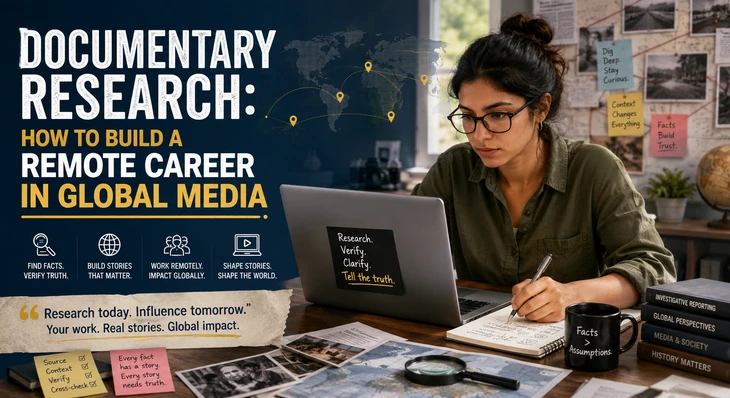
Documentary Research: How to Build a Remote Career in Global Media
There are careers that feel obvious—titles you grow up hearing about, like doctor, engineer, journalist. And then there are careers you only notice once you’re already living in a digital world that quietly changed everything. Documentary research sits in that second category.
It’s not loud. It doesn’t always get credit on screen. But it shapes what people believe, remember, and talk about.
And right now, it’s also becoming one of the most realistic ways to build a remote career in global media without being tied to a single city, office, or country.
Documentary research isn’t what most people think
If you ask someone what documentary research means, they’ll probably say “finding information.” That’s technically true, but it’s a very small version of what actually happens.
In real work, documentary research feels like solving a puzzle where half the pieces are missing and the other half might be wrong. You’re constantly checking what’s real, what’s repeated, and what has quietly changed over time.
One day you might be reading an old government archive. Another day, you’re watching a blurry interview clip from years ago, trying to catch a single sentence that confirms a timeline. Then you’re comparing that with modern reports that don’t always agree.
That’s the job. Not glamorous, but extremely important in global media.
Because without it, stories don’t hold.
We live in a time where content moves faster than verification. That creates a problem.
A documentary might look polished, emotional, even powerful—but if its foundation is weak, the entire story collapses under scrutiny.
Strong documentary research careers exist to prevent that.
They quietly ensure:
- Stories are built on facts, not assumptions
- Context is not lost when content crosses borders
- Sources can actually be traced back
- Different perspectives are not ignored
It’s not about making stories dramatic. It’s about making them real.
There was a time when global media work meant physical presence. You had to be in the newsroom, the studio, or on location. If you weren’t there, you weren’t part of it.
That barrier has slowly disappeared.
Now, a large part of media production happens through screens—shared folders, cloud drives, video calls, and long message threads that stretch across time zones.
And documentary research fits perfectly into that system.
What actually changed behind the scenes
It wasn’t one big shift. It was several smaller ones happening at once:
Streaming platforms created constant demand for documentary content. Freelance culture made talent global. Research tools moved online. And suddenly, collaboration stopped depending on geography.
Now, a remote career in global media is not unusual at all. It’s normal workflow for many teams.
A researcher might sit in a quiet town and still be part of a project released on an international platform months later.
No relocation. No office. Just structured, consistent research work.
Skills that actually matter (and what people misunderstand)
There’s a misconception that careers in documentary research require a long list of formal qualifications. In reality, most teams care more about how you think than what degree you hold.
Because this job is less about memorizing information and more about questioning it.
Good researchers don’t rush to conclusions. They slow things down mentally, even when deadlines are tight.
They keep asking small but important questions:
Where did this come from? Who said it first? Does another source confirm it? Why does this version look slightly different?
That habit matters more than anything else.
Being comfortable working digitally
Most documentary research today happens online. That sounds simple, but it requires discipline.
You’re constantly switching between archives, documents, notes, and conversations. Nothing is in one place.
So you learn to stay organized even when information is scattered.
Writing things in a way others can actually use
This is where many beginners struggle.
Finding information is one thing. Turning it into something a writer or editor can immediately use is another.
Good researchers don’t just collect facts. They structure them so clearly that someone else can build a story from them without confusion.
How people actually start a remote career in documentary research
Most people don’t enter this field with a clear roadmap. They usually enter it out of curiosity—watching documentaries, reading stories, and slowly becoming interested in what happens behind the scenes.
From there, things start to build.
At first, it’s not about jobs. It’s about awareness.
You start noticing how stories are constructed. You begin questioning headlines. You compare reports instead of trusting the first version you see.
That shift alone is the beginning of documentary research thinking.
Then comes practice
You start doing small exercises without even realizing it.
Breaking down a news story. Checking sources. Writing short summaries. Comparing two versions of the same event.
Slowly, this becomes a skill instead of just curiosity.
Portfolio building without overthinking it
People often delay this step because they think it has to be perfect. It doesn’t.
A simple collection of research samples is enough:
A breakdown of a social issue. A fact-check exercise. A short research note on a documentary you watched.
What matters is clarity, not size.
At some point, you start working with real people—independent creators, small production teams, or digital storytellers.
This is where remote media careers start feeling real.
You’re no longer practicing. You’re contributing.
Documentary research sounds intellectual, but the day-to-day work is very practical.
It depends heavily on tools that keep everything structured.
You might spend hours inside online archives, academic databases, or news platforms. Then switch to video calls for interviews or clarifications. Then move everything into documents where it can be shared.
The tools themselves are simple. What matters is how consistently you use them.
Over time, your system becomes your memory.
The part nobody talks about: the pressure behind accuracy
Remote documentary research sounds flexible, and in many ways it is. But there’s also quite a pressure attached to it.
Because your work directly influences what others will see on screen.
A small error in a date, a misinterpreted quote, or a missing source can change the meaning of an entire segment.
So attention to detail becomes part of your identity as a researcher.
Not because someone is constantly watching—but because the work demands it.
Where documentary research careers actually lead
There isn’t just one path in this field.
Some people stay in documentary production for years. Others move into journalism, investigative media, or digital storytelling.
Some even work with NGOs, museums, or academic institutions where research is used to preserve history or explain cultural change.
The interesting part is that all these paths still rely on the same core skill: turning scattered information into something reliable.
This is not a fast career. It rewards patience more than speed.
People who do well in documentary research careers usually share one habit: they stay consistent even when work is slow.
They keep learning. They keep improving how they organize information. They don’t treat research as a task, but as a long-term skill.
Over time, that consistency turns into trust. And in global media, trust is what brings repeat work.
Technology will keep changing how research is done. AI tools will become part of workflows. Information will become easier to access.
But the core responsibility will stay human.
Because deciding what is reliable, what is meaningful, and what should be included in a story still requires judgment.
That’s why documentary research will continue to matter in global media, especially in remote work environments where teams rely heavily on written clarity and trust.
If anything, remote media careers will make this role even more important.
FAQs
What does documentary research involve in real work?
It involves collecting, verifying, and organizing factual information that supports documentaries, news stories, and digital media content.
Can someone start this career remotely without experience?
Yes. Many people begin with small freelance tasks, personal research projects, or collaborations with independent creators.
What skills matter most for documentary research careers?
Clear thinking, attention to detail, strong research habits, and the ability to present information in a structured way.
Where do remote opportunities usually come from?
They often come from freelance platforms, media production teams, independent creators, and journalism networks.
Is this a stable long-term career path?
Yes. As global media continues to grow, the demand for reliable documentary research is also increasing.
Conclusion
A remote career in global media through documentary research is not built overnight. It grows slowly through observation, practice, and consistency.
It rewards people who are patient with information and careful with details.
And as global storytelling continues to expand across platforms and borders, the role of documentary research will only become more central to how stories are created and trusted.