
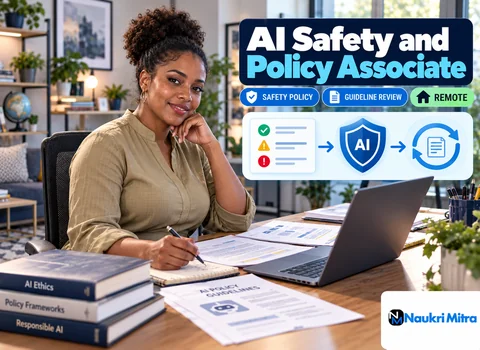
Draft rule: "The model should not give dangerous advice." Rewrite: "General safety information, such as how to store household cleaners away from children, is allowed. Step-by-step instructions for causing serious harm to people are not allowed. Where a request could go either way, the response should give the safe, general version and decline the specific part." The second version is longer, and it is the one a team can actually apply. Turning the first kind of sentence into the second is a large part of what these online AI safety and policy associate jobs involve. This is AI safety and policy associate work from home, part-time, available worldwide, at USD 17 per hour.
A safety policy is only as good as the reviewer's ability to apply it consistently. "Dangerous" means different things to a chemist and a teenager. A useful rule names the category, says what falls inside and outside it, and gives a couple of borderline cases with the expected outcome. When two reviewers read the same AI response against that rule and reach different verdicts, the problem is usually in the wording, not the reviewers.
Red teaming, in plain terms, means testing an AI model with difficult or unusual requests to find where its behaviour breaks down before real users find it. You write prompts that sit near the edges of a policy and see whether the model holds the line, over-refuses something harmless, or slips. Each finding gets written up: what you asked in general terms, what the model did, which policy area it touches, and how severe it looks.
This listing does not describe specific attack methods, and you should not expect a project to want you to publish or share them. Findings stay inside the project tool. Often the most valuable result is mundane, such as a model refusing a harmless first-aid question.
The second strand is reading model outputs and deciding whether each one follows the policy you have been given. Many calls are not easy. A response might give accurate general information but include one sentence that goes further than the rule allows. Another might refuse correctly but lecture the user in a way the style guide discourages. You choose the label, mark the severity, and write a short justification another reviewer could check.
Grey areas take the most judgement. A sensible habit is to quote the exact rule clause you relied on, state which side of the line the response falls on, and flag it for discussion if the rule genuinely does not cover the case. A well-explained "the policy is silent here" note is often what prompts the next revision of the rubric.
The third strand closes the loop. You draft or revise the policy rubrics that raters and models are measured against. That means clear definitions, a list of what counts and what does not, and edge cases with a worked decision. For example, a rubric on medical content might separate "explains what a common medication is for" (allowed) from "advises someone to change a prescribed dose" (not allowed, redirect to a professional), with a note on how to treat a question that mixes both.
Revision work is usually driven by evidence from the labelling queue: if raters keep disagreeing on one category, the definition needs another pass. Writing concise justifications for your own decisions is part of every task in all three strands.
Put together, the AI safety and policy associate job description reads like this: test models, judge their answers against written rules, and improve those rules. A session might start with a batch of labelling tasks, move to a short red-team assignment on a single policy area, and end with comments on a draft rubric. Work arrives through a task platform, and hours are not fixed or promised; availability depends on project volume, which is normal for part time AI safety and policy associate jobs.
Every applicant has to pass an online assessment before receiving paid tasks. Expect reading a short policy and applying it to sample responses, explaining one or two decisions in writing, and possibly a brief writing exercise on a definition. It tests whether you read carefully and reason in clear English. Read the instructions twice and give each justification a specific reason.
This work involves reading content that can be upsetting. Model responses you review may touch on violence, self-harm, abuse, hate speech or other distressing topics, because those are exactly the areas a safety policy has to cover. The qualifications state plainly that you must be able to handle sensitive or harmful content. Please take that seriously before applying.
Before you accept a project, ask the platform or client directly what wellbeing support exists. Useful questions include whether you can skip specific categories, whether there are limits on time spent in high-severity queues, and whether any counselling or support resources are offered. Answers vary, and this listing does not promise any particular support. It is also fair to ask the employer how breaks work and whether you can pause or stop a session that is affecting you.
A bachelor's degree in any field is preferred, not mandatory. Study or work in public policy, social science, law, journalism or trust and safety is a plus, because those fields teach you to read rules closely and argue from evidence. Required are excellent English writing, critical thinking and the steadiness to handle difficult content. You will need your own laptop and a reliable internet connection.
There are AI safety and policy associate jobs for freshers, and this is one of them; good raters often come from teaching, moderation or paralegal work. If you are looking for AI safety and policy associate jobs that need no experience, this one fits, since the degree and background are preferred rather than required. For anyone asking how to become an AI safety and policy associate, practising on published examples is a good start. No AI safety and policy associate certification is required, and no paid AI safety and policy associate course is needed. Free material on AI ethics, content moderation principles and published model usage policies from AI developers is a solid start.
The two roles overlap but face different directions. A trust and safety analyst usually reviews what human users post on a platform and enforces community rules. This role reviews what an AI model produces, tests it on purpose, and helps write the standards the model is held to.
The AI safety and policy associate salary per hour here is USD 17, part-time. No weekly hour count is given, so don't assume one. Many such roles are offered on a contractor or freelance basis, so freelance AI safety and policy associate jobs are a common arrangement; confirm the exact terms, payment method and invoicing schedule in writing before starting. You pay nothing to apply, and a real project has no reason to sell you training, a starter kit or an assessment.
An AI safety and policy associate resume should show careful reading and clear writing. List anything where you applied rules to cases: moderation queues, grading against a marking scheme, compliance checks, editing to a style guide, case notes. One line describing a decision you justified in writing is worth more than a list of soft skills.
Common AI safety and policy associate interview questions test judgement, so practise explaining a borderline call out loud in under a minute: the rule, the facts, your verdict and what would have changed it. The AI safety and policy associate skills that matter most are precision and calm reasoning.
Click apply here, attach your resume, and include a short note on why careful, rule-based judgement suits you. If shortlisted, you will receive the online assessment. Keep a copy of any task guidelines you are given, since projects update them and you will want to refer back.