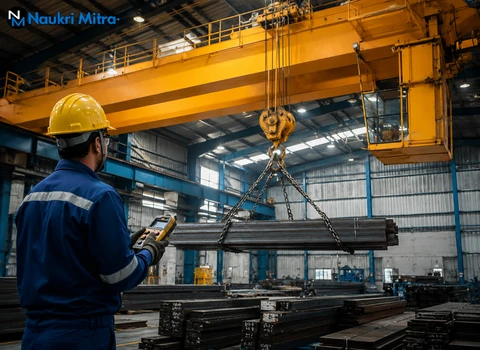
Moving Heavy Loads Without Moving a Muscle: The Gantry Crane Operator's World
Walk into most heavy manufacturing units and somewhere on the floor you'll spot a beam running overhead, carrying steel or machine parts from one end of the shed to the other. Someone is controlling that movement, usually from a pendant box or a small cabin, and that person is a Gantry Crane Operator. This particular opening is a full-time position in Hazira, Gujarat, India, and it's built for people who like working with machinery, don't mind repetition, and take instructions seriously when weight and height are involved.
Why Factories Bother Hiring a Dedicated Operator for This
You could ask, why not just use a forklift or extra hands? For loads that are too heavy, too awkward, or too tall for ground-level handling, a gantry crane is often the only practical option. Steel coils, casting blocks, large fabricated parts - these don't move safely without a proper lifting system and someone who knows exactly how much that hook can take. One misjudged lift can mean a damaged part worth lakhs, or worse, an injury. So companies would rather train and pay a dedicated operator than take that risk with untrained staff.
What the Shift Actually Looks Like
Most days start the same way - checking the crane before touching the controls. Wire ropes, hooks, brake response, limit switches, nothing gets skipped even if it feels routine. Once the shift gets going, work comes in as instructions from a supervisor or the production line: lift this, shift it there, hold until the fitter signals. There's a lot of back-and-forth with the ground crew too, usually through hand signals or a radio, because the operator often can't see everything from up in the cabin.
- Pre-shift check of hooks, ropes, brakes and controls
- Lifting and positioning material based on floor instructions
- Coordinating with riggers and helpers using signals or radio
- Flagging odd sounds, jerks or wear to maintenance right away
- Keeping a basic record of lifts done during the shift
Factories, Yards and Sheds Where You'll Find This Job
This kind of role turns up mostly in steel and metal processing plants, fabrication workshops, engineering units and material warehouses - anywhere heavy stock needs to move without being dragged or manually carried. Hazira, being part of Gujarat's industrial belt, has a fair concentration of such heavy manufacturing and processing activity, which is where roles like this tend to come up.
How a Gantry Crane Is Actually Built
People sometimes confuse a gantry crane with overhead bridge cranes that hang from ceiling tracks. A gantry is different - its beam sits on legs, and those legs either run along ground-level rails or stay fixed in one spot. Movement is handled through a pendant control, a wireless remote, or sometimes a cabin panel, depending on what the plant has installed. Operators also need to know the crane's safe working load and stick to it, because pushing past that limit is exactly how accidents happen.
The Equipment That Comes With the Job
- Pendant box or wireless remote for crane operation
- Slings, chains, hooks and shackles for securing loads
- Tape measures or gauges to check load size and clearance
- Locking pins and load limit indicators on the crane itself
Skills That Actually Matter on the Floor
Knowing which lever does what is the easy part. What makes someone good at this job is judgment - reading how a load will swing before it's even off the ground, sensing when the balance feels off, staying aware of who's walking underneath. Steady hands help, but so does patience. Rushing a lift because the supervisor is waiting is how mistakes creep in, and experienced operators learn to hold their ground on that.
Getting In: ITI, Diplomas and Practical Training
Employers generally look for candidates with an ITI in a relevant trade or some form of practical crane and rigging training. Where the local rules require it, a crane operator license or certification is expected too. That said, most companies weigh hands-on experience just as heavily as the paper qualification - actual time spent on the controls tends to matter more than what's written on a certificate.
Standing, Sitting, and Sometimes Sweating: The Physical Side
Depending on whether the setup is cabin-based or remote-controlled, expect long stretches of sitting or standing, along with the usual factory conditions - noise, dust, and temperatures that shift with the season. Rotational shifts, including night duty, are common in plants that run round the clock, so this isn't a strict nine-to-five kind of role.
Safety Isn't Optional Here
There's not much room for shortcuts when heavy loads are swinging over people's heads. PPE - helmet, safety shoes, high-visibility vest, gloves - is standard on most sites. Daily checks, clear signals to the ground team, and respecting load limits aren't just formalities; they're what keeps the shift accident-free. Most incidents on cranes trace back to someone ignoring a warning or trying to save two minutes on a lift.
What Makes the Job Hard Some Days
Long shifts with constant focus can wear a person down, especially when lifts involve working at heights or in awkward angles. Getting the timing right with multiple ground crew members during a tricky lift takes practice too - it's not something you pick up in a week. Operators who pace themselves and communicate clearly tend to handle this better than those who try to power through fatigue.
Where the Experience Can Take You
A few years in, operators who've built a solid safety record often move toward more complex lifting jobs, take on lead operator duties, or shift sideways into crane maintenance and safety supervision within the same material handling setup. It's less about switching fields and more about being trusted with bigger responsibility on the same floor.
What the Pay Looks Like
For this full-time position in Hazira, Gujarat, India, the monthly salary is ₹34,000. Beyond that, some employers add overtime pay, PF, ESI, bonuses, uniforms, or transport and canteen facilities - though these depend entirely on the company and shouldn't be assumed as fixed for every workplace.