What a Gantry Crane Operator Actually Does
There's a
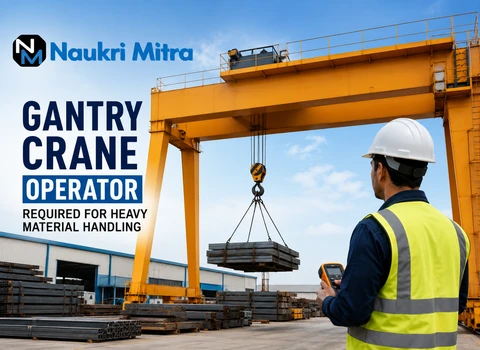
full-time job opening in Hazira, Gujarat, for a Gantry Crane Operator, paying ₹34,000 per month. If you've never looked closely at this line of work before, here's the short version: you sit or stand at the controls of a crane that runs along a fixed track, and your job is to move heavy loads from one point to another without dropping them, swinging them into someone, or damaging what's underneath. Steel plates, machined components, structural sections, pipe sections — whatever the plant is working with that day.
It sounds simple until you're actually holding several tonnes of steel a few feet above someone's head.
Why Plants Bother Hiring a Dedicated Operator for This
You could ask why a factory doesn't just use a forklift or manual labor for everything. The answer is weight and reach. Some materials are too heavy, too awkwardly shaped, or positioned too high up to move any other way. A gantry crane, supported on two legs running along an overhead rail, can lift and move loads that would otherwise require a small crew and a lot of luck. Get it wrong, though, and you're looking at damaged stock, a stalled production line, or worse — an injury. That's exactly why plants don't hand crane controls to just anyone.
How the Shift Usually Plays Out
Before touching the controls, there's an inspection to get through — hooks, wire ropes, brake response, control panel. Skip this, and you're operating blind. Once that's cleared, instructions come from a supervisor or production lead about what needs to move and where. From there it's a repeated cycle: lift, travel, position, release, repeat, with constant back-and-forth signaling to whoever's on the ground guiding the load in.
Some of what fills the day:
- Lifting and positioning material with the gantry crane, load after load
- Checking slings, chains, and hooks before each lift, not just the first one of the day
- Sticking to the load chart even when a supervisor wants something moved faster
- Reading hand signals or radio calls from ground staff without hesitation
- Flagging anything odd — a grinding sound, a slow brake response — before it becomes a bigger problem
- Keeping the crane track and control area reasonably clear
The Kind of Places That Need This Skill
Heavy engineering workshops, steel and metal fabrication units, shipbuilding yards, warehouses, large construction sites — all of them lean on crane operators at some point. Hazira sits in a stretch of Gujarat with a fair amount of industrial and port activity, so demand for this skill set tends to stay steady there. Some days you're indoors under a shed roof; other days it's an open yard with the sun doing its thing overhead.
Beyond the Crane: What Else You're Working With
The crane controls are just one part of it. You'll also be dealing with measuring tapes, load indicators, slings, shackles, and sometimes spreader beams for oddly balanced loads. Being able to read an engineering drawing helps, too — it tells you exactly where a component needs to land at a workstation, not just roughly. Plenty of operators end up spotting minor mechanical faults before anyone else, simply because they're the ones at the controls every day.
What Employers Tend to Look For
Machining or tool room training goes a long way here. Depending on how technical the work at a given plant is, an ITI in a machining-related trade, a Diploma in Mechanical or Tool and Die Engineering, or similar vocational training is usually enough to be considered. What often matters just as much, though, is hands-on exposure — time spent around EDM machines, reading engineering drawings, using precision measuring instruments. A candidate who's done that kind of work tends to pick up crane operations faster than someone with paper qualifications alone.
A few things that separate an average operator from a genuinely good one:
- Judging distance and depth accurately, especially with loads that aren't symmetrical
- Not panicking when something moves slower or faster than expected
- A rough sense of how much a load weighs before the numbers confirm it
- Physical stamina — cabins aren't always comfortable, and shifts run long
- Actually reading the load chart instead of eyeballing it
What the Body Goes Through
This isn't a desk job. There's climbing involved to reach some crane cabins, working at height in certain setups, and long hours of sustained focus where even a moment's loss of concentration matters. Being full-time, the role may also involve rotational shifts, which is fairly normal across manufacturing plants that keep production running across multiple shifts rather than a single daytime slot.
Safety Isn't a Checkbox Here
Lockout-tagout procedures, respecting load limits, never operating with a known fault — none of this is negotiable, and for good reason. A crane that's mishandled doesn't just damage material; it can seriously hurt someone. The usual protective gear includes a safety helmet, safety shoes, a high-visibility vest, and gloves, with hearing protection added in the noisier corners of a plant. Operators who take this seriously, even when no one's watching, are the ones who last in this line of work.
Where New Operators Tend to Struggle
Judging load balance takes time to get right, particularly with irregularly shaped objects. Noise, coordinating with several ground staff at once, staying sharp through a long shift — these wear people down early on. Most operators say the fix isn't some trick; it's repetition. You get a feel for the crane's response the same way a driver gets a feel for a car, and rushing a lift under production pressure is usually where mistakes happen.
Where This Can Lead Over Time
Operators who stick with it and perform consistently often move into senior operator roles, or start training newer staff coming up behind them. Some shift toward crane maintenance and inspection work instead of day-to-day lifting. A number eventually end up supervising material-handling operations across an entire unit, which is really just the floor experience from earlier years carried forward into a different role.
Pay and What Might Come With It
For this particular position in Hazira, Gujarat, the salary is ₹34,000 per month, full-time. Beyond the base pay, some employers offer overtime, Provident Fund (PF), ESI, bonuses, uniforms, or transport and canteen access — though these vary quite a bit from one company to another, so it's worth confirming directly rather than assuming any of them apply.
If you're weighing this kind of work, Hazira's industrial base makes it a reasonably active market for skilled crane operators right now, and the role itself offers a fairly clear path forward for anyone willing to put in the years.