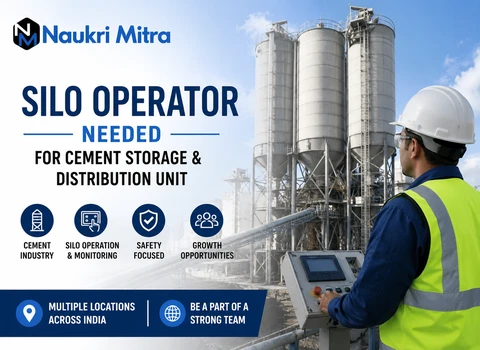
What Does a Silo Operator Actually Do?
Walk into any cement storage and distribution unit, and you'll notice tall, cylindrical structures dominating the yard. Those are silos, and someone has to keep them running. That someone is the Silo Operator — the person who controls how cement moves in, sits, and eventually moves back out of these storage units before it reaches trucks, packing lines, or dealers.
It's not glamorous work, but it's necessary. Cement arrives in bulk from production units and can't just be dumped in a pile. It needs controlled storage — protected from moisture, monitored for pressure, and released in a way that doesn't clog the system or waste material. That's the job in a nutshell.
Why Companies Bother Hiring Specifically for This
You might wonder why a business would create a dedicated position just to "watch" a silo. The answer becomes obvious once something goes wrong. A jammed valve or a pressure spike left unnoticed for even twenty minutes can shut down an entire loading line. Material bridges inside the silo — essentially forming a stuck arch that stops flow — and suddenly nothing comes out, no matter how hard the system tries.
So plants in Chandrapur and elsewhere in Maharashtra staff this role on a Full-time basis, across shifts, because dispatch schedules don't pause for equipment problems.
How a Shift Usually Plays Out
Most operators start by checking level indicators and pressure gauges — a quick round to confirm nothing shifted overnight. From there, it's a mix of active monitoring and hands-on control: opening and closing valves during filling, watching load cell readings as material is drawn out, and staying in contact with the dispatch or weighbridge team so trucks don't sit around waiting.
In between, there are physical rounds. Climbing access ladders to check aeration pads, listening for unusual sounds near the rotary airlock, checking dust collectors haven't choked up. It's less sitting-and-watching than people assume.
What the Job Actually Involves, Day to Day
- Running silo control panels and pneumatic conveying equipment
- Tracking stock levels through load cells and level sensors
- Opening and shutting inlet/outlet valves during load-in and load-out
- Working alongside weighbridge and dispatch staff to keep trucks moving
- Flagging faults — blocked lines, air leaks, sensor errors — before they escalate
- Keeping the area around the silo clean and clear of spillage
Where This Kind of Work Is Found
Beyond cement manufacturing plants themselves, you'll find this role in ready-mix concrete units, bulk terminal warehouses, and standalone storage-and-distribution setups that receive cement in bulk and redistribute it — either in bags or via tanker loading. Basically, anywhere cement sits in bulk before moving onward.
The Equipment You'll Be Working Around
Pneumatic conveying systems, rotary airlocks, bin activators, dust collectors, slide gate valves — these become familiar fast. On the measurement side, expect pressure gauges, level indicators, and load cells, sometimes paired with basic vibration sensors that detect flow blockages before they become visible problems.
Understanding why compressed air is used to move material — and why aeration pads sit at the bottom of a silo to keep cement loose enough to flow — helps a lot here. It's not complicated once someone explains it, but it's not obvious either if you've never worked around bulk material handling.
Who Tends to Do Well in This Role
Freshers with an ITI background in the mechanical, electrical, or instrumentation trades usually pick this up with little trouble. So do diploma holders looking for their first hands-on plant role. What matters more than the certificate, honestly, is temperament — staying alert during material transfer, not skipping steps in the procedure just because "it usually works fine," and being able to explain a problem clearly to the maintenance or dispatch team instead of just shrugging.
Physical Side of the Job
Expect to be on your feet a lot, climbing ladders to check silo tops, and working in an environment where cement dust is simply part of the air. Shift work is standard, as dispatch operates across multiple shifts to meet delivery timelines. Noise near the conveying equipment can be significant, and comfort with working at moderate heights is important — silo access points aren't always at ground level.
Staying Safe Around Bulk Material Handling
Dust masks, helmets, safety shoes, and gloves are the baseline here — not optional extras. Beyond PPE, the habits matter more: following lockout steps before touching any machinery, not lingering near active discharge points longer than necessary, and reporting a strange pressure reading the moment it's noticed rather than waiting to see if it "fixes itself."
The Problems You'll Run Into
Material bridging, valve jams, and dust buildup are the recurring headaches in this line of work. The right response isn't to improvise a fix — it's to report it early and let the maintenance process handle it properly. Operators who try to force a stuck valve or clear a blockage without authorization tend to be the ones who get hurt, or who damage equipment that then takes days to repair.
Where This Can Lead
Operators who stick with it and demonstrate understanding of the equipment tend to move up — toward senior operator positions, shift-in-charge roles, or maintenance-support work within the same plant. It's a role where consistency and reliability get noticed over time, more than flashy shortcuts.
Pay and What Else Might Come With It
This is a Full-time position based in Chandrapur, Maharashtra, India, with a monthly salary of ₹29,500. Depending on the employer, there may also be extras like overtime pay, PF and ESI coverage, bonuses, uniforms, or transport and canteen facilities — though these vary by company and shouldn't be assumed as guaranteed.