What Does an EOT Crane Operator Actually Do?
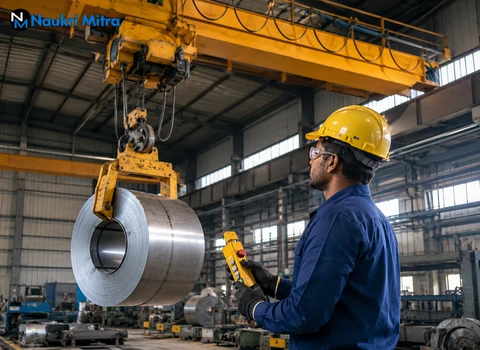
Walk into any large manufacturing shed, and you'll probably hear it before you see it — the low hum of an overhead crane sliding along its rail, carrying a steel coil or a heavy mold across the floor. That's the work of an EOT Crane Operator. EOT stands for Electric Overhead Traveling, and the job involves controlling this crane to lift, shift, and place materials that are far too heavy or awkward for a team of workers to handle manually.
It sounds simple from the outside. It isn't. A good operator is reading the load, the swing, the people below, and the crane's mechanical condition all at once, several times an hour.
Why This Job Exists on Every Serious Production Floor
Steel sheets, engine blocks, cast components, machine dies — none of these move themselves. Plants that deal with heavy material need someone who can pick these loads up cleanly and set them down exactly where they're needed, without damaging the part or hurting a colleague standing nearby. That's the reason recruitment for this role stays fairly constant across manufacturing hubs, including industrial belts like Jamshedpur in Jharkhand, where steel and heavy engineering work is part of the local economy.
A Shift, Start to Finish
Most shifts open with a walk-around inspection — checking the hook, the wire rope for fraying, the brakes, and the pendant or cabin controls. Nothing gets lifted until this is done. After that, instructions usually come from a supervisor or the production team, and the actual lifting begins.
Common tasks through the day include:
- Moving steel coils, sheets, or fabricated parts between workstations
- Positioning heavy components so machinists or fitters can work on them
- Loading and unloading trucks at the material yard
- Signaling and coordinating with riggers on the ground
- Noting down any unusual sound, vibration, or slippage for maintenance
More Than Just Running the Controls
People assume the job is about pressing buttons. It's really about judgment. Before every lift, the operator has to estimate the weight, determine the balance point, and plan the swing path so the load doesn't clip a wall, a machine, or a person. If something feels off — a strange noise, a load that doesn't sit right in the sling — the correct move is to stop, not push through. That instinct usually takes a few months of supervised work to build properly.
Where This Work Happens
Steel plants, automobile parts manufacturers, foundries, and heavy fabrication units are the typical employers. Given Jamshedpur's industrial character, much of the demand here comes from metal processing and engineering manufacturing setups. Within a plant, the operator's world usually consists of the production shed and the adjoining material storage yard.
The Equipment You'll Be Working With
The crane itself is operated either through a hand-held pendant or from a control cabin mounted on the crane bridge, depending on the plant's setup. Alongside the crane, operators handle wire rope slings, chain blocks, hooks, and sometimes load-testing indicators. Reading a load chart correctly — knowing what the crane can safely lift at a given radius — is a basic requirement, not an advanced skill.
Qualifications Plants Usually Ask For
An ITI certificate in Electrician, Fitter, or a related mechanical trade is generally the entry point, and a Diploma in Mechanical Engineering also works well for this role. That said, many plant supervisors will tell you plainly that hands-on crane handling experience counts for just as much as the certificate on paper. Knowing how to spot early mechanical or electrical trouble on the crane — a burning smell, an odd click in the motor — often matters more in daily practice than any classroom lesson.
Skills That Separate an Average Operator from a Good One
- Strong depth perception — judging distance and height accurately from a distance
- Staying calm and decisive when a lift doesn't go as planned
- A working sense of basic electrical and mechanical systems
- Discipline around safety rules, even when work is rushed
- Clear, quick communication with the ground crew
What the Body Goes Through
This isn't a desk job by any measure. Depending on the plant, operators either stand at a pendant station for long stretches or sit in a crane cabin positioned well above the shop floor. Heat from nearby furnaces, machine noise, and constant vigilance are part of the package. Since this is a Full-time position, plants may run rotational shifts, and operators should be prepared for that rhythm rather than a fixed nine-to-five.
Safety Isn't Optional Here
Helmets, safety shoes, high-visibility vests, and gloves are standard PPE for this job. Before any lift, the load and rigging get checked. Nobody stands directly under a suspended load — that's a rule, not a suggestion. Most plants also run regular toolbox talks where safety points get reinforced, and the crane's rated capacity is never pushed past its limit, no matter how urgent the job feels.
What Trips Up New Operators
Judging how a load will swing once it's airborne is harder than it looks on day one. So is working close to furnace areas where the heat is intense. Most operators get past this with time — supervised practice, sticking to the checklist even when it feels repetitive, and asking questions rather than guessing. The ones who rush this learning phase are usually the ones who cause near-misses.
Where the Career Can Go From Here
Operators who put in solid years on smaller cranes often move up to handling higher-capacity equipment, and from there into senior operator or floor-supervisor roles overseeing material handling for an entire section. Staying current with newer crane technology and updated safety norms tends to keep an operator's prospects open as the years go by.
Pay and What Else Might Come With It
This EOT Crane Operator opening in Jamshedpur, Jharkhand, India, pays ₹32,000 per month. Beyond the base salary, some employers add overtime pay, PF, ESI coverage, bonuses, uniforms, or transport and canteen facilities — though this varies from plant to plant and shouldn't be assumed as a given.
If You're Just Starting Out
Freshers, ITI pass-outs, and diploma holders looking to break into manufacturing will find this a reasonably practical entry point. Get hands-on time with rigging basics, take safety training seriously from your very first week, and the rest of the learning curve tends to fall into place through actual shop-floor experience.