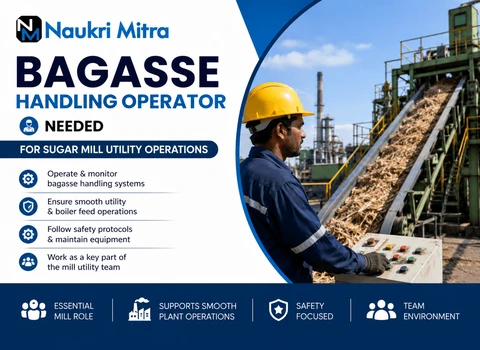
Understanding the Role of a Bagasse Handling Operator in a Sugar Mill
Sugar mills across India rely on a steady chain of workers who keep the production process moving without interruption. Among these roles is the Bagasse Handling Operator, a position that plays a quiet but essential part in how a sugar factory manages its byproducts and fuel supply. Bagasse is the fibrous residue left after sugarcane is crushed to extract juice, and it does not simply get discarded. Instead, it becomes a valuable resource, used primarily as fuel for boilers in the mill's own power and steam generation system. This Full-time position, based in Erode, Tamil Nadu, India, involves the physical handling, transport, and management of this material as it moves from the crushing section to storage yards or directly to the boiler house.
Why Sugar Mills Need Dedicated Bagasse Handlers
A sugar mill cannot function efficiently if bagasse piles up faster than it can be used or stored. Left unmanaged, bagasse can block walkways, pose fire hazards, or disrupt the flow of raw materials through conveyor systems. This is why mills recruit operators specifically for this task rather than leaving it to general helpers. The role requires someone who understands the rhythm of the mill's crushing schedule and can respond quickly when bagasse output increases or conveyor systems require adjustment or clearing.
What a Typical Working Day Looks Like
The daily routine of an operator in this role generally follows the crushing season's operating hours, which in Tamil Nadu often run intensively for several months each year. A shift usually begins with checking the condition of conveyor belts, elevators, and chutes that move bagasse from the mills to the boiler feed area or storage yard. Throughout the shift, the operator monitors the flow of material, clears blockages, and coordinates with boiler house staff to ensure a consistent fuel supply. Since sugar mills often run continuously during peak season, this position may involve shift work, including night shifts and rotating schedules.
Core Duties on the Production Floor
- Operating and monitoring bagasse conveyor systems and elevators
- Clearing jams or blockages in chutes and transfer points
- Coordinating bagasse flow between the crushing house and boiler feed system
- Maintaining storage yard organization to prevent overflow or fire risk
- Reporting mechanical issues in conveyors, motors, or gearboxes to maintenance staff
- Keeping work areas free of loose fibrous waste that can cause slips or dust accumulation
Machines and Equipment Commonly Used
This work involves regular interaction with mechanical conveyor systems, bagasse elevators, hydraulic or belt-driven feeders, and, if the mill compresses excess material for storage or sale, bagasse baling equipment. Operators also use basic hand tools to clear blockages, along with safety equipment when working near moving machinery. Familiarity with how conveyor drives, pulleys, and motorized systems function helps an operator identify problems early, before they cause a full production stoppage.
Skills That Make a Strong Candidate
Employers generally look for candidates who are comfortable with physical work and mechanical systems. While formal qualifications are not always mandatory for entry-level positions, having an ITI certificate in a relevant trade or basic technical training can improve prospects and may be preferred for operator-level responsibilities. Practical understanding of how conveyor systems, motors, and material-handling equipment work is often valued as highly as classroom education. Alertness, physical stamina, and the ability to work as part of a team during continuous shift operations are equally important.
Physical Demands and Working Conditions
This is an active, hands-on job in a working sugar mill environment. Operators should expect exposure to dust, machinery noise, and warm conditions near the boiler and crushing sections. The work often requires standing, walking across the plant floor, climbing platforms near conveyors, and occasional lifting. Good physical fitness and the ability to stay alert during long shifts are necessary for handling this role safely and effectively.
Safety Practices and Protective Gear
Because this role involves working near moving conveyor belts and rotating machinery, safety awareness is critical. Operators are typically expected to use personal protective equipment such as safety shoes, gloves, dust masks, and helmets. Following lockout procedures before clearing jams, staying clear of pinch points, and reporting unsafe conditions immediately are standard practices in most well-run sugar mills. Fire safety is also a key concern, since dry bagasse can be combustible if not stored and handled properly.
Challenges Operators Commonly Face
Seasonal variation is one of the biggest challenges in this line of work, as crushing activity and bagasse volume can fluctuate depending on cane supply. Operators may also deal with mechanical breakdowns, dusty conditions, and the physical fatigue that comes with shift-based work. Adapting to these fluctuations while maintaining consistent fuel supply to the boiler house requires patience and problem-solving under time pressure.
Building a Long-Term Career in Mill Operations
Workers who perform well in this role often gain a strong practical understanding of sugar mill operations as a whole. Over time, this experience can open pathways toward boiler house assistant roles, senior operator positions, or supervisory responsibilities within utility operations, depending on the mill's internal structure and the individual's willingness to learn additional systems. Consistency, reliability, and a demonstrated understanding of plant safety often matter more for advancement than formal qualifications alone.
Salary Expectations for This Position
For this Full-time Bagasse Handling Operator role in Erode, Tamil Nadu, India, the monthly compensation is ₹31,800. This reflects a stable, structured pay scale suited to operator-level utility work within sugar mill operations.
Possible Additional Benefits
Depending on the employer's policies, workers in this type of role may also receive benefits such as overtime pay during peak crushing season, Provident Fund (PF) and ESI coverage, annual bonus, uniforms, or transport and canteen facilities. These benefits are not guaranteed and can vary between employers, but they are commonly offered in structured industrial and manufacturing environments across Tamil Nadu.