
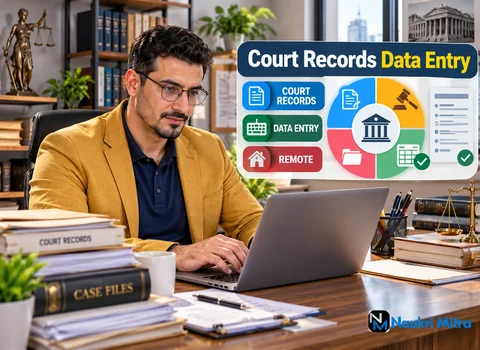
A court file holds the details a database needs: the parties who brought the matter or must answer it, a reference number that follows it from the first filing to the final order, and a run of hearing dates. On paper, those details help only whoever is holding the file. The operator in online court records data entry jobs turns them into searchable fields, so a lawyer, clerk or researcher can find the matter by typing a name or a number. This listing is a part-time, remote role paying $5 per hour, USD, open to applicants worldwide.
A misspelt surname or a hearing date keyed one day out can make a file very hard to find later, so accuracy is the heart of this role.
If you want the court records data entry job description in a single line, it is this: you read court documents and record their key particulars in a legal database, accurately and in the agreed format. The documents may be scanned petitions, cause lists, summonses or orders. Your task is not to interpret the law in them but to capture who, what and when, the same way every time.
It is court records data entry work from home, so you work alone with the files and nobody stands beside you to catch a slip. It suits people who enjoy order and notice small discrepancies.
Most entries are built from four groups of information.
Entering is only half the duty. After keying a record you cross-check it against the source document, field by field. Where the paper is illegible, or a field the database requires is simply not there, you flag it rather than guess. An honest blank with a note attached is far more useful to the court than a confident mistake.
Files also change over time. When a new order arrives, perhaps an adjournment or a disposal, the existing record must be updated to show the current position.
The core court records data entry skills are practical ones. You will enter data into a legal database or case management system through forms with fixed fields, drop-down lists and search screens. Each client may use its own system, so what you need is comfort with that style of work: tabbing between fields, searching before creating a duplicate, and saving properly.
Excel matters too. Many batches arrive or are reported as spreadsheets, so you should be able to sort and filter, keep columns consistent, use simple formulas such as COUNTIF to spot duplicates, and keep date columns stored as true dates. Accurate typing and good written English complete the kit.
A graduate with accurate typing and good English is preferred. A legal background, or simple familiarity with court terminology such as vakalatnama, ex parte, adjournment or decree, is a plus, but it is not required. Many sound operators have learned the vocabulary on the job. You must be able to handle confidential records responsibly and be comfortable with database entry and Excel. A secure laptop and a stable internet connection are required.
No court records data entry certification is demanded for this listing. A short court records data entry course, or a general course in legal terminology or spreadsheets, can help you feel prepared, but treat it as preparation rather than an entry ticket.
Your hours here are part-time and paid at $5 per hour, USD. When people search for the court records data entry salary per hour, they will find wide variation, because rates depend on the client, the jurisdiction and the volume of work. The only figure I can give you is the one in this listing. Part-time hours sit well alongside study or other duties, but do not expect the role to replace a full-time income.
Part time court records data entry jobs and freelance court records data entry jobs often look alike from the outside. Before accepting, confirm how hours are recorded, how often payment is made and in what way, so there is no confusion at the end of the first cycle.
This kind of work usually comes through legal process outsourcing (LPO) firms. These businesses handle document review, records management and indexing for law firms and legal departments, and litigation support teams hire for similar work. When you look for such roles elsewhere, check the firm's own official website and careers page, and be cautious of any offer that arrives only through a messaging app with no traceable organisation behind it.
Court records data entry jobs for freshers do exist, and this listing sets no minimum experience. Not every legal data entry post is that open, so read requirements carefully. If you have no history in the field, a few habits help. First, raise your typing accuracy before your speed. Second, practise in Excel with a mock register of invented cases, entering numbers, parties and dates, then checking your own work. Third, read a few publicly available cause lists or orders so the layout no longer feels foreign.
Your court records data entry resume should show accuracy, not adjectives. Mention typing tests you have taken, any spreadsheet or records work, any law-related study, and any role where you handled private information. For court records data entry interview questions, you may face a short typing or entry test, a question about how you would treat a missing field, and a question about keeping files confidential. Answer them with specific habits rather than general promises.
Court records can include names of minors, family disputes and financial details, and some matters are sealed. Treat everything you see as confidential and discuss none of it outside the work.
The two roles are often confused. A data entry operator reads documents and records their particulars into structured fields. A legal transcriber listens to audio, such as hearings, depositions or dictation, and types it out word for word as continuous text. If you prefer reading to listening, data entry is the better fit.
Time spent entering court records teaches you how cases move: how they are numbered, which documents come in what order and how orders change a matter's status. That knowledge is a useful base for records management or litigation support. Some operators go on to paralegal work, but that step usually calls for further study, such as a paralegal course or a law qualification, and depends on local rules and on the opportunities available. Treat this role as a solid first rung, not a guaranteed route, and keep learning as you go.