
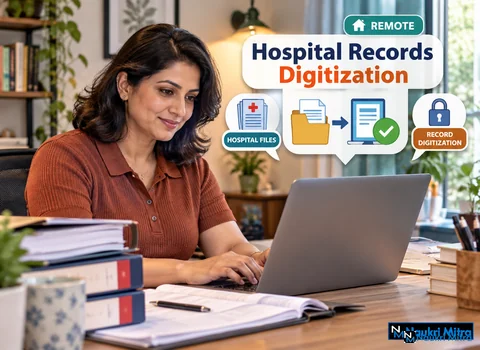
A patient sits down for a follow-up appointment, and the doctor opens her electronic chart to look at last month's ultrasound report. It is there, filed under the right date, attached to the right visit, and readable from the first line to the signature. That happened because someone confirmed whose report it was, matched it to the visit and filed it correctly. That is the work in these online hospital records digitization jobs, offered part-time at $15 per hour, USD, to applicants anywhere in the world.
Hospitals still produce a lot of paper: posted referral letters, old charts in storage, hand-signed consent forms, printed outside lab results. Before any of it can help a clinician, it has to enter the patient's electronic health record (EHR). Put simply, the hospital records digitization job description is this: you index scanned patient documents into the EHR, link each one to the correct patient and encounter, check that the image can be read, and record the key details that make the document easy to find later.
It is quiet, careful work, and it rewards a steady habit of checking before you file.
Most of the work comes in batches of scanned images placed in a document queue inside the EHR or a connected document management tool. A normal sequence for each item looks like this:
The single most serious error in this field is a document filed to the wrong patient. A misfiled pathology result can mislead a doctor and also expose one person's health information in another person's record. That is why matching is never done on the name alone. Two patients can share a name, and a surname may be spelled three ways across three forms. Good indexers treat any mismatch as a stop sign, note what they saw and escalate it.
A scanned page is only useful if a clinician can read it. Before filing, you check that text is not cut off at the edges, that handwriting and signatures are visible, that pages are upright and in order, and that faint carbon copies or faxed sheets are still readable. Blank pages and duplicates are noted according to the procedure you are given. When a page fails the check, you do not guess at the content; you send it back for rescanning with a clear reason.
Epic is one of the most widely used EHR platforms, and many hospitals run its document and scanning functions alongside the main chart. Other organizations use different EHR products or a separate document management system that feeds into the record. Each client may use a different system, so earlier exposure to any EHR makes the first weeks easier.
In remote setups, scanning is usually done on site with high-volume document scanners, and you work with the images through a secure connection. Core hospital records digitization skills are comfort with image viewers, keyboard shortcuts and accurate data entry, more than any particular machine.
A graduate or diploma holder is preferred, ideally with a background in medical records, nursing or healthcare administration. People from hospital front desks or clinic billing offices often adapt well because they know how charts are organized.
You also need working knowledge of medical terminology, familiarity with EHR systems such as Epic, and an understanding of HIPAA privacy rules or the equivalent rules in your country. On the practical side, a secure computer, stable internet and a private workspace are required.
The most useful hospital records digitization course is a short one in medical terminology, which teaches you to recognize report types and abbreviations at a glance. HIPAA training is commonly offered online and covers how protected health information may be used and shared. HIPAA is a United States law, so if you are elsewhere, look for training on your own region's health data rules as well, such as GDPR in Europe or India's data protection law. A hospital records digitization certification or broader health information credential is not required here.
Expect $15 per hour, USD, for a part-time load handled from home, in whichever country you live. Hours depend on document volume, so it suits someone fitting work around study or family duties. When comparing hospital records digitization salary per hour figures, check whether other listings pay hourly, per document or per batch.
Remote indexing work is often arranged through healthcare BPO companies, which handle back-office tasks for hospitals, clinic networks and records departments. People seeking freelance hospital records digitization jobs also check hospital group careers pages. Look up any hospital or vendor on its own site before sharing details, and treat requests for money as a warning sign.
Hospital records digitization work from home carries the same privacy duties as work inside a hospital, and the employer may check how you meet them. You will usually connect only through a company-approved secure VPN or virtual desktop, and you should never download or save patient images on your own device. Your screen must not be visible to family or visitors, so you need a room or corner you can close off. Lock the screen when you step away, keep your login private, and never print, photograph or discuss a record. Employers often ask for a signed confidentiality agreement before granting access.
Both jobs involve clinical documents, but they differ. Digitization and indexing is about getting each document into the right place in the record with accurate identifying details. Medical coding goes further: a coder reads the clinical content and assigns standardized diagnosis and procedure codes, such as ICD-10 and CPT, which are used for billing and statistics. Coding usually needs specific training and often a certification; indexing experience can help if you study it later.
Hospital records digitization jobs for freshers do exist. Even when a role lists no experience, employers still expect basic medical language and privacy knowledge. Steps that help:
Part time hospital records digitization jobs are often the entry point, and steady accuracy may lead to more hours or added responsibility over time.
Some people stay in indexing because the routine suits them. Others use it as a step toward becoming a health information technician, a role that covers record quality, release of information and data management. That move is not automatic. It usually requires further study, such as a diploma or associate degree in health information management, and in some countries a recognized credential. Handling real records gives useful grounding for that route.