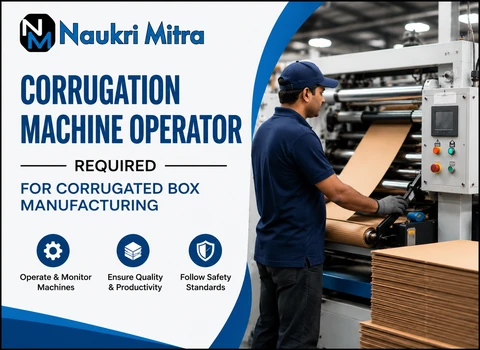
What a Corrugation Line Actually Looks Like
Walk into any corrugated box unit, and you'll hear it before you see it — the hiss of steam, the steady clatter of rollers, the smell of hot glue and kraft paper. Somewhere in the middle of that noise stands the corrugation machine operator, adjusting a dial, watching a sheet come off the line, deciding in a split second whether it's good enough to pass or needs to be pulled. It's not a glamorous job. But it's one that keeps an entire packaging supply chain moving, and India's box industry runs on people who know how to do it well.
Why This Role Keeps Showing Up in Hiring Lists
Corrugators are expensive, fast, and unforgiving. Get the glue temperature wrong or misjudge the paper tension, and you can lose an hour's worth of board to warping or delamination. That's the real reason factories keep hiring for this position — not because the machine is hard to switch on, but because running it *well*, shift after shift, takes a trained eye. Companies manufacturing corrugated boxes for FMCG, e-commerce, and export packaging need operators who won't let quality slip when the order volume spikes.
A Shift, Roughly
Start of shift means checking the paper reels on the mill roll stand, confirming glue viscosity, and making sure steam pressure is where it should be. Once the line is running, most of the job is watching — the single facer, the double facer, the way the flute forms as paper passes between the corrugating rollers. Board thickness is sometimes checked by hand, not just by gauge. Toward the end of the shift, there's usually a log to fill: output count, downtime if any, faults reported to the next operator coming in.
What the Job Actually Involves, Day to Day
- Loading paper reels and setting flute size per the day's order sheet
- Watching glue consistency and adjusting steam temperature as needed
- Catching warped or delaminated sheets before they move down the line
- Working with the slitter-scorer and cut-off operator to keep sizing accurate
- Reporting machine issues immediately, not at the end of shift
- Basic housekeeping around the machine — paper dust and glue spillage add up fast
Where You'd Actually Be Working
This is factory floor work, plain and simple — corrugated box manufacturing units, packaging plants, sometimes larger paper processing facilities. Expect noise, heat near the rollers, and a lot of standing. This particular opening is a full-time position in Surat, Gujarat — one of the more active manufacturing belts in western India, with a steady stream of packaging demand from nearby industrial and export units.
The Machines You'll Get to Know
The corrugator itself is the centerpiece, but you'll also be dealing with the mill roll stand, single facer, double facer, slitter-scorer, and cut-off knife. Pressure gauges, thickness gauges, and moisture meters are used for quality checks. Steam boilers and glue mixing units matter too — most people underestimate how much the bonding strength of a finished board depends on getting these right.
Skills That Actually Matter Here
Technical knowledge helps — understanding paper grades, flute types, how adhesive behaves under heat. But honestly, a lot of good operators say the real skill is learning to *hear* the machine. An odd sound or a slight change in rhythm often tells you something's off before it ever shows up in the output. Employers tend to prefer candidates with an ITI qualification in a relevant mechanical trade, or diploma-level vocational training, though solid hands-on experience on similar machines often counts for just as much.
What It Asks of You Physically
Long hours on your feet. Lifting paper rolls. Working close to heat and steam lines without losing focus. It helps to be someone who doesn't mind repetitive motion and can stay alert through a full shift — rotating shifts are common in this line of work, so some flexibility around timing goes a long way.
Safety Isn't Optional on This Line
Hot rollers, moving parts, steam — this is not a machine you get casual around. Safety gloves, heat-resistant aprons, safety shoes, and ear protection are standard here given the noise levels. Lockout procedures during maintenance matter; hands stay clear of rollers while they're moving, and any steam leak gets reported the moment it's noticed, not after the shift ends.
The Parts of the Job That Wear You Down
Heat, mostly. Also the repetitiveness, and the pressure that builds when a big order needs to go out and paper quality that day isn't cooperating. Batches vary — one reel behaves differently from the next — so operators end up making small adjustments constantly rather than setting the machine once and walking away. People who do well here tend to be patient and methodical rather than reactive.
Where This Can Lead
Operators who stick with it and keep learning the finer points of the machine often move up to senior operator roles, then shift in charge, and eventually machine supervisor positions — all within the same corrugation and packaging line of work. Staying current with newer corrugator technology and basic quality control practices tends to help this progression along.
Pay and What Else Might Come With It
The role pays ₹24,000 a month. Beyond that, some employers offer overtime pay, PF, ESI, an annual bonus, uniforms, and occasionally transport or canteen facilities — though these vary company to company and shouldn't be assumed as guaranteed.
A Fair Take, Before You Apply
This isn't a job you master in a week. Freshers, ITI candidates, diploma holders — anyone coming into this full-time role in Surat, Gujarat should expect a learning curve on the machine itself, and a workplace that runs on discipline more than excitement. But for people willing to put in the hours and pay attention to the details, corrugation machine operation offers something a lot of factory jobs don't: a clear, steady path forward in an industry that isn't going anywhere.