
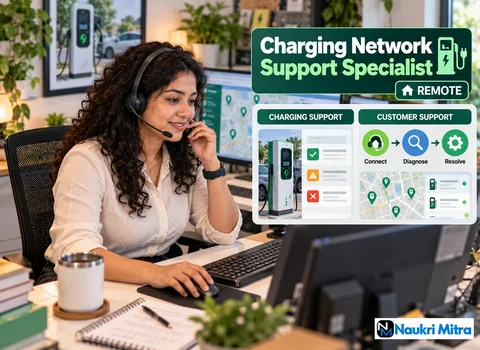
It is raining, the car is down to a few miles of range, and the screen on the public charger has been stuck on "Authorising" for five minutes. The driver has tapped the card twice, unplugged and plugged back in, and now they are holding a phone to one ear under a dripping canopy, waiting for someone to pick up. In remote charging network support specialist jobs, you are the person who picks up. The pay is $2,500 USD every month for full-time shifts, every one of them worked from home, and applicants from anywhere in the world are welcome.
The best calls in this work end with a stressed caller hanging up calmer than they started. That is most of the job. The rest is technical and learnable, and the clearest way to show it is to follow one ticket from start to finish.
Contacts arrive on three channels. Phone calls tend to be the urgent ones, from a driver standing at the bay. Chats come from people sitting in the car with the app open. Emails are slower stories: a double charge, a missing receipt.
On the call, your first job is to lower the temperature. Say your name, say you can see the network from your side, and ask one simple question at a time. A wet, worried driver wants to hear that someone is on it.
Drivers rarely know the station ID. They know "the one behind the supermarket." So you ask for the sticker on the unit, the address in the app, or the connector number near the cable holster, match it against the site in the system, and confirm out loud: "You are at the second unit, connector two, the CCS cable?" Getting this wrong means resetting a charger that some other driver is happily using, which is the kind of mistake you only make once.
Most public chargers talk to a central system using OCPP, the Open Charge Point Protocol. The backend you work in shows each charger's status, its recent messages and any error codes it has sent. Reading that log is the core skill. A connector showing "Faulted" tells a different story from one stuck in "Preparing," and a station that stopped sending heartbeats an hour ago may simply have lost its mobile connection.
Typical remote actions you might take from the backend include:
Back at the rainy bay, the log shows the authorisation request reached the server but no reply went back. You try a soft reset, talk the driver through the two-minute reboot, then start the session from your screen. The car begins charging. You hear the relief before you see the status change.
Once the driver is charging, you log the contact in Zendesk while it is fresh: station and connector, what the driver reported, what the backend showed, what you did and the result. Tag it properly, so if one unit needs a reset every few days, someone reading the tickets can spot it. Write each ticket for a tired colleague reading it at the end of a shift.
Not everything clears with a reset. A cracked screen, a damaged cable, a connector that will not lock, a unit with no power at all: these need hands on site. Your part is to escalate the hardware fault to the field service team with enough detail that the technician arrives with the right part. You may also mark the connector out of service so other drivers are not sent there. Then you tell the caller honestly that this unit will not work today, and point them to the nearest working station.
A ticket is not finished when the cable starts drawing power. Depending on the team's process, follow-up might mean confirming the session completed and billed correctly, emailing a driver whose refund you raised, or checking back once field service has closed their visit. Drivers remember who called them back.
You do not need a degree for this position. One to two years in customer support or technical helpdesk work is preferred, because the hardest part of the job is staying steady with an unhappy caller while reading a screen of error codes. Clear spoken and written English is expected. So is a basic understanding of how EV charging works and what an OCPP backend does, plus some hands-on time in Zendesk. The particular backend a team uses is usually learned on the job.
Charging network support specialist skills that matter most on shift: patient questioning, typing accurate notes while listening, and knowing when to stop troubleshooting and escalate.
The charging network support specialist salary for this listing is $2,500 USD per month, for full-time work. Because drivers charge at all hours, shift patterns may include evenings or weekends; the exact rota depends on the team and is not fixed in this listing.
For charging network support specialist work from home jobs, the setup matters as much as the knowledge. You will need a quiet space where a caller cannot hear a television or a barking dog, a decent headset with a noise-cancelling microphone, and stable internet that holds up through a long call.
Many people in this seat come from retail, telecom or software support. You already know how to de-escalate and keep notes. What you add is the EV layer:
No single charging network support specialist certification is required for this role. On your resume, put your support experience first, name the ticketing tools you have used, and describe one tricky case you resolved. In charging network support specialist interview questions, expect role-play: an angry driver, a frozen screen, a cable that will not release. Talk through your steps out loud.
An EV field technician works on site with tools, safety gear and usually electrical training, replacing parts and repairing damaged units. You work from a headset, solving what can be solved remotely and passing along the rest. A good escalation saves a technician a wasted trip, and their repair notes teach you which faults a reset will never fix.
ChargePoint and EVgo are examples of companies running large public charging networks, alongside many regional operators and charger makers worldwide, which is why charging network support specialist jobs remote worldwide exist at all. Growth paths include tier-two support for harder technical cases, team lead, quality review, knowledge-base writing or network operations. Promotions are earned rather than given, and a year of clean tickets and calm calls is the evidence.