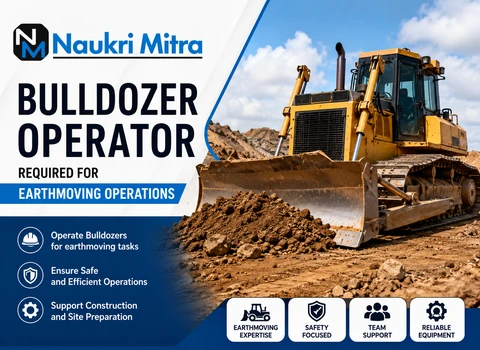
What a Bulldozer Operator Actually Does
Push a pile of soil across a site, level a stretch of uneven ground, clear away debris before a foundation is poured — that's the daily reality behind a Bulldozer Operator Required for Earthmoving Operations. It sounds like heavy, rough work from the outside. Up close, it's more about control than force. The machine does the pushing; the operator decides where, how deep, and how fast.
Why This Role Keeps Showing Up in Hiring Lists
Earthmoving is one of the first jobs on any construction or mining site, and one of the easiest to get badly wrong. A careless cut can throw off an entire grading plan. A skilled operator, on the other hand, saves the contractor time and money simply by getting it right the first time. That's the reason experience with the blade, the levers, and reading ground conditions carries real weight when employers are shortlisting people.
How the Morning Usually Starts
Before the engine even turns on, there's a walk-around check — tracks, blade, hydraulic hoses, oil levels. Skip this, and you're asking for trouble later in the day. Once everything checks out, the operator receives instructions from the site supervisor or surveyor on what needs leveling, clearing, or cutting, and the work begins.
What the Job Involves, Practically Speaking
- Pushing, cutting, or spreading soil with the front blade
- Bringing uneven patches of ground to a level suited for foundation work
- Clearing rocks, tree roots, or demolition debris off the site
- Staying in sync with excavator and dumper operators nearby so nobody's in the wrong place at the wrong time
- Flagging mechanical issues early, before a small leak becomes a stalled machine
Where Operators Usually End Up Working
Road building crews need them. So do mining operations, dam projects, canal work, and land development sites getting ready for construction. In and around Korba, Chhattisgarh, a lot of this work ties into coal mining support and the industrial and power-sector construction the region is known for. It's not the only place hiring happens, but it's a fairly steady source of earthmoving work locally.
The Equipment That Comes With the Job
The bulldozer is obviously the centerpiece — usually fitted with a front blade, and on some models, a rear ripper for breaking up harder ground. But operators also lean on grade stakes and laser levels to check they're cutting to the right depth. Some newer sites have GPS-guided grading systems built into the cabin, showing the target elevation on a screen so there's less guesswork involved. Older sites still rely on the operator's eye and a surveyor's markers, which is a skill in itself.
What Separates an Average Operator From a Good One
Anyone can learn which lever does what within a week. Reading the terrain is harder. Knowing when soil is about to give way under the tracks, sensing when a slope needs a lighter touch instead of a full push — that only comes with hours in the seat. For entry into this field, an ITI qualification in a mechanical or heavy-vehicle trade helps, and a diploma in mechanical engineering is also looked upon favorably. That said, plenty of operators working today built their skill mostly through practice rather than a classroom.
The Physical Side of the Job
You're seated most of the shift, but it's not restful. Constant vibration, engine noise, and the need to stay alert for hours add up. This is a full-time position, and depending on the project's deadlines, shift work isn't unusual — some sites push extended hours to hit earthmoving targets before the next phase of construction starts.
The Site Itself Isn't Always Comfortable
Dust in the dry months. Mud and slippery ground once the monsoon hits. Visibility drops in low light or heavy rain, and that's exactly when discipline matters most — sticking to marked paths, sounding the horn before moving, not cutting corners because the shift is almost over.
Staying Safe Around Heavy Machinery
Helmet, high-visibility vest, safety boots, ear protection, gloves — standard gear on most sites. Beyond wearing it, operators are trained to keep distance from ground workers, avoid leaving the machine idling on a slope, and communicate clearly with anyone working nearby. Most accidents on earthmoving sites come down to skipped steps, not equipment failure.
Common Early Struggles
New operators often misjudge blade depth — cutting too deep in one pass, too shallow in the next. Slopes are another sticking point; the machine handles differently on an incline than on flat ground, and that takes getting used to. Practicing on level terrain first, paying attention to how the engine sounds under load, and watching how an experienced operator handles the same stretch of ground all help shorten this learning curve.
Where This Can Lead Over Time
Operators who stick with it tend to move toward larger or more advanced machines, take on site supervision duties, or specialize in GPS-guided grading, which more projects are adopting each year. None of this happens overnight, but earthmoving experience carries weight across construction and mining projects alike.
Pay and What Might Come With It
This is a full-time role based in Korba, Chhattisgarh, India, offering a monthly salary of ₹35000. Some employers add extras on top — overtime pay, PF, ESI, bonuses, uniforms, or transport to and from the site — though these vary from one employer to another and shouldn't be assumed as guaranteed.