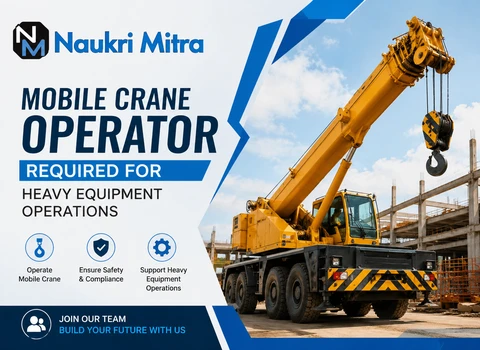
What Does a Mobile Crane Operator Actually Do
Walk onto any active construction site or fabrication yard and you'll likely spot a mobile crane parked at an angle, outriggers extended, boom stretched out over a stack of steel or concrete. The person in the cabin, controlling it all, is the Mobile Crane Operator. Unlike tower cranes that stay fixed in one place for the length of a project, mobile cranes drive in, do the job, and move to the next site. That flexibility is exactly why so many contractors keep operators on staff or hire them on a project-by-project basis.
This particular Full-time opening is based in Faridabad, Haryana, India, and pays ₹35,000 a month. It's a role suited to someone who wants hands-on technical work with real responsibility attached, not just repetitive labor.
Why This Job Exists in the First Place
Lifting heavy material sounds simple until something goes wrong. A miscalculated load, a shift in wind, or a crane parked on uneven ground can turn a routine lift into a serious accident. That's the real reason companies don't hand crane controls to just anyone. They want someone who reads load charts correctly, understands how boom angle affects capacity, and knows when to stop a lift rather than push through it.
Faridabad sits within India's National Capital Region and has a fairly dense mix of industrial units, warehousing operations, and ongoing construction activity. That combination keeps demand for trained crane operators fairly steady in the area.
A Rough Sketch of the Working Day
Most shifts start before any lifting happens. The operator checks the hydraulic system, inspects the wire ropes for fraying, tests the outriggers, and looks over the hook and boom sections. Skipping this step is how small problems turn into breakdowns mid-lift.
Once the machine is cleared, positioning comes next. Outriggers go down, the site gets a quick visual check for overhead lines or obstacles, and the operator coordinates with a rigger or signal person before the first lift of the day. From there it's a mix of:
- Rotating and extending the boom to reach the drop point
- Reading the load chart before every lift that involves a new weight or angle
- Watching hand signals or listening on the radio for guidance from ground staff
- Logging what was lifted and noting anything odd about the machine's behavior
Where Operators Actually Work
Construction sites are the obvious answer, but they're not the only one. Steel fabrication units, warehouse setups, and machinery installation jobs also need crane support, especially when equipment has to be positioned precisely or lifted into tight spaces. In and around Faridabad, this often means moving between an active building site one week and an industrial yard the next.
The Equipment and Instruments Involved
The crane itself is a hydraulic mobile unit, and tonnage varies depending on the job. Alongside it, operators work with wire rope slings, shackles, outrigger pads, and a radio set for site communication. The load chart deserves special mention here because it's arguably the most important tool in the cabin. It tells the operator exactly how much weight the crane can safely lift at a given radius and boom angle. Misreading it, or ignoring it under time pressure, is one of the more common causes of crane accidents on Indian sites.
Skills That Actually Matter on the Job
Technical training gets you in the door, but judgment is what keeps you employed long-term. Operators need to gauge distances by eye, maintain steady concentration through slow, deliberate movements, and notice small mechanical warning signs before they become expensive problems.
Formal training helps build this foundation. An ITI qualification in a relevant trade, or time spent training under an experienced operator, is usually how people get started. Some come in through diploma programs; others learn largely on the job under supervision before being allowed to operate independently.
Physical Side of the Work
Expect long hours seated in the cabin, broken up by climbing up and down for inspections. Weather doesn't pause for a project deadline, so operators work through heat, dust, and occasionally rain, depending on site conditions. Shift work is common, particularly on projects racing against a completion date, and early morning starts aren't unusual.
Safety Isn't Optional Here
Crane operation carries genuine risk, which is why site safety rules tend to be strict and non-negotiable. Keeping a safe distance from overhead power lines, never exceeding the rated load, and halting work in high winds or low visibility are basic expectations, not suggestions. Standard protective gear includes a helmet, safety shoes, a high-visibility vest, and gloves. Operators who stick to these habits consistently tend to build a reputation that keeps them in demand.
What Trips Up New Operators
Judging how a load swings once it's airborne is harder than it looks, and most beginners underestimate it. Working closely with a rigger in a crowded site takes coordination that only comes with repetition. Staying composed while lifting something expensive or fragile is also something experience teaches better than any manual.
Growing Within the Trade
Operators who put in the years usually move toward handling higher-tonnage cranes, which tend to come with better pay and more complex lifts. Some take on lead operator responsibilities, overseeing lifting operations on larger sites rather than just executing individual lifts. A clean safety record and a reputation for careful work go a long way in this field.
Pay and What Might Come With It
This role in Faridabad, Haryana offers ₹35,000 per month on a full-time basis. Depending on the employer, there may also be additional benefits like overtime pay, PF, ESI coverage, bonuses, uniforms, or transport and canteen facilities. These aren't guaranteed across every workplace, so it's worth checking specifics with the employer directly.
For someone who likes mechanical, hands-on work and doesn't mind the responsibility that comes with handling heavy loads, crane operation offers a practical way into India's construction and industrial workforce, with room to grow as skills and experience build.