Getting Up to Height Safely: The Job of a Boom Lift Operator
Walk onto any industrial construction site and you'll notice one thing quickly — a lot of the work happens well above ground level. Welding a steel joint, running cables along a shed roof, painting a tall wall. Someone has to get workers up there safely, and that's where a
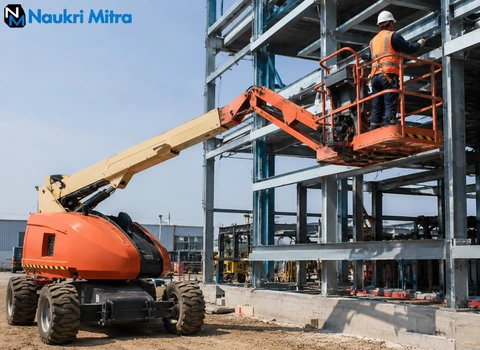
Boom Lift Operator Required for Industrial Construction comes in. This full-time position is based in Chennai, Tamil Nadu, India, and it centres on one machine: a hydraulic lift with an extendable arm that raises a platform to whatever height a job demands.
Why Sites Hire For This Instead of Building Scaffolding
Scaffolding takes hours to assemble and just as long to dismantle. A boom lift skips all that. Move it into position, extend the arm, and work can start within minutes. That's the main reason industrial contractors keep trained operators on their crew rather than relying on temporary structures for every task at height. It's faster, and honestly, it's safer when handled by someone who knows the machine.
What the Shift Actually Looks Like
The day doesn't start with climbing into the platform. It starts on the ground — checking hydraulic lines, tyre or track condition, and whether the control panel and safety interlocks are responding correctly. Only after this walk-around does the operator take instructions for the day and move the lift toward the work zone. From there, it's a mix of raising, repositioning, and holding steady while someone else does the actual welding or fitting work above.
What Falls Under This Role
- Setting the machine on level, stable ground before extending anything
- Reading hand signals or staying on radio contact with ground crew
- Watching for overhead power lines and structural obstacles
- Noting machine hours and flagging anything unusual to maintenance
- Wiping down the platform and controls at the end of a shift
The Kind of Sites Where This Work Happens
This isn't limited to one type of project. Industrial shed erection, warehouse fit-outs, steel fabrication yards, factory expansion work — all of it needs elevated access at some point. Around Chennai and the wider Tamil Nadu industrial belt, much of the demand comes from contractors handling plant maintenance and multi-storey structural jobs, where a lift is on site almost daily rather than occasionally.
Knowing the Machine: Boom Types and Controls
Two designs dominate the field. Telescopic booms extend in a straight line, useful when you need maximum reach without much side movement. Articulating booms have jointed sections that bend around obstacles — better for tight, cluttered sites. Either way, an operator works the joystick controls, keeps an eye on the outrigger stabilisers, and never ignores the load chart. Most accidents on these machines trace back to one thing: someone overloaded the platform or misjudged the reach limit.
What Separates a Careful Operator From a Careless One
Machine handling is only part of it. Judging distances correctly, staying calm when a task drags on, and not cutting corners on safety checks even during a routine week — that's what actually matters over time. A bit of mechanical sense helps too, since spotting a hydraulic leak early can save the machine and possibly someone's day. Working well with riggers and electricians on the ground also makes a real difference to how smoothly things move.
How People Get Into This Work
An ITI qualification in a mechanical or electrical trade is a common starting point, though plenty of operators learn through supervised, on-the-job training instead. What's usually non-negotiable is a valid boom lift or aerial work platform operating licence, along with a working understanding of hydraulics and safe load limits. Any prior time spent around heavy construction equipment tends to count in an operator's favour.
Working Conditions and What the Body Goes Through
Expect to be outdoors most of the time — sun, dust, sometimes rain. Standing for long stretches, climbing in and out of the platform, staying focused during extended lifts. It's physical, if not in the way people usually picture manual labour. Shift timings generally follow the site's own working hours rather than a fixed office schedule.
Safety Gear and Site Practices
None of this works without discipline around safety. A full-body harness clipped to the platform anchor point is standard, along with a helmet, safety shoes, and high-visibility clothing. Before any lift begins, there's a pre-use check, a look at wind conditions, and barricading around the base to keep the ground area clear.
What Tends to Go Wrong
Uneven ground catches people out more than anything else, followed by cramped work areas and sudden weather changes. The operators who avoid trouble are usually the ones who plan their path before moving, keep talking to the ground crew, and refuse to rush a lift into position without checking clearance first — even when the site supervisor is in a hurry.
Where This Can Lead Over Time
Stick with it, and there's room to grow — handling larger or more specialised lifting machines, taking on safety coordination duties, or eventually supervising a team of operators across a bigger project. What usually pushes someone forward isn't seniority alone; it's a clean safety record combined with genuine hands-on experience across different machines.
What This Role Pays
The position is offered at a monthly salary of ₹35,000, full-time, based in Chennai, Tamil Nadu, India. Some employers add extras on top — overtime pay, PF, ESI coverage, a bonus, uniforms, transport, or canteen access — though these depend entirely on the company and shouldn't be assumed as standard.