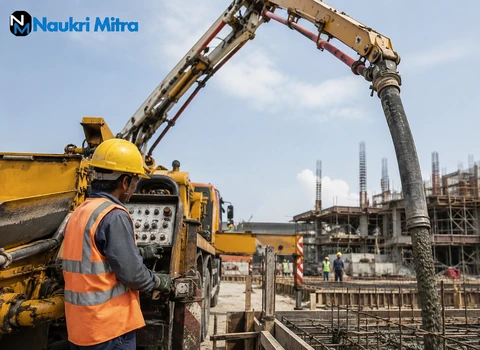
What Happens When You Pour Concrete for a 10-Storey Building?
You can't just carry buckets up ten floors. That's where the Concrete Pump Operator Required for Construction Projects in Noida, Uttar Pradesh, comes in. The job is straightforward to describe but hard to do well: get liquid concrete from the mixer truck on the road to wherever the mason needs it, whether that's a footing at ground level or a column on the eighth floor. Miss the timing and the concrete starts setting in the pipe. Get it right, and nobody on site even thinks about how the concrete got there.
Why This Job Exists on Every Big Site
Manual pouring works fine for a small house. It falls apart on a commercial tower or a flyover. Concrete has a working window of maybe 60 to 90 minutes before it stiffens, so speed matters more than almost anything else on a pour day. A contractor who tries to save money by skipping the pump usually ends up paying more in labor, wasted material, and delays. That's the real reason this role keeps showing up in hiring lists across Noida's construction belt.
A Pour Day, Start to Finish
Before any truck shows up, the operator walks around the pump — checking hydraulic fluid, hose couplings, the boom, the outriggers that keep the machine stable. Rushing this step is how accidents happen later. Once the mixer arrives, the pump gets positioned, the boom is extended toward the pour point, and the operator works in sync with the driver and the site supervisor. It's less about pressing buttons and more about reading the situation second by second.
Once pumping starts, the operator is watching pressure readings, listening for changes in the motor sound, and adjusting flow based on how thick or thin the mix looks. A blockage mid-pour can cost an hour of cleanup. When the pour ends, washing out the pipeline isn't optional — dried concrete inside a hose basically ruins it.
What the Job Actually Involves Day to Day
- Setting up and operating boom or line pumps
- Positioning the vehicle so the boom has proper reach without tipping risk
- Watching gauges and adjusting flow rate mid-pour
- Staying in constant contact with the mixer driver and pour team
- Cleaning the pump and pipeline at the end of every shift
- Flagging worn hoses or hydraulic leaks before they fail on the job
Sites Where You'll Actually Find This Work
Residential towers, commercial complexes, road projects, and bridge work all need pump operators. Noida and the wider Uttar Pradesh region have seen steady construction activity for years, so this isn't a role that dries up between projects the way some seasonal trades do.
The Equipment You'll Be Handling
Boom pumps and trailer-mounted line pumps are the main machines. You'll also work the remote control panel that steers the boom, keep an eye on hydraulic pressure systems, and manage long delivery hoses that can run across an entire site. Wrenches and grease guns come out during maintenance breaks. Some sites also expect operators to run a slump test — basically checking how stiff or runny the concrete mix is before it goes anywhere near the pump.
Where the Real Skill Lies
Anyone can learn which lever does what. The harder part is understanding hydraulics well enough to troubleshoot on the spot, and being able to look at a site drawing and know exactly where the boom needs to reach. Most employers lean toward candidates with an ITI in a mechanical trade or a Diploma in Mechanical Engineering, though plenty of good operators built their skills purely through years on heavy equipment. A background with precision instruments or general mechanical troubleshooting tends to count for a lot, sometimes more than the certificate itself.
None of that matters much without patience, though. A pour can turn stressful fast — a stuck valve, a driver running late, weather turning. Staying calm and making the right call in that moment is what separates a decent operator from a good one.
What the Body Goes Through
This isn't desk work. You're on your feet for long hours, moving heavy hoses, sometimes working near the boom at height. Dust and noise are part of the package, and Uttar Pradesh's summer heat or monsoon rain doesn't pause the project schedule. The role is Full-time, and since concrete pours often need to happen early to beat the heat, expect some early-morning starts depending on the project timeline.
Staying Safe Around the Machine
A helmet, safety boots, gloves, a high-visibility vest, and ear protection are the basics you'll wear most days. Beyond that, operators have to stay conscious of hydraulic pressure hazards, the swing radius of the boom, and overhead power lines — that last one especially near taller structures, where a boom brushing a live wire is a real risk if nobody's paying attention.
What Goes Wrong on a Bad Day
Blocked pipelines are the most common headache, usually from a bad mix ratio or a hose that wasn't cleaned properly last time. Sudden rain can halt a pour halfway through. Mixer trucks running late throw off the whole schedule. Operators who last in this trade tend to be the ones who catch small problems — a slightly worn seal, a hose that's due for replacement — before they turn into a stalled site.
Where Experience Takes You
A few years in, operators often move into senior operator roles or start supervising pumping crews on bigger projects. The larger boom pumps used on high-rise towers usually go to operators who've already proven themselves on smaller jobs, so time on the smaller machines isn't wasted — it's the path to the bigger ones.
Pay and What Might Come With It
The role pays ₹34,000 a month. Depending on the employer, that could come with extras like overtime pay, PF, ESI coverage, uniforms, transport, or canteen access — none of these are guaranteed across the board, so it's worth confirming directly with whoever is hiring.