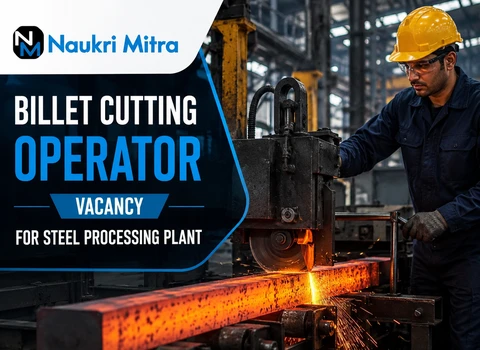
What a Billet Cutting Operator Actually Does
Before steel becomes a rod, angle, or beam, it starts out as a billet — a thick, solid bar that comes straight from the casting line. Someone has to cut that bar into the right lengths before it can go anywhere near a rolling mill. That's the job of a billet cutting operator. It's not glamorous work, but a rolling mill grinds to a halt without it, which is why steel plants keep this position filled year-round.
Why This Job Exists in the First Place
Rolling mills and forging lines run on exact numbers. A billet that's even a few centimeters off can throw the whole batch out of spec, and a rough or uneven cut can chip a blade further down the line. So plants hire operators specifically trained to read cutting charts, set machine parameters correctly, and catch problems before they turn into wasted material. Get this step wrong and everything after it slows down or costs more.
How a Shift Usually Goes
The day starts with a machine check and a look at the cutting schedule — what sizes are needed, how many, and in what order. Billets then move in on a conveyor or get lifted into place; the operator sets the cut length, runs the cycle, and watches the result. Between cuts there's time spent checking blade wear, confirming alignment, and pulling a piece aside to measure it against spec. Toward the end of the shift, production numbers get logged, and anything unusual — a strange sound, a slow cycle, a billet that doesn't sit right — gets reported before handover.
What the Role Involves, Day to Day
- Running shearing machines or saw-cutting units to size billets according to the production order
- Reading cutting charts and matching output to what's actually required
- Measuring finished pieces with tape measures, calipers, or gauges
- Adjusting stops, blade pressure, and cycle timing for different billet sizes
- Clearing and stacking cut billets safely for the next stage
- Flagging blade wear, unusual vibration, or alignment issues to maintenance
- Keeping basic shift records of output and quality checks
Where You'd Actually Be Working
This kind of work is common in re-rolling mills, induction furnace units, and integrated steel plants. Mandi Gobindgarh in Punjab has been a steel processing hub for decades, with a dense cluster of induction furnaces and rolling mills that regularly need cutting operators on the floor. This position is based in Mandi Gobindgarh, Punjab, India — a location where steel manufacturing has long been a core part of the local economy.
The Machines and Tools You'll Handle
Depending on whether the billet is cut hot, straight off the casting line, or after it's cooled, operators use hydraulic or mechanical shearing machines, hot saws, or cold saws. There's usually a control panel for setting length and cycle speed, and alongside that, hand tools — tape measures, steel rules, calipers — for checking dimensions manually. Being able to read a basic engineering drawing or cutting chart makes it a lot easier to match what comes out of the machine to what the order actually calls for.
What Employers Tend to Look For
An ITI in Fitter, Machinist, or Mechanical trade is the usual entry point most plants prefer. A Diploma in Mechanical Engineering also works, particularly for operators who'll be setting up more complex cuts rather than just running a fixed program. That said, plenty of experienced operators without a diploma get hired purely on the strength of hands-on skills — reading drawings, using precision instruments, understanding how the machine actually behaves under load. Attention to detail counts for a lot here, since a small measurement error early on multiplies into bigger problems later.
The Physical Side of the Job
This is a full-time role, and it's physical — long stretches on your feet, guiding or lifting heavy metal pieces, working close to machinery that doesn't stop for anyone. Most steel plants run round the clock, so rotational shifts including nights are standard rather than the exception. Anyone considering this line of work should be honest with themselves about whether they can handle a noisy, physically demanding floor on a regular basis.
Safety on the Shop Floor
Steel plant floors run hot and loud, especially near furnaces and hot-cutting stations. Operators are trained to maintain clear distances from moving billets, never work around a bypassed machine guard, and properly follow lockout steps during any maintenance. The standard PPE kit includes a safety helmet, heat-resistant gloves, safety goggles, ear protection, and steel-toe boots. None of this is optional — it's what keeps a genuinely risky environment from becoming accident-prone.
Problems Operators Run Into
Heat, vibration, and the repetitive rhythm of cutting cycles wear people down over a full shift, especially in summer. Blades dull faster than people expect, and a small misalignment can go unnoticed until several pieces come out wrong. Operators who stay alert to changes in sound or vibration and speak up early rather than waiting generally avoid the bigger delays and risks.
Moving Up From Here
Operators who stick with this work and build their knowledge of different billet grades, machine troubleshooting, and shift planning often move into senior operator roles or take on shift-level quality checks. From there, a shift supervisor position overseeing the cutting section is a realistic next step for someone who's put in the years and knows the floor well.
Pay and What Else Might Come With It
This full-time position in Mandi Gobindgarh, Punjab pays ₹33,200 a month. Beyond the base salary, some steel plants offer overtime pay, PF, ESI coverage, an annual bonus, uniforms, and occasionally transport or canteen facilities — though these vary from one employer to another and aren't guaranteed, so it's worth confirming directly during the hiring process.
If You're Thinking of Applying
Freshers coming out of an ITI program should spend some time getting comfortable with basic measuring instruments before walking into an interview — it makes a real difference. Experienced workers switching from another kind of machine shop should mention any prior experience with shearing or cutting equipment, even if the material wasn't steel. And for diploma holders looking to get a foot in the door in steel manufacturing, this is a solid, practical starting point — the kind of floor experience that can lead somewhere over the next few years.