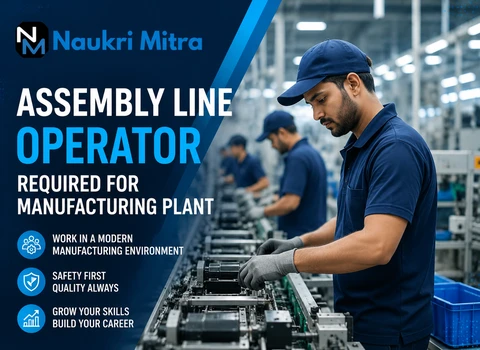
What Happens on a Manufacturing Assembly Line
Step onto the floor of a manufacturing plant in Chennai, Tamil Nadu, and you'll notice something immediately: everyone has a station, and everyone sticks to it. Parts move down the line, hands do the same task again and again, and the whole operation only works if each person plays their part correctly. That's the job of an Assembly Line Operator in a nutshell.
Why do factories bother hiring for this specific role instead of just letting anyone fill in? Because a single distracted moment on the line can ripple through an entire batch. Miss a component, misalign a part, skip a check, and the defect travels forward. Operators are the people who keep that from happening.
A Typical Shift, Start to Finish
Most operators arrive, check their station, and confirm the tools or fixtures for the day are in order before the line even starts moving. Then the cycle begins: pick up a component, fit it, run it through a machine or process step, pass it on. Repeat for hours.
- Loading and unloading parts as they move along the line
- Running pneumatic tools, conveyor systems, or semi-automatic machines
- Comparing finished pieces against a sample or drawing
- Flagging faulty components or machine trouble to a supervisor
- Keeping the station tidy and free of clutter during the shift
Because this is a Full-time role, operators are on the floor for the entire scheduled shift, not just part of it. Output has to stay steady from the first hour to the last.
Where This Kind of Work Happens
You'll find assembly-line roles in automotive component units, electronics assembly plants, consumer goods manufacturing, and various light engineering setups. Chennai has a fairly strong industrial base, and plants in the region often run multiple shifts just to keep pace with order volumes.
Tools and Instruments Operators Rely On
The exact toolkit changes depending on what's being assembled. Screwdrivers and wrenches are common, but so are pneumatic screwdrivers, riveting tools, and small presses. Quality checks usually involve a vernier caliper or gauge to confirm a part is within tolerance before it moves to the next stage. Reading a basic engineering drawing or a work instruction sheet also comes up often enough that it's worth getting comfortable with.
What Makes Someone Good at This Job
Technical know-how counts, but it's not the whole story. A lot of what separates a reliable operator from an average one is attentiveness — noticing when something's slightly off before it becomes a bigger problem.
- Basic familiarity with machine operation and hand tools
- Ability to follow simple drawings or process sheets
- Staying accurate even when working at a steady pace
- Working well as part of a shared line, not just solo
- Standing for long stretches and repeating the same motion without losing focus
An ITI qualification in a relevant trade or a Diploma in Mechanical engineering tends to be an advantage, since it means less time spent learning tool handling and workshop basics from scratch. It's not the only path in, though. Plenty of plants take on freshers with decent technical aptitude and train them on the job.
Physically, What Does the Job Demand?
Expect to be on your feet for most of the shift, moving between stations and using your hands constantly. It's not desk work. The floor itself comes with machine noise, nearby moving parts, and a pace that must stay steady to hit daily targets. Shift work is fairly standard in this line of work too, so schedules can rotate depending on how the plant operates.
Staying Safe on the Floor
Safety isn't optional in this kind of environment. Operators are usually expected to wear PPE — safety shoes, gloves, sometimes safety glasses or ear protection, depending on which machines are nearby. Lockout procedures before touching moving parts, keeping walkways clear, reporting anything unsafe right away — these aren't formalities. They're what keeps people from getting hurt.
Where New Operators Tend to Struggle
The repetition trips people up more than anything technical. Doing the same motion for hours, staying accurate while keeping pace — that takes some getting used to. Add in the occasional machine breakdown or last-minute production change, and operators need to stay adaptable, not just fast.
Moving Up From Here
Operators who show up consistently and take initiative often move into line leader, quality checker, or machine setter roles over time. Learning multiple stations instead of sticking to one, picking up basic quality-check skills, and simply being dependable — these are the things that tend to get noticed within a plant.
What the Pay Looks Like
For this Assembly Line Operator position in Chennai, Tamil Nadu, India, the monthly salary is ₹26,500. Beyond the fixed pay, some plants offer overtime, Provident Fund (PF), Employee State Insurance (ESI), an annual bonus, uniforms, and occasionally transport or canteen facilities. None of these extras are guaranteed — they depend on the individual employer.
Should You Consider This Role?
If hands-on, structured work suits you, and you're looking for something stable with a path toward more skilled positions, this is a reasonable entry point into manufacturing. It works for freshers just starting out and for experienced workers who'd rather be on the floor than behind a desk.