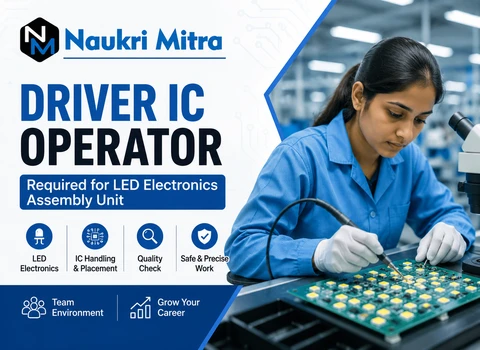
Understanding the Role of a Driver IC Operator in LED Manufacturing
A Driver IC Operator works inside electronics assembly units where LED products are built, tested, and prepared for final use. The role revolves around handling driver integrated circuits, the small components that control how current flows to LED chips. Anyone researching the
Driver IC Operator role for the first time will find that it sits at the practical, hands-on end of electronics manufacturing rather than in a design office. This opening is based in Greater Noida, Uttar Pradesh, India, and is a Full-time position.
Why LED Electronics Units Hire for This Position
LED manufacturing depends on accuracy at every stage. A single faulty driver IC can cause an entire batch of lights or display panels to flicker, dim unevenly, or fail early. Companies recruit dedicated operators for this reason, since automated machines still need trained people to load components correctly, monitor readings, and catch defects before products move to packaging. Demand for such operators has grown alongside India's expanding electronics and lighting manufacturing base.
What a Typical Working Day Looks Like
The day usually begins with a machine and workstation check, followed by collecting the driver ICs and PCB boards scheduled for the shift. From there, the operator loads components onto the assembly or testing line, watches the process closely, and records results at set intervals.
- Setting up driver ICs on assembly or testing fixtures
- Running functional and continuity checks on completed units
- Adjusting minor machine settings within permitted limits
- Segregating defective pieces for rework or rejection
- Maintaining production logs and shift handover notes
Core Responsibilities on the Assembly Line
Beyond routine machine operation, the operator is expected to keep production moving without compromising quality. This includes reporting unusual readings to a supervisor, following the standard operating procedure for each product variant, and keeping the workstation free of loose components or clutter. Consistency matters more than speed here, since rushed handling often leads to short circuits or damaged ICs.
Machines, Tools and Measuring Instruments Commonly Used
Operators in this field work with a mix of manual tools and electronic testing equipment. Common items include soldering irons, multimeters, continuity testers, ESD-safe tweezers and trays, and automated or semi-automated IC placement machines. Precision measuring instruments are used to confirm voltage output and current flow match the required specification before a unit is approved.
Technical Skills and Educational Background Employers Prefer
Most units look for candidates who understand basic electronics concepts such as voltage, current, and circuit continuity, as well as the ability to read simple wiring or assembly diagrams. Employers may prefer candidates with relevant machining or tool room training. Depending on the complexity of the work, an ITI in a machining-related trade, a Diploma in Mechanical or Tool and Die Engineering, or equivalent vocational training may be considered suitable. Practical experience with EDM machines, engineering drawings, and precision measuring instruments is often valued as much as formal education, since it demonstrates comfort with technical, hands-on work.
Practical Workplace Skills That Matter
Technical knowledge alone is not enough on a fast-moving assembly line. Operators also need steady hands for handling fine components, patience for repetitive tasks, and the discipline to consistently follow ESD (electrostatic discharge) precautions, since static electricity can silently damage a driver IC without any visible signs.
Physical Requirements and Shift Work
The job involves long periods of standing or sitting at a workstation, along with repetitive hand movements. Good eyesight or corrected vision is helpful for inspecting small components. As a Full-time role, it may include rotational shifts depending on production demand, which is common practice across assembly units in this sector.
Working Environment and Safety Practices
LED assembly units are generally indoor, climate-controlled spaces designed to protect sensitive electronic components from dust and humidity. Safety practices typically include wearing ESD wrist straps, anti-static footwear or coats, and following clean workstation protocols. Basic personal protective equipment such as safety glasses and gloves may also be provided depending on the specific task.
Common Challenges Operators Face
New operators often find the repetitive nature of the work and the need for sustained concentration challenging at first. Identifying subtle defects, managing production targets during peak shifts, and adapting quickly to different product variants are common hurdles that improve with experience and proper training.
Building a Long-Term Career in Electronics Assembly
With experience, operators can progress toward roles such as line supervisor, quality inspector, or senior technician within the same industry. Those who develop a stronger technical understanding of circuits and testing equipment often become the go-to person for troubleshooting on the floor, which naturally opens doors to more responsibility over time.
Salary Expectations and Possible Benefits
This Driver IC Operator position in Greater Noida, Uttar Pradesh offers a monthly salary of ₹33,800. As with many manufacturing roles in India, employees may also be eligible for additional benefits such as overtime pay, Provident Fund (PF), Employee State Insurance (ESI), annual bonus, uniforms, or transport and canteen facilities, depending on company policy. These are common possibilities in the sector rather than guaranteed inclusions, and candidates should confirm exact terms with the employer.