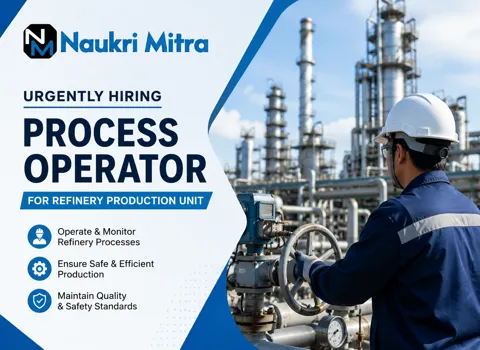
What a Process Operator Actually Does at a Refinery
Refineries run all day and all night. Someone has to be in the control room or out on the floor watching pressure gauges, checking valves, making sure nothing drifts out of range. That job belongs to the process operator. There's an opening for this role right now in Panipat, Haryana, India. It's Full-time work, and the pay is ₹41,200 a month.
If you've never worked in a plant before, the idea might sound intimidating. It isn't, once you get the hang of it. Most operators will tell you the first few weeks are about learning where things are and what normal looks like. After that, it becomes routine, though never boring exactly.
Why Refineries Need Someone Watching the Numbers
A production unit can't just be switched off when something looks a bit off. Temperature swings, pressure changes, unexpected flow readings - these things need attention fast, and automated systems only catch so much. A pump might start vibrating weeks differently before it actually fails. An experienced operator notices that kind of thing before an alarm ever goes off. That's really the whole reason this job exists.
A Regular Shift, More or Less
Shifts start with a handover. Whoever's leaving tells the incoming operator what happened, what to watch, anything unusual. From there it's a mix of things:
- Reading control panels and screens for temperature, pressure, flow
- Walking the unit, checking pumps and valves and pipelines in person
- Starting or adjusting equipment based on what production needs that day
- Writing down readings in the logbook, still a big part of the job
- Reporting leaks, smells, odd sounds - right away, not after the shift ends
Some shifts are slow. You check readings, everything's fine, you write it down, repeat. Other shifts throw three problems at you before lunch. You never really know which kind you're getting until you clock in.
Equipment You End Up Knowing By Heart
Distillation columns, heat exchangers, compressors, storage tanks - after a few months these stop being intimidating names and start being just part of the furniture. Same goes for the instruments used to monitor them: pressure gauges, flow meters, thermocouples, and level indicators. Many refineries in India now run on Distributed Control Systems, so much of the monitoring happens on screens, though physical walkarounds haven't gone away.
Training That Employers Look For
An ITI certificate in a relevant trade opens doors here. So does a Diploma in Chemical or Petrochemical Engineering. But honestly, a lot of what makes someone good at this job doesn't come from a classroom. Knowing how to read a process flow diagram, understanding shutdown procedures, having actually handled instrumentation with your own hands - employers notice that.
The Skills That Don't Show Up on a Resume
Staying sharp at 3 AM when nothing's happening is harder than people think. A missed reading isn't like missing an email - it can actually matter. Good operators communicate clearly during handovers, get along with the maintenance team, and don't panic when something goes sideways. That last part especially. Panic doesn't fix a stuck valve.
The Physical Side of the Job
You're on your feet a lot. Climbing stairs to reach platforms, walking the length of the unit multiple times in one shift. Production doesn't stop for anyone, so shift rotation is standard, and yes, that includes nights. Some parts of the plant get hot. Some are noisy. It's an industrial job, and it feels like one.
Safety Comes Up Every Single Day
Not just during the induction training. Helmets, safety shoes, gloves, goggles, flame-resistant coveralls - this is what you wear on the floor, every shift, no exceptions. Lockout-tagout before maintenance starts. Knowing the fire response steps cold. Reporting hazards the moment you spot them instead of waiting for someone else to notice. None of this is optional in a refinery setting.
What Trips Up New Operators
Shift rotation is the big one. Sleeping during the day, working through the night, then flipping back - it takes a few weeks for your body to adjust, and some people never fully love it; they just get used to it. The other thing is the quiet stretches. A calm night shift can lull you, and then an alarm goes off and your heart jumps. That reaction fades with experience. Give it three or four months, and most of it starts to feel manageable.
Where This Can Lead
People usually start as junior or trainee operators. Stick around, build a reputation for being reliable, and senior operator or shift-in-charge roles become realistic. Some operators pick up extra certifications in instrumentation or safety management along the way, which can lead to supervisory work or panel-in-charge positions within the same plant, sometimes years down the line.
Salary and What Else Might Come With It
This particular role, based in Panipat, Haryana, pays ₹41,200 a month on a Full-time basis. Beyond salary, refinery jobs in India often include a combination of overtime pay, PF, ESI, an annual bonus, uniforms, and, occasionally, transport or canteen facilities. What exactly gets offered depends on the employer, so it's worth asking during the hiring process rather than assuming.
For someone fresh out of ITI, or holding a diploma and looking for real industrial experience, this is the kind of job that teaches you fast and keeps teaching you for years, provided you're willing to put in the shift work that comes with it.