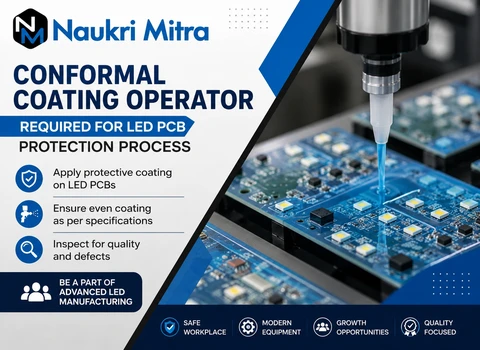
Understanding the Role of a Conformal Coating Operator in Electronics Manufacturing
Electronics assembly work has grown steadily across Gujarat, and one specialized position within this field is the Conformal Coating Operator Required for the LED PCB Protection Process. This is a full-time opening based in Gandhinagar, Gujarat, India, offering a monthly salary of ₹32,600. The role sits inside the printed circuit board (PCB) manufacturing process, where thin protective layers are applied to guard sensitive electronic components against moisture, dust, chemicals, and temperature changes.
What Conformal Coating Actually Means
Conformal coating is a thin polymer film applied to a PCB after soldering. It "conforms" to the shape of the board, covering components, wires and connections evenly. LED PCBs, used in lighting fixtures, signage and display panels, are particularly vulnerable to humidity and dust because they operate for long hours and often sit in outdoor or semi-outdoor conditions. Applying a protective coating extends the board's working life and reduces failure rates after the product reaches the customer.
Why Manufacturers Hire for This Position
Companies producing LED lighting products, PCB assemblies, and electronic control panels need operators who can apply coatings consistently, without gaps, bubbles, or uneven thickness. A poorly coated board can short-circuit or corrode within months, leading to product returns and warranty claims. This is why factories prefer trained operators over unskilled labor for this task.
A Typical Day on the Production Floor
A production worker in this role usually begins the shift by checking the coating machine or manual spray booth, inspecting nozzle condition and coating material levels. Boards arrive from the soldering or reflow section and are visually checked for defects before coating. The operator then applies the coating using spray guns, dip tanks, or selective coating machines, depending on the factory's setup. After coating, the boards move to a curing oven or a UV curing chamber, and the operator monitors the curing time and temperature.
Core Responsibilities
- Loading and unloading PCBs from the coating line
- Mixing coating material to the correct viscosity
- Operating spray, dip or selective coating equipment
- Checking coating thickness using measuring instruments
- Masking connectors and components that should not be coated
- Recording batch numbers and production quantities
- Reporting equipment faults to the supervisor or maintenance technician
Tools, Machines and Instruments Used
Depending on the scale of the factory, an operator may work with automatic selective coating machines, manual spray booths, dip coating tanks, UV or thermal curing ovens, and film thickness gauges. Some plants also use magnifying inspection lamps to check for pinholes or uneven coverage before boards move to packing.
Skills That Help an Operator Succeed
Technical job seekers, including ITI candidates and diploma holders in electronics or electrical trades, tend to adapt quickly to this work because they already understand basic PCB layouts. Steady hands, attention to detail, and the ability to follow standard operating procedures matter more than heavy technical qualifications. A basic understanding of electronic components, the ability to read simple work instructions, and comfort working near chemical coating materials are practical advantages.
Working Conditions and Physical Demands
This job type is full-time and generally involves standing for extended periods near coating booths or conveyor lines. Shift work is common in electronics manufacturing units, so flexibility around rotating shifts can be an advantage. The work environment includes exposure to coating fumes, so proper ventilation and protective equipment are essential parts of the daily routine.
Safety Practices and Protective Equipment
Operators typically wear gloves, safety goggles, aprons, and, where required, respiratory masks suited for solvent-based coatings. Good housekeeping around chemical storage, proper labeling of coating materials, and following fire safety norms near curing ovens are standard expectations in this line of work.
Common Challenges on the Job
New operators often struggle initially to achieve an even coating thickness, since a layer that is too thin offers poor protection, while a layer that is too thick can affect component performance. Learning to judge viscosity and spray distance takes practice, and experienced technicians usually mentor newcomers during the first few weeks.
Growing Within the Same Field
With experience, a coating operator can progress to quality inspection roles, line supervision, or specialized technician positions that handle automated coating equipment. Familiarity with different coating chemistries and equipment calibration adds long-term value within the same production environment.
Salary and Possible Benefits
The position offers a monthly salary of ₹32,600 for this full-time role in Gandhinagar, Gujarat. Depending on the employer, additional benefits such as overtime pay, Provident Fund (PF), Employee State Insurance (ESI), attendance bonus, uniforms, transport facility, or canteen access may also be provided, though these vary by company policy.