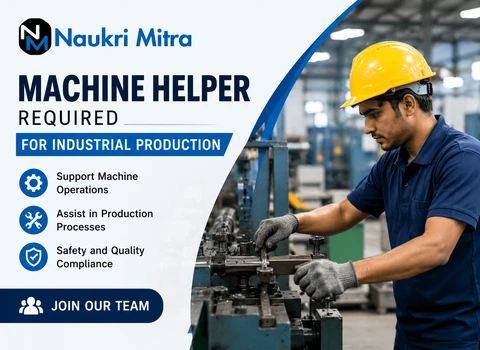
What Does a Machine Helper Actually Do?
Walk onto any production floor, and you'll notice the operators aren't working alone. Someone is feeding material, clearing scrap, and checking that the last batch came out right. That's the Machine Helper. It's a Full-time role in Ahmedabad, Gujarat, and it exists because production lines don't run on operators alone — they run on the people who keep everything around them moving.
Ahmedabad has a long manufacturing history, and units across the city still hire for this exact kind of support work. If you're new to factory jobs, this is often where people start.
Why This Position Exists on the Shop Floor
A machine can only be as fast as the person feeding it. When helpers aren't around, operators end up doing double duty — running the machine and handling material — and output drops. Companies hire helpers to close that gap. It's not a glamorous reason, but it's the honest one.
A Regular Shift, Hour by Hour
No two factories run identically, but a shift for a helper tends to follow a similar shape:
- Checking the machine and work area before the line starts
- Bringing raw material to the station and clearing finished pieces
- Helping the operator during changeovers or tool swaps
- Wiping down and lubricating parts of the machine as instructed
- Watching pressure gauges and dials for anything that looks off
- Flagging strange noises, leaks, or vibrations to a supervisor right away
None of this sounds difficult on paper. In practice, it takes focus, because a missed step can hold up an entire batch.
Where the Work Happens
Helpers get hired across engineering workshops, plastic and rubber units, packaging lines, metal fabrication shops, and general manufacturing plants. Ahmedabad's industrial belt has plenty of these, which keeps demand for the role fairly steady through the year.
The Machines and Tools You'll Be Around
Depending on where you land, you might be working near CNC machines, lathes, power presses, injection molding units, or conveyor belts. You don't need to operate them yourself, but knowing the basics helps — spanners, screwdrivers, vernier calipers, micrometers. If you can read a simple engineering drawing, that's a real advantage when a supervisor hands you a job sheet and expects you to follow it without hand-holding.
What Employers Look For
Employers may prefer candidates with relevant machining or tool room training. Depending on the complexity of the work, an ITI in a machining-related trade, a Diploma in Mechanical or Tool and Die Engineering, or equivalent vocational training may be considered suitable. Practical experience with EDM machines, engineering drawings, and precision measuring instruments is often valued as much as formal education — sometimes more, if you can prove it on the shop floor.
That said, technical knowledge only gets you halfway. Turning up on time, staying alert near moving parts, and taking instructions without arguing about them matter just as much. Supervisors notice this fast.
What the Job Asks of Your Body
You'll be on your feet for most of the shift. Some lifting is involved, and you'll be working close to running machinery, so tired legs and sore hands aren't unusual in the first few weeks. Many units in Gujarat operate on rotational shifts, so be ready for early mornings, late nights, or both, depending on the roster.
Staying Safe Around Moving Equipment
Factories aren't forgiving of carelessness. The basics matter:
- Safety shoes, gloves, and a helmet, worn properly, not just carried
- Ear protection near machines that run loud
- Following lockout steps before touching a machine for cleaning
- Keeping the floor clear of oil, loose cable, or scrap material
PPE (personal protective equipment) isn't optional in a well-run unit, and most supervisors will pull you up quickly if you skip it.
The Hard Part Nobody Tells You Upfront
The first month is usually the toughest — adjusting to the noise, the heat near certain machines, standing for hours, learning shift timings that don't match a normal routine. It gets easier once your body and eyes learn to read the machine's rhythm. Most helpers say the real learning happens in the second or third month, not the first week.
Where This Role Can Take You
Stick with it, learn the machines beyond your own station, and you can move up to machine operator, then eventually toward technician or supervisor roles. This isn't guaranteed — it depends on how much initiative you show and whether the unit is willing to train you further. But it's a realistic path, and plenty of people have walked it starting from exactly this position.
Pay and What Else You Might Get
This Full-time Machine Helper position in Ahmedabad, Gujarat, India pays ₹22,000 a month. On top of that, some units offer extras like overtime pay, PF, ESI coverage, bonuses, uniforms, transport, or canteen access — none of these are guaranteed, and they vary from one employer to another, so it's worth confirming during the hiring process.