
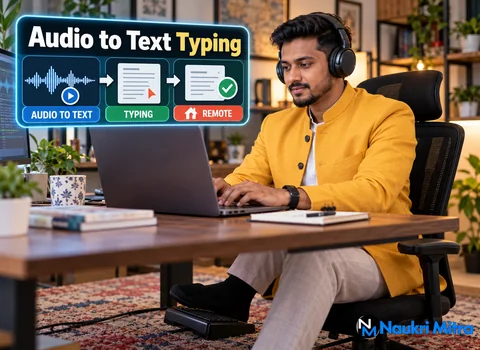
Minute four of the file. A woman says, "So the rent went up in March," and before she finishes a man cuts in with "No, April, it was after the wedding." Behind them a pressure cooker lets out a long whistle, then a second one, and someone laughs. On the page, that thirty seconds becomes three clean lines: Speaker 1: So the rent went up in March. Speaker 2: No, April, it was after the wedding. [crosstalk] [00:04:12] and a note that the next phrase is [inaudible] under the whistle. That is the daily work in online audio to text typing jobs. This post is for a part-time, remote role open worldwide, and it pays $80 USD per week. You listen to interviews, podcasts and meetings and type them word for word. No degree is required.
It is careful reading, only with your ears. You play a few seconds, stop, type, rewind, check, and carry on. A good transcript lets someone who never heard the recording know who said what, when it was said, and where the audio failed.
One day it is a calm two-person interview. The next it is a laptop recording of a meeting with a fan humming. Both get patient listening and honest marking of anything you cannot hear.
So if someone asks what an audio to text typing job description really boils down to, the short answer is this: turn speech into accurate text that follows a client's rules, and hand it in on time.
The first craft skill is telling voices apart. Before typing much, I listen to the opening minute and note each speaker by pitch, pace and habits. Those small clues save you when two people talk over each other.
Timestamps tell the reader where to find a moment in the file. Some clients want one at every speaker change, others only next to unclear sections. Follow the guide exactly, because a transcript with the wrong timestamp style can be sent back even if every word is right.
Unclear audio tags are where honesty matters most. If a word is buried under a door slam or that pressure cooker whistle, you mark it, usually as [inaudible] or [unclear] with a timestamp. If you think you heard a word but are not sure, many guides let you write your best guess in brackets with a question mark. What you never do is fill the gap with something that sounds plausible. A confident wrong word does more harm than a marked blank.
You need transcription software, not just a media player. Express Scribe and oTranscribe are two common options. Both let you slow the audio, rewind with a key press and insert timestamps. oTranscribe runs in a browser, so nothing needs installing.
A foot pedal lets you play, pause and rewind with your foot while both hands stay on the keyboard. It is nice to have, not a must. Plenty of people use hotkeys instead. Pick one rewind key and one play/pause key, set a small automatic rewind on pause, and practise until your fingers do it without thinking.
Good headphones matter more than most beginners expect. Closed-back headphones block room noise and keep the soft endings of words that cheap earbuds swallow. You also need a computer and a stable internet connection to download files and submit work.
On speed, the requirement for this role is accurate typing of around 40 words per minute or more. Notice the word accurate. Fast typing with lots of errors costs more time in proofreading than it saves. Strong audio to text typing skills also include good grammar and punctuation and spelling names correctly after a quick check.
When the first draft is done, the job is only half done. I play the file again from the top and read along. This is where you catch the "their" that should be "there" and the speaker label that slipped. Then I check the style guide rules, such as tag format and whether filler words like "um" stay in. Only then does the file go back, before the deadline.
General data entry means copying information from forms, documents or images into a system. Audio typing is a listening job first. The source is spoken and sometimes unclear, so you make judgement calls about speakers and gaps.
About the audio to text typing salary: for this role, pay is $80 USD per week, part-time. Some platforms in this field pay per audio minute instead, so the amount depends on how many minutes you complete and how difficult the audio is. Here, the audio to text typing salary per week is the figure stated above, though no particular volume of files is promised from one week to the next.
These are genuinely audio to text typing jobs for freshers. You do not need a degree, a certificate or previous transcription work. What you do need is a good ear for English, steady typing and the patience to replay a phrase five times. Even openings that ask for no experience usually expect a clean test file, so practise first.
Getting started works best in small steps. Take a public podcast clip and transcribe two minutes with speaker labels and timestamps, then compare it against the audio. An audio to text typing course or audio to text typing certification can help with structure, but neither is required here.
Rev, TranscribeMe and GoTranscript are well-known transcription platforms that use entry tests and publish style guides, which makes them useful to study while you prepare. They are named only as examples; this post is not connected with any of them.
Many audio typing roles start with a short test file. Read the style guide twice before you press play. A correct sentence with the wrong tag format can still fail. Type exactly what you hear and do not fix the speaker's grammar unless the guide says to.
For the application itself, your audio to text typing resume can be short. List your typing speed honestly, the software you have used, your headphones and setup, and any practice transcripts you can share. When it comes to audio to text typing interview questions, expect things like how you handle an unclear word, how you label overlapping speakers, and how you manage a deadline.
Genuine audio typing employers pay you; they do not charge you to begin. Walk away if someone asks for a fee covering a starter kit, a test, or access to files. Pay that sounds far too high, vague details, requests for bank passwords and pressure to decide right away are other red flags. Real roles give you a style guide and clear terms.
This is audio to text typing work from home, so you need a quiet spot and a routine you can stick to. Part time audio to text typing jobs suit people who like focused solo work in shorter sessions. People looking at freelance audio to text typing jobs will find the habits here carry over well: steady listening, honest tagging and on-time delivery. If you like catching the small sounds other people miss, you will probably enjoy this.