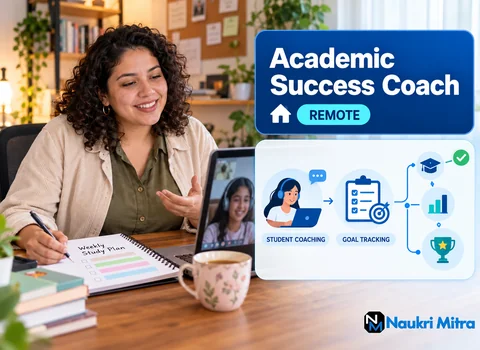
Take a first-year student we'll call Jordan. It is the third week of term; Canvas shows three missing assignments in Intro to Psychology and Composition, and Jordan has not logged in for ten days. Nobody has failed anything yet. The coach's first message is short: "Hi Jordan, I'm your success coach this term. I noticed things have gone quiet in Canvas, and I wanted to check you're okay. No lecture, promise. Have you got fifteen minutes on Thursday for a quick video call?" Messages like that one, sent many times a week, make up a large part of remote academic success coach jobs. The post is full-time and open worldwide, with pay of USD 3,750 per month.
What follows is the academic success coach job description told through one term of coaching. It then covers the background colleges look for, the home setup you'll need, the pay, and how to prepare your application.
Advertisement
Week one: saying hello before anything goes wrong
You start the term with an assigned caseload. Before you post a single grade, you send every student a personal welcome: who you are, how to book time with you, and one question about what they hope to get out of the term. Most won't reply. The ones who do tell you a lot, such as the student working night shifts or the one who is quietly terrified of statistics.
You log each of these first contacts. It feels like admin, but in week seven, when a student says "you never told me about tutoring," the record shows the date you did.
When an early-alert flag lands in EAB Navigate
By week two or three, flags start arriving. An instructor marks a student as absent, or the platform raises an alert from low engagement. You open EAB Navigate, read the note, then check Canvas grade data to see the fuller picture. Is it one missed quiz, or a pattern across every course?
Jordan's case would come in exactly this way. A good coach reaches out within a day or two, by message first, then by phone if the college allows it. Some institutions run their student records in Salesforce instead, so you may log contacts there rather than in Navigate. The habit matters more than the tool: read the flag, look at the data, make contact, write it down.
The first video session
When Jordan finally books that call, you are not there to scold. You ask what happened. Often it's ordinary: a job that took more hours than planned, a family situation, or simply not knowing where the assignment link was. Sometimes it's bigger, and that is when you refer the student to financial aid, wellness, or counseling services rather than trying to fix it yourself.
Sessions are usually short. You end each one with one or two concrete next steps and a date for the next check-in, not a vague "let me know how it goes."
Building study plans students actually open
From here, the work becomes a rhythm of weekly one-on-one check-ins. With each student, you build a simple study plan and a goal tracker. For Jordan, an illustrative plan might be: email both instructors by Friday about late work, block two evening hours on Tuesday and Thursday for Composition, and book one tutoring session to review for the psych quiz.
Plans work best when they are tiny and specific. A color-coded spreadsheet with forty rows tends to get abandoned. Three tasks with dates, reviewed every week, tend to stick.
The mid-term check
Around week eight, you look across the whole caseload. Who has recovered? Who is still sliding? Canvas grades give you a reasonably honest snapshot, and you compare them against the notes from earlier calls. This is when you might suggest a student talk to their advisor about dropping a course before the deadline, or push hard for a tutoring referral that was ignored the first time.
It is also when you'll need to manage your own time. Mid-term is often the busiest point of the caseload.
End of term: looking back with each student
The last session is a reflection. What worked? What would they do differently next term? Some students will have turned things around completely; others will have scraped through or withdrawn. You record outcomes, close out your notes, and hand over anything the next coach or advisor needs to know.
Coming in with a degree and tutoring behind you
A bachelor's degree in education, counseling, or a related field is the baseline. Some colleges prefer a master's, particularly where the job leans toward counseling, but it isn't a blanket requirement here. You'll also need one to two years of advising, tutoring, or student success experience, a working knowledge of EAB Navigate and Canvas, and clear written English.
If you have tutored, you already have most of the instincts: noticing when someone is lost, breaking a task into steps, and following up. On your academic success coach resume, describe that work in caseload terms. A line such as "met a set group of students weekly across two terms" says more than "tutor." That reframing is the usual answer to how to become an academic success coach when your history is mostly tutoring.
Truly entry-level remote academic success coach jobs, or academic success coach jobs with no experience at all, are uncommon because this role expects a year or more with students. Volunteering as a peer mentor or tutor is a realistic way to build that year.
Coach and advisor are not the same job
An academic advisor mainly handles course selection, degree requirements, and graduation audits. A coach focuses on habits, motivation, and staying enrolled. The two work closely, and coaches often refer students to advisors for anything involving the course plan itself.
The remote setup: laptop, phone, video and CRM
These are academic success coach work-from-home jobs in the full sense, so the basics have to be solid. You'll need a reliable laptop and stable internet that holds up for video sessions, plus a quiet spot where a student can talk about something personal without hearing your household behind you. Expect to move between video calls, phone outreach (where used), messaging, Canvas, and a CRM such as EAB Navigate or Salesforce to log every contact.
Because the listing is worldwide, the students you support may sit in a different time zone from you. Ask early in the process what hours you'd be expected to cover.
Monthly pay in remote academic success coach jobs like this one
The monthly salary for this full-time academic success coach role is USD 3,750. That's what the listing states. If you are comparing offers, check whether others quote yearly or hourly pay and convert them yourself before deciding. Ask about pay dates and how you'll get paid if you're outside the US.
Practice, stories and a sample message
- Practice with the tools. Canvas publishes free user guides, and EAB has public overview material on Navigate. Knowing where grade data and alerts live will show in an interview.
- Prepare stories, not adjectives. Common academic success coach interview questions include "Tell me about a student you helped get back on track" and "How would you handle a student who never replies?" Have a real, anonymized example ready for each.
- Write one sample outreach message. Some hiring teams ask for one. Keep it warm, brief, and give the student an easy next step.
On the academic success coach course and academic success coach certification question: no specific certificate is listed for this job. Free courses on coaching conversations, student retention or online teaching can help you talk confidently, and your degree plus student-facing experience carry the most weight.
Coaching careers, and how to apply here
If this reads like the work you want, submit your application and add a few sentences about the students you have supported and the tools you have used. No stage of this process costs you anything; treat a payment request as a scam. Academic success coach jobs remote worldwide attract a wide pool of applicants, so a clear, specific note will help yours stand out.
Over time, coaches often move into lead coach roles, retention or student success management, and eventually a student success director post, usually after several years and often with a master's.