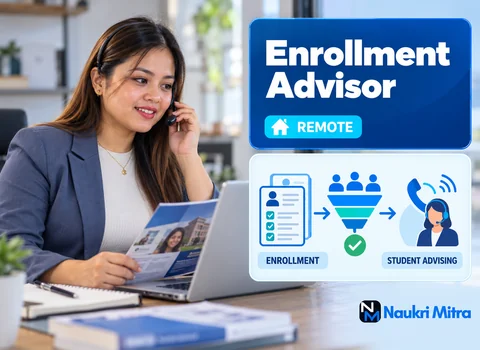
Headset on, coffee within reach, and the dialer loads the next number. The woman who picks up is 34 (a composite, drawn from no real person), works shifts at a pharmacy, and her first question is blunt: "Is an online degree actually real, or is it one of those things?" How you answer her in the next minute or two is most of what remote enrollment advisor jobs come down to. This page stays with her from that first call to her first week of class, so you can judge whether the work suits you.
Advertisement
Opening Question: "Is an Online Degree Real?"
That question comes up more than you'd expect, and it deserves a straight answer rather than a script. A good advisor starts with what can be verified: whether the school is accredited, which body accredits it, and how the program is delivered. Then ask why she's asking. Often the real worry sits underneath. A cousin paid for a certificate nobody recognized, or she's scared of wasting money she doesn't have.
That exchange is the job in miniature. At an online university, the enrollment advisor is usually the first person a prospective student talks to after an inquiry. You call and email inbound leads interested in degree programs, explain admission requirements, deadlines, and costs, and guide applicants through forms and document uploads. You help someone decide with good information, then make the paperwork less painful.
Discovery: The Questions That Do the Heavy Lifting
Once she relaxes, you stop explaining and start asking. A decent discovery conversation covers things like:
- What she wants the degree to change: a promotion, a career switch, finishing something she started at nineteen.
- How many hours a week she can honestly give to study once you count work and family.
- Whether she has earlier college credit, and where those transcripts are.
- How she plans to pay, and whether her employer contributes anything.
You type notes while she talks, just what you'll need on call three. A line like "nights Tue to Thu, prefers texts after 6 pm, some community college credit from years back" saves a whole follow-up.
Fit Comes Before the Application
This is where advisors either earn trust or lose it. Suppose the program she asked about expects live evening sessions twice a week and she works nights. You tell her. Maybe a different program with self-paced classes suits her better. Maybe the right answer is "wait until your schedule changes, and I'll call you in the spring." Saying so early is better for her than withdrawing a month into the term.
You'll also get asked things you can't answer, usually about financial aid or credit transfer. The honest reply is "I don't know, but here's who decides that and when you'll hear." Guessing to keep a lead warm only creates problems later.
Follow-Ups, Logged Properly in Salesforce
Very few people apply on the first call. Your follow-up rhythm lives in Salesforce CRM: every call outcome, every email, the next task with a date attached. The dialer software feeds your queue, but the notes you leave decide whether the next conversation picks up where the last one stopped or starts from zero.
A normal shift mixes new inbound leads, booked call-backs, and application chasers. Update each lead after every contact, and keep following up until the student enrolls or tells you she's out. When she opts out, you record it and stop. No "just checking in" emails to someone who said no.
Documents, Deadlines and the Hand-Off
Say she applies. Now the work moves from conversation to logistics. Transcripts need to be requested from that community college, ID has to be uploaded in an accepted format, and the application deadline is coming whether the paperwork is ready or not.
Deadlines are where advisors get tempted to push. Don't. Remind her clearly, early, and in writing, and tell her what actually happens if she misses one, which is often just a later start date.
Once she's accepted and registered, you introduce her to whoever supports students once classes start, such as a student services team, and pass on anything useful: the night shifts, the nerves about essays, the preference for texts. A clean hand-off note means she doesn't repeat her story to a stranger.
Advising Without Pressure Tactics
Is this really sales? Usually, yes. Most of these roles are measured on activity and enrollments, so expect targets of some kind, and ask about them in the interview because the details vary between employers. What matters is how you reach them. Ground rules worth looking for in any team:
- No invented deadlines or "only a few seats left" lines unless they're true.
- No skating past the fees. She hears the full cost from you, not from a surprise bill.
- "I need to talk to my partner" is a reason to book a call-back, not an objection to overcome.
- If the program is wrong for her, you say so, even in the last week of the month.
Students who were rushed into enrolling tend to leave early, and that costs them far more than it costs your numbers.
The Phone Habits Remote Enrollment Advisor Jobs Reward
A bachelor's degree is preferred, but strong call center or inside sales experience is often accepted in its place. The enrollment advisor skills that matter most here:
- Comfort with high daily call volumes without sounding flat by the last one.
- Clear, persuasive spoken English, where persuasive means explaining well, not pushing.
- Working knowledge of Salesforce CRM and dialer software, or the ability to learn them fast.
- Tidy notes and dependable follow-up.
Entry-level remote enrollment advisor jobs do exist, and searches for enrollment advisor jobs with no experience aren't hopeless, but "no experience" usually means no admissions background, not no phone work at all. Retail, hospitality, tutoring or customer support all count. If you're asking how to become an enrollment advisor with a thin record, a few months on an inbound support desk is the most direct route.
Your Home Office: Headset, Quiet Room, Steady Connection
The equipment list is short and not optional. You need a headset (a wired noise-canceling one is the safest bet), a quiet space with a door you can shut, and stable internet. Students notice a television or a lagging line. Do a test call with a friend first.
With work-from-home enrollment advisor jobs, the commute disappears, but the structure has to come from you: a fixed start time, breaks away from the desk, and notifications off while the dialer runs.
Base Pay, and the Bonus Question
The base is USD 3,750 per month for full-time hours. That's the enrollment advisor salary per month for this listing, and it's the only pay figure the listing gives. Commissions and bonuses go unmentioned, so leave them out of your budget and ask the hiring manager: are there any, and what would they hinge on? Treat any general enrollment advisor salary figure online as background, not a promise about this job.
Mock Calls and Trailhead Before the Interview
No particular enrollment advisor course or enrollment advisor certification is required for this listing. More useful preparation: Salesforce's free Trailhead modules, a basic read on accreditation, and a few mock calls with a friend playing a doubtful adult learner. Read the enrollment advisor job description above again and match your examples to it.
Common enrollment advisor interview questions include a role-play with a hesitant caller, what you'd do when a student wants a program that clearly won't fit their schedule, and how you track callbacks. On your enrollment advisor resume, lead with phone and CRM work, and use real numbers from past jobs only if you actually have them.
Applying From Anywhere, Starting With a Phone Screen
Listed as remote enrollment advisor jobs worldwide, these accept applicants from any country whose English, setup, and connection meet the bar above. It is among the remote enrollment advisor jobs hiring now on Naukri Mitra. Use the apply button with two or three lines on your call experience. Employers hiring for phone roles often start with a short phone screen, since how you sound on a call matters. You won't pay a cent at any point, and a school that wants money from an applicant isn't hiring honestly.