📚 Table of Contents
- Understanding IoT in Simple Terms (And Why It Matters Now)
- Why Remote IoT Development Careers Are Growing So Fast
- What changed?
- Skills You Actually Need for a Remote IoT Development Career
- Programming That Matters
- Understanding Devices (Without Getting Too Technical)
- Networking Basics (Very Important but Often Ignored)
- Cloud Platforms
- Data Handling
- A Practical Roadmap to Start Your IoT Remote Career
- Step 3: Learn How IoT Systems Actually Work
- Project Ideas That Actually Help You Get Hired
- Smart Home Automation
- Wearable Health Tracker
- Predictive Maintenance System
- Smart Farming Solution
- Tools You Should Get Comfortable With
- Development Tools
- Cloud & Backend
- Testing & Simulation
- Communication Tools
- Building a Strong Remote IoT Portfolio
- What to include:
- A small but powerful tip:
- Where Remote IoT Jobs Actually Come From
- Challenges You Should Be Aware Of
- Hardware Limitations
- Security Risks
- System Complexity
- Future of IoT Remote Development Careers
- FAQs
- 1. Can I start IoT development without hardware?
- 2. Is IoT a good career for remote work?
- 3. Which language should I learn first?
- 4. How long does it take to become job-ready?
- 5. Do I need a degree to work in IoT?
- Conclusion
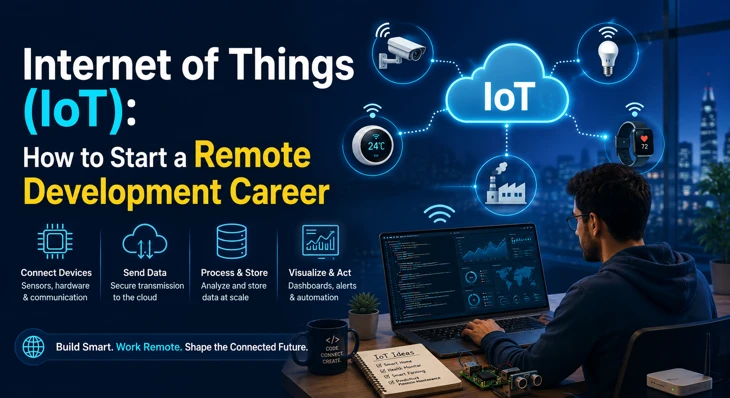
Internet of Things (IoT): How to Start a Remote Development Career
The Internet of Things (IoT) is no longer a futuristic buzzword. It’s already part of everyday life—quietly running behind smart homes, fitness trackers, connected cars, and even modern factories. If you’ve ever adjusted a smart thermostat from your phone or tracked your steps on a wearable device, you’ve already interacted with IoT without even thinking about it. Now here’s the exciting part: this growing ecosystem is opening real doors for a remote development career in IoT. You don’t always need to be on-site with hardware anymore. With cloud platforms, simulation tools, and modern development environments, IoT developers are building powerful systems from anywhere in the world. This guide breaks everything down in a practical, easy-to-follow way so you can understand how to get started, which skills actually matter, and how to move toward real remote IoT development opportunities.Understanding IoT in Simple Terms (And Why It Matters Now)
At its core, IoT is just a network of physical devices that communicate with one another over the internet. These devices collect data, share it, and sometimes even take action based on it. Think about it this way: instead of humans constantly checking and controlling machines, the machines monitor themselves. A few real-life examples make it clearer:- A smart AC that adjusts temperature based on room occupancy
- A health monitor that sends heart rate data to your doctor
- A factory sensor that detects machine overheating before failure
Why Remote IoT Development Careers Are Growing So Fast
A few years ago, IoT work meant being physically near hardware. That’s no longer the case. Today, a large portion of IoT development happens in the cloud or through virtual environments. This shift has made remote IoT developer roles much more common than before.What changed?
- Cloud platforms replaced on-site infrastructure in many cases
- IoT simulators reduced dependency on physical devices
- Open-source hardware made prototyping easier
- Global teams now collaborate on distributed systems daily
Skills You Actually Need for a Remote IoT Development Career
Let’s be honest—IoT can sound overwhelming at first. Hardware, software, cloud, networking… it feels like a lot. But you don’t need to master everything at once. You just need the right mix of practical skills.Programming That Matters
Start with languages that are actually used in real IoT systems:- Python: for automation, APIs, and data handling
- C/C++: for embedded systems and device-level programming
- JavaScript: for dashboards and web-based IoT interfaces
Understanding Devices (Without Getting Too Technical)
IoT devices run on microcontrollers like Arduino or Raspberry Pi. These are small computers that interact with sensors and actuators. Once you start experimenting with them, things become much more practical. Even simple projects like a motion sensor light or temperature monitor can teach you a lot.Networking Basics (Very Important but Often Ignored)
IoT devices constantly communicate. That communication happens through protocols like:- MQTT (lightweight messaging system used in IoT)
- HTTP/HTTPS (web-based communication)
- CoAP (used in low-power devices)
Cloud Platforms
This is where most remote IoT work actually happens. Learn the basics of:- AWS IoT Core
- Microsoft Azure IoT Hub
- Google Firebase
Data Handling
IoT is basically a data machine. Sensors generate continuous streams of information. Knowing how to filter, visualize, and interpret that data will instantly make you more valuable as a developer.A Practical Roadmap to Start Your IoT Remote Career
You don’t need a perfect plan—you need a simple direction. Here’s a realistic path most beginners can follow: Start with Python or C. Focus on understanding logic, loops, and APIs. Don’t rush. Even a basic Arduino kit is enough. Start small:- LED blinking project
- Temperature sensor
- Motion detection system
Step 3: Learn How IoT Systems Actually Work
At this stage, focus on the big picture: How does a device send data? Where does the data go? How is it displayed or used? Try sending sensor data to a cloud platform. This is the moment IoT starts feeling real. A few beginner-friendly ideas:- Smart home control system
- Soil moisture-based irrigation system
- Remote weather station
- Basic health monitoring system
- GitHub for version control
- Docker for deployment
- VS Code Remote for cloud coding
Project Ideas That Actually Help You Get Hired
A strong portfolio matters more than IoT certificates. Here are projects that recruiters actually care about:Smart Home Automation
Control appliances using an app or web dashboard. This shows full-stack IoT thinking.Wearable Health Tracker
Track heart rate or movement and send data to a cloud dashboard.Predictive Maintenance System
Simulate machines that detect failures before they happen.Smart Farming Solution
Use soil sensors to automate irrigation decisions. These projects show that you understand both hardware and software—not just theory.Tools You Should Get Comfortable With
You don’t need every tool—but knowing the right ones helps a lot.Development Tools
- Arduino IDE
- PlatformIO
- Visual Studio Code
Cloud & Backend
- AWS IoT Core
- Azure IoT Hub
- Firebase
Testing & Simulation
- Tinkercad Circuits
- Proteus
Communication Tools
- MQTT Explorer
- Postman
Building a Strong Remote IoT Portfolio
Think of your portfolio as your real resume. What matters most is clarity, not complexity.What to include:
- GitHub projects with clean structure
- Short documentation explaining each project
- Screenshots or demos
- Simple explanations of how things work
A small but powerful tip:
Always explain the real-world use case of your project. For example, don’t just say “smart irrigation system.” Say how it helps reduce water waste and improve farming efficiency. That small shift makes a big difference.Where Remote IoT Jobs Actually Come From
Once you’re ready, start exploring platforms like:- Upwork
- Toptal
- Remote OK
- AngelList
- IoT firmware developer
- Cloud IoT engineer
- Embedded systems developer
- IoT data analyst