What Does a Water Treatment Plant Operator Actually Do?
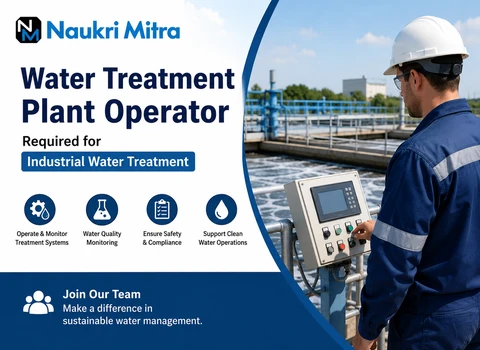
Raw water rarely arrives clean enough for factory use. Before it can go anywhere near a boiler, a cooling tower, or a production line, someone has to filter it, dose it with the right chemicals, and check it against quality parameters repeatedly. That someone is the Water Treatment Plant Operator. There's an opening for this exact role right now in Jamnagar, Gujarat, India, offered on a Full-time basis. It's worth understanding what the work really involves before applying.
Why This Job Exists in the First Place
Untreated water damages equipment. Scaling builds up inside pipes, corrosion eats away at metal parts, and contaminants can ruin an entire production batch. Factories don't take that risk lightly, so they keep a dedicated operator on hand whose only job is to ensure the water entering their systems meets the required standard, shift after shift.
A Shift, Start to Finish
Walk into the plant at the start of a shift and the first thing an operator does is check what the previous shift left behind — readings, chemical stock, any notes about equipment behaving oddly. From there it's a cycle of monitoring filtration units, adjusting dosing pumps, and logging numbers like pH, turbidity, and hardness at set intervals. In between, there's a fair bit of walking the plant floor, listening for strange sounds from pumps, and checking for leaks before they become a bigger headache.
What the Job Actually Involves Day to Day
- Running and monitoring filtration, softening, and reverse osmosis systems
- Measuring out coagulants, disinfectants, and other dosing chemicals correctly
- Noting down readings from flow meters, pressure gauges, and conductivity meters
- Handling basic upkeep on pumps, valves, and connecting pipelines
- Flagging anything unusual to the shift supervisor before it turns into downtime
The Kind of Places You'll Find This Work
This isn't office work. Expect to be based at an industrial water treatment facility attached to a manufacturing unit, a power plant, a chemical facility, or another process industry. The physical space usually includes overhead tanks, filter beds, a dosing room, a control panel, and pipe runs stretching across the site that require regular inspection.
Equipment You'll Get Familiar With
Sand filters, activated carbon filters, water softeners, dosing pumps — these become second nature fairly quickly. Some plants also run reverse osmosis membranes for higher purity requirements. On the measurement side, a pH meter, TDS meter, and turbidity meter get used constantly. Knowing how to read these instruments quickly, without second-guessing yourself, is what separates a confident operator from someone still learning the ropes.
What Employers Tend to Look For
ITI holders in trades like Fitter, Electrician, or Chemical Plant Operator usually pick this up with little trouble. Diploma holders in Chemical or Mechanical Engineering fit in just as well. That said, formal education isn't the whole story here — knowing how to operate a valve manually, read an electrical panel, or troubleshoot a stuck dosing pump matters just as much on the floor. Freshers aren't ruled out either, provided they're genuinely willing to learn and pay attention during training.
What the Body Goes Through
There's a fair amount of standing and moving around involved — climbing short ladders to check tanks, occasionally lifting chemical containers, staying on your feet for stretches at a time. Since a treatment plant can't simply shut down overnight, shifts rotate, including night duty. Rotational shift work is fairly standard across industrial operations in Gujarat's manufacturing belt, so this is worth factoring into your decision.
Keeping Yourself Safe Around Chemicals and Pressure Systems
Chemical handling and pressurized equipment don't leave much room for carelessness. Gloves, safety goggles, and gumboots are standard, and respiratory protection is required when handling concentrated chemicals. Before any maintenance work begins, lock-out/tag-out procedures must be followed properly, and keeping the floor free of spills is part of the daily routine rather than an afterthought.
Where New Operators Usually Get Tripped Up
Monsoon season tends to be the toughest stretch. Raw water turbidity spikes, and dosing that worked fine a week earlier suddenly needs adjusting. Filters need backwashing more often too. Operators who've been through a few monsoons develop a feel for these shifts; newcomers often need a season or two before the seasonal patterns stop catching them off guard.
Where This Role Can Lead
Stick with it for a few years, and the path usually opens up toward senior operator or shift-in-charge positions, where training juniors and coordinating with the maintenance team becomes part of the job. Some operators go on to specialize further, working specifically with reverse osmosis systems or effluent treatment, staying within the same broad field but narrowing into a more technical niche.
What the Pay Looks Like
This Full-time role in Jamnagar, Gujarat, India comes with a monthly salary of ₹29,000. Given the technical demands of the job and the fact that water treatment doesn't pause for anyone, that figure reflects the steady, hands-on responsibility the position carries.
Benefits That May Come With the Job
Depending on the employer, additional perks could include overtime pay, PF and ESI coverage, a festival or annual bonus, uniforms, and sometimes canteen or transport facilities. None of these are guaranteed across the board — they vary from one company to the next — but they're common enough in industrial setups that it's worth asking about during an interview.