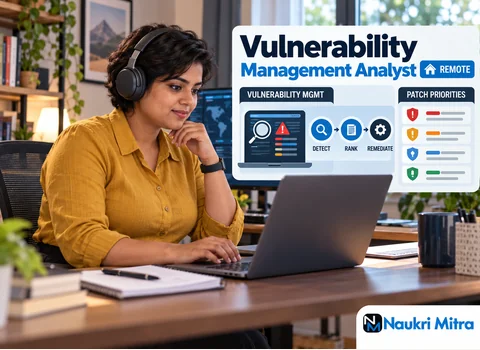
You will never patch everything, so the real work is deciding what to patch first and making sure it happens. That is the whole of this role. It is one of the
remote vulnerability management analyst jobs that runs full-time, pays $90,000 a year in US dollars, and can be done from any country, provided your connection and working hours hold up. You run the scanners, rank the findings, chase the owners, and tell leadership the truth about where things stand.
Advertisement
What the analyst owns, and what they don't
People sometimes ask what a vulnerability management analyst does all day, expecting an answer about hacking. The honest vulnerability management analyst job description is closer to operations. You own the process: scan coverage, finding accuracy, priority order, tracking, and reporting. You don't own the servers, and you usually don't apply the patches yourself. IT and engineering teams do that.
Your authority comes from evidence and agreed deadlines, not admin rights. Any former sysadmin remembers tickets that said "critical, fix now" with no context. The job is to never send one.
Scan schedules in Tenable, Qualys, and Rapid7
This listing expects hands-on time with at least one of the three big platforms: Tenable (Nessus, Tenable Vulnerability Management or Tenable Security Center), Qualys VMDR, or Rapid7 InsightVM. You should know how each handles agents versus network scans, credentialed scanning, and asset tagging.
Scheduling is less glamorous than it sounds and goes wrong in predictable ways. A sensible baseline looks something like this:
- Authenticated scans of servers on a regular cadence, timed away from backup windows and month-end batch jobs.
- Agents on laptops that rarely sit on the corporate network.
- External perimeter scans run separately, since that surface is what attackers see first.
- Discovery scans to catch hosts that nobody added to the inventory.
Unauthenticated results are thin and full of guesses. If credentialed scans are failing on a subnet, fix that before you trust any number coming out of it.
Why a CVSS score is only the first filter
CVSS tells you how bad a flaw could be in theory. It does not tell you whether anyone is using it, or whether the affected box matters. Sort only by CVSS and you will have thousands of "critical" items and no way to choose. Prioritizing CVEs well means stacking several questions on top of the base score.
- First, is it known to be exploited? The CISA Known Exploited Vulnerabilities catalog is the list most teams check here, and anything on it jumps the queue.
- Second, how likely is exploitation soon? EPSS gives a probability estimate based on observed activity. Treat it as a signal, not a verdict.
- Third, can an attacker reach it? An internet-facing VPN appliance and an isolated lab machine with the same flaw are different problems.
- Fourth, what is the asset worth? A domain controller, a payment system, or a host holding customer data outranks a test VM.
Write this logic down. When someone asks why their medium-scored finding is due before another team's critical, you should be able to point to the rule, not your memory.
Finding the person who owns the box
The hardest part of tracking patches is often finding a name. Scanners report IP addresses and hostnames. Tickets need a team and, ideally, a person. That means working with the CMDB, cloud account tags and asset inventories, and correcting them when they are wrong, which they will be.
Group findings so owners can act. One ticket per CVE per host buries a team. One ticket per fix (upgrade this package across these twenty hosts) gets done. Then confirm closure on the next scan instead of trusting the ticket status.
SLAs, exceptions and accepted risk
Remediation deadlines only work if they were agreed in advance and tied to severity and exposure. Your part is to measure them honestly and flag breaches before they become surprises.
Some things cannot be patched on time: legacy systems, vendor appliances, production freezes. That is what exceptions are for. A good exception has a compensating control, an expiry date, and a named person with authority to accept the risk. An exception with no end date is a vulnerability you decided to stop counting.
Reporting to leadership without drowning them in counts
Leadership does not need forty thousand findings on a slide. They need to know whether exposure is rising or falling, where SLAs are being missed and why, and which decisions are waiting on them. Track a handful of measures over time: mean time to remediate by severity, known-exploited items still open, scan coverage, and overdue exceptions. Explain the trend in plain language. If one team is consistently late, say so, and say what is blocking them.
The hiring bar: years, scanners, and certificates
You will want two to four years behind you in security operations or systems administration, hands-on Tenable, Qualys, or Rapid7 experience, and a working understanding of CVSS, patch management, and operating systems. Windows and Linux both come up constantly.
Core vulnerability management analyst skills, in practice:
- Reading a scanner finding and judging whether it is a real issue or a false positive.
- Knowing how patching works on Windows Server, common Linux distributions, and major third-party software.
- Spreadsheet or scripting fluency for de-duplicating and grouping results; Python or PowerShell helps.
- Writing tickets and summaries that busy engineers will read.
On vulnerability management analyst certification: CompTIA Security+ or CySA+ is commonly requested. Security+ covers the broad foundation. CySA+ is closer to this work, with more on vulnerability scanning, analysis, and response. Neither replaces having run scans on real networks.
Remote vulnerability management analyst jobs: access and setup
Like most vulnerability management analyst work-from-home jobs, this one means you will connect through a company VPN or a zero-trust access tool, usually with multi-factor authentication and a managed laptop. Scanner consoles may only be reachable from inside that tunnel. Expect a stable, reasonably fast connection, a private space for calls about unpatched systems, and the discipline not to copy scan data onto personal devices. Scan results are a map of every weakness in the network, so treat them that way.
The $90,000 annual figure is what this listing pays; vulnerability management analyst salary elsewhere depends on employer and region. Because the role is open worldwide, maintenance windows in other time zones will sometimes fall outside your normal day.
Organizations that hire for this include banks and insurers, hospitals and healthcare networks, universities, SaaS and cloud companies, managed security service providers, government contractors, and manufacturers: anywhere with regulated data and more servers than people.
Getting in from sysadmin or SOC work
Be realistic about entry-level openings. This role expects two to four years of experience, and most others do too, because you must understand how systems are built and patched before you can judge their risk. Searches for vulnerability management analyst jobs with no experience mostly turn up internships or mislabelled listings.
The usual route is help desk to systems administration or a SOC analyst role, then volunteering for patching and scanning work. Run Nessus Essentials or a community scanner in a home lab against machines you own. A vulnerability management analyst course is useful only alongside that practice. On your vulnerability management analyst resume, describe outcomes: coverage you improved, backlog you reduced, a process you wrote down.
Penetration testers ask a different question
A penetration tester asks how far an attacker can get, proves it on a few targets, writes a report, and moves on. A vulnerability management analyst asks which known weaknesses across the whole estate need fixing first, and stays until they are fixed. Testing is deep and time-boxed. Vulnerability management is broad and continuous. Patience for follow-up is the dividing line.
Next steps from the vulnerability queue
After a few patch cycles, common next steps are senior analyst, vulnerability management lead or program owner, security engineering, or a move into cloud security posture work, which applies the same thinking to misconfigurations. Others go towards risk and governance, because they already spend their week talking about accepted risk. The core skill never changes: decide what matters, find who fixes it, verify it got fixed.