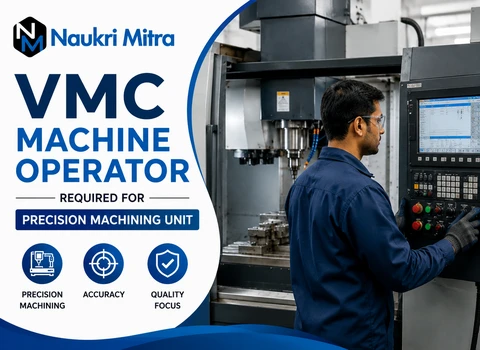
What Does a VMC Machine Operator Actually Do?
Walk into any precision machining unit, and you'll notice one thing quickly: the machines look impressive, but nothing runs well without the person standing in front of them. That's the VMC Machine Operator. VMC stands for Vertical Machining Center, a CNC-controlled machine that cuts, drills, and mills metal into shapes that match an engineering drawing almost exactly. In Rajkot, Gujarat, several manufacturing units use these machines to make components for automobile parts, pumps, valves, and general engineering products, and they need operators who can run the equipment without constant supervision. This is a full-time role based in Rajkot, Gujarat, India, paying ₹30,000 a month.
Why This Job Exists in the First Place
You might wonder why a machine that's already computer-controlled still needs a human operator. The short answer: machines don't think for themselves. They follow programs, but someone has to load the material correctly, set the right tool offsets, watch for tool wear, and catch a problem before it ruins ten pieces instead of one. A single wrong setting can waste an entire batch of raw material, and that's expensive. This is exactly why factories in Gujarat's engineering and auto-component sector hire trained operators rather than leaving machines unattended.
A Regular Day on the Shop Floor
Most shifts begin the same way — checking the machine, wiping down the work area, and going through the job card for that day. Then the actual work starts. Some days it's straightforward, running the same job repeatedly. Other days bring new components that need fresh setup, which takes more concentration.
- Fixing the job piece onto the machine table correctly
- Entering or adjusting tool offsets before the cycle starts
- Watching the cut closely, especially during the first piece
- Measuring finished parts and comparing them to the drawing
- Noting down how many pieces were made and how many got rejected
None of this sounds difficult on paper. In practice, staying alert for eight or more hours while the machine keeps cutting is where the real skill shows.
Instruments You'll Get Comfortable With
A vernier caliper and a micrometer end up in your hand more times a day than you'd expect. Height gauges come out for anything needing precise vertical measurement, and dial indicators help when alignment matters. Some units also run EDM machines alongside VMCs for jobs that need a different kind of precision cutting. None of this replaces reading the drawing first — every measurement you take is really just confirming whether the part matches what's on paper.
Getting Job-Ready: What Employers Look For
Formal education helps, but it's not the only path in. An ITI certificate in a machining trade or a Diploma in Mechanical or Tool and Die Engineering is a commonly accepted qualification, and equivalent vocational training with genuine hands-on machine time counts too. What tends to matter more on the shop floor is whether you can actually read a drawing, understand basic G-code logic, and set tool offsets without guessing. Someone who's spent real hours on EDM machines or handling precision instruments often has an edge over someone with only classroom knowledge.
The Physical Side Nobody Mentions in Job Ads
This job keeps you on your feet. Shifts can rotate depending on how busy the production line is, and the shop floor isn't quiet — there's machine noise, a hint of coolant, and metal dust in the air. It's not a desk job by any measure, and stamina matters as much as technical skill when a shift runs long.
Staying Safe Around Moving Machinery
Spindles rotate fast, and cutting tools don't forgive carelessness. Safety goggles, proper gloves, safety shoes, and ear protection in louder sections are standard PPE on most shop floors. Lock-out procedures during maintenance exist for a reason, and bypassing a machine guard — even once, even to save time — is how accidents happen. Operators who last long in this trade are usually the ones who never treat safety steps as optional.
What Trips Up New Operators
Tool breakage, dimensional mismatches, a program that doesn't behave as expected — these often show up when someone is new. The fix isn't complicated, though: inspect the first piece carefully before running the full batch, keep an eye on tool sharpness, and keep the machine bed clean so material doesn't shift mid-cut. Most experienced operators picked up these habits the hard way, after a batch went wrong early in their career.
Where This Role Can Take You
Operators who stay consistent and reliable often move on to handling more complex jobs or running multiple machine setups at once. Over time, that experience across different materials and components builds into the kind of expertise that precision units actively look for when filling senior operator positions.
Pay and What Else Might Come With It
This position offers ₹30,000 per month, full-time, based in Rajkot, Gujarat. Some employers add extras on top — overtime pay, PF, ESI, a bonus, uniforms, transport, or canteen facilities — though these depend entirely on the company and shouldn't be assumed as guaranteed.