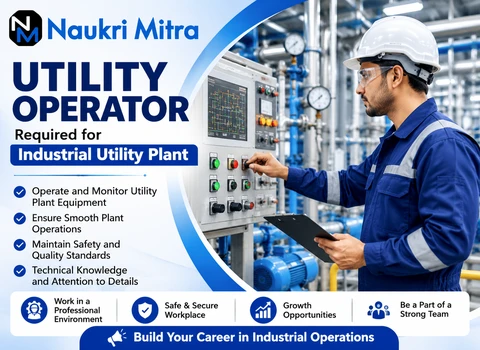
What Actually Happens Inside a Plant's Utility Section
Walk into any factory, and you'll notice most people never see the room that keeps everything else running. Boilers hissing, compressors thumping away, water lines humming under pressure — that's the utility section, and it rarely gets the attention it deserves. This job is about keeping that section alive. It's a full-time Utility Operator position in Vadodara, Gujarat, paying ₹29,500 a month, and it sits at the center of a plant's daily operations even though most visitors would walk right past it without a second glance.
Why This Job Exists in the First Place
Production lines don't run on hope. They run on steam, compressed air, treated water, and steady power — and someone has to make sure those things never stop flowing. When a boiler pressure drops or a compressor trips, it isn't just an inconvenience; it can shut down an entire shift. That's the reason chemical plants, food units, pharma companies, and general manufacturing setups all keep dedicated people watching over their utilities instead of leaving it to chance.
How a Shift Usually Unfolds
Most operators start by walking the floor before touching anything. You check the previous shift's logbook, look at pressure gauges, and listen for anything that sounds off. A compressor running slightly rougher than usual, a valve that's leaking more than it should — these are the small things that experienced operators catch before they become big problems.
From there, the day fills up with hands-on work:
- Keeping an eye on boiler pressure and water levels
- Running compressors and cooling towers, and catching irregularities early
- Checking ETP or WTP readings against set parameters
- Logging consumption figures for the next shift to reference
- Doing small maintenance jobs — greasing bearings, swapping filters, tightening loose fittings
- Flagging anything serious to the maintenance team rather than trying to force a fix
The Equipment You'll Actually Get Your Hands On
Boilers, air compressors, DG sets, chillers, cooling towers, water softening plants, effluent treatment units — this is the everyday toolkit. Reading instruments correctly matters more than people expect going in. A pressure gauge that's slightly off, a flow meter reading that doesn't match yesterday's baseline — catching these early is often the difference between a smooth shift and a costly breakdown.
What Employers Are Really Looking For
Most plants prefer candidates with an ITI background in a fitter, Electrician, or similar mechanical trade. A Diploma in Mechanical Engineering works too, depending on how technical the plant's systems are. But qualifications only get someone through the door. What actually matters on the floor is whether you can read a drawing, make sense of a basic electrical circuit, and handle precision instruments without needing someone to hold your hand through it.
A few things tend to separate a good operator from an average one:
- Spotting a mechanical or electrical fault before it escalates
- Staying calm around rotating machinery
- Reading manuals and pressure charts without getting confused
- Logging readings carefully, not just glancing and writing whatever number comes to mind
- Picking up plant-specific procedures fast instead of relying only on what was taught elsewhere
Why Vadodara, Specifically
Gujarat accounts for much of the country's chemical, pharma, and engineering manufacturing, and Vadodara sits right in the middle of that industrial belt. Nearly every manufacturing unit here depends on steam, compressed air, or treated water at some stage of production, which keeps demand for utility operators fairly consistent compared to some other technical roles.
The Physical Side of the Job
This isn't a chair-and-desk role. Expect to be on your feet, walking between equipment, climbing platforms to check readings, occasionally lifting tools or small parts. Utilities don't pause for convenience, so plants usually run this position across rotating shifts, night duty included, to keep coverage round the clock.
Working Conditions: Nobody Sneaks Around
Heat near the boilers, noise from the compressors, occasional contact with treatment chemicals — this comes with the territory. Safety protocols exist for a reason here, and plants take lockout-tagout procedures seriously before anyone touches equipment for servicing. Standing too close to a line during startup, or trying to fix a leak without shutting things down first, is exactly the kind of shortcut that gets people hurt. Operators are trained to report problems, not improvise solutions on the spot.
PPE on the floor usually includes:
- Safety shoes built for standing on hard, sometimes wet surfaces
- Ear protection near compressors and generators
- Gloves suited to hot surfaces or chemical handling
- Goggles when working near treatment chemicals
- A helmet in the zones that require one
Where New Operators Usually Struggle
Reading a gauge fast enough, or tracing an odd noise back to its actual source — these take time to get right. Long shifts near boiler heat wear people down faster than expected in the first few months. The operators who settle in quickest are usually the ones who stay close to experienced colleagues and ask questions rather than guessing.
Where This Can Lead Over Time
Utility roles aren't a dead end. Someone who sticks with it, learns the equipment inside out, and shows up reliably can move up to Senior Operator, Shift In-charge, or eventually a Utility Supervisor position. Picking up extra certifications along the way — a boiler attendant license, for instance, when the plant requires one — tends to speed up that progression considerably.
Pay and What Might Come With It
The role pays ₹29,500 per month, full-time, and is based in Vadodara, Gujarat. Beyond the base salary, some employers offer extras like overtime pay, PF and ESI coverage, an annual bonus, uniforms, or transport and canteen facilities — though none of this is guaranteed and it varies by employer, so it's worth confirming directly during the hiring conversation rather than assuming.
A Few Honest Tips Before You Apply
If you're serious about this line of work, get familiar with basic utility equipment before your first day — through ITI coursework, plant visits, or even just watching videos of boiler and compressor operations. Shift work takes some adjusting to, so go in expecting that. And take safety seriously from day one; the operators who last in this field are the ones who never treat protocol as optional, even when things get busy.