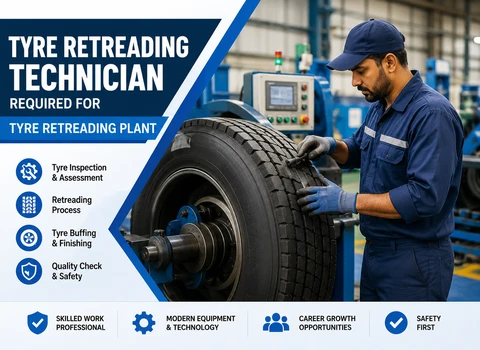
Understanding the Role of a Tire Retreading Technician
A Tire Retreading Technician Required for a Tire Retreading Plant is a skilled worker who gives old, worn-out tires a second life by rebuilding their tread layer rather than sending them straight to scrap. This process, known as retreading, is widely used across India's transport, logistics, and commercial vehicle industries because it reduces costs and extends the usable life of heavy tires on trucks, buses, and industrial vehicles. This full-time opening is based in Ludhiana, Punjab, India, and offers a monthly salary of ₹26000.
Why Retreading Plants Continue Hiring Skilled Hands
Retreading is far cheaper than buying new tires, which is why transport companies, fleet owners, and tire service centers regularly send worn tires to retreading plants. Because the process involves multiple technical stages, plants need trained operators who can inspect, buff, repair, and rebuild tires correctly. A poorly retreaded tire can fail on the road, so plants prefer workers who understand both the machinery and the safety standards involved.
A Look at the Daily Work Routine
The daily schedule of a machine operator in this trade usually follows a set sequence. Tyres arrive at the plant, get inspected for damage, and are then processed through several machines before being ready for dispatch. A typical day may include:
- Inspecting incoming tires for punctures, cracks, or internal damage
- Operating buffing machines to remove the old worn tread
- Applying rubber cushion gum and new tread material
- Loading tires into curing chambers for heat treatment
- Checking finished tires for balance and surface quality
Core Responsibilities on the Production Floor
As a production worker in a retreading unit, the main duty is to ensure every tire passes through each stage without shortcuts. This includes spotting hidden damage using inspection lights, marking repair areas, skiving damaged rubber sections, and applying rubber compounds evenly. Technicians are also expected to maintain machines, keep work logs, and report any faulty equipment to supervisors before it causes a bigger issue.
Industries and Work Locations for This Profession
Tire retreading technicians typically work in dedicated retreading plants, tire service workshops, and units attached to transport companies or fleet operators. Since Punjab has a strong presence of transport, logistics, and agricultural machinery businesses, retreading plants in this region often handle tires from trucks, tractors, and commercial vehicles. Some technicians also find opportunities with industrial equipment suppliers that maintain their own tire servicing sections.
Machines, Tools, and Instruments Used on the Job
This role involves working closely with specialized retreading equipment. Common machines and tools include:
- Buffing machines for removing old tread rubber
- Skiving tools for cutting out damaged rubber sections
- Cushion gum applicators and tread builders
- Curing chambers or autoclaves for heat-setting the new tread
- Tread depth gauges and pressure gauges for quality checks
- Inspection lamps for spotting internal tire damage
Understanding how a curing chamber bonds rubber under heat and pressure, or why buffing must be done evenly, helps technicians avoid weak spots that could cause tread separation later.
Technical and Practical Skills That Matter
Employers generally look for candidates who combine mechanical understanding with hands-on precision. Useful skills include reading tread wear patterns, judging correct buffing depth, handling rubber compounds, and operating pressure-based curing equipment safely. Basic knowledge of tire construction, such as the difference between radial and bias-ply tires, is often an advantage.
Employers may prefer candidates with relevant technical or vocational training. Depending on the complexity of the work, an ITI qualification in a mechanical or related trade, a Diploma in Mechanical Engineering, or equivalent hands-on training may be considered suitable. Practical exposure to industrial machinery, engineering drawings, and precision measuring instruments is often valued as much as formal certificates, since much of the learning happens on the shop floor itself.
Physical Demands and Shift Patterns
This is physically active work. Technicians spend long hours standing, lifting heavy tires, and operating machinery that requires steady hands and good stamina. Since this is a full-time position, workers should be prepared for structured shift timings, and some plants may require rotational shifts depending on production demand. Good physical fitness and the ability to work around moving machinery safely are important for this trade.
Working Environment Inside a Retreading Unit
The work environment inside a plant is industrial in nature, with exposure to rubber odor, machine noise, and heat from curing chambers. Ventilation and lighting are usually maintained to reduce health risks, but workers are still expected to follow strict safety routines given the presence of heavy equipment and heated surfaces.
Safety Practices and Protective Equipment
Because this job involves heavy machines, rotating parts, and heat-based processes, safety is taken seriously. Technicians are usually required to use personal protective equipment such as:
- Safety gloves for handling rubber and hot surfaces
- Safety goggles to protect eyes from rubber dust
- Steel-toe safety shoes for foot protection
- Ear protection near noisy buffing machines
- Aprons or protective clothing during compound application
Following lockout procedures before machine maintenance and keeping the work area free of loose rubber scraps are simple habits that prevent most workplace accidents in this trade.
Challenges Faced and Tips to Handle Them
New technicians often find it challenging to judge the correct buffing depth or spot hidden tire damage in the early days. Consistent practice under supervision, careful observation of tread wear patterns, and asking experienced coworkers for guidance can speed up learning. Maintaining patience during quality checks is equally important, since a rushed inspection can allow a defective tire to pass.
Growth Opportunities Within the Trade
With experience, a plant operator in this field can move into roles such as senior technician, shift supervisor, or quality inspector within the same retreading unit. Skilled workers who understand machine maintenance well may also transition into equipment maintenance roles inside the same industry, strengthening their long-term career stability.
Salary and Common Workplace Benefits
For this position in Ludhiana, Punjab, India, the offered monthly salary is ₹26000, provided on a full-time basis. Depending on the employer, additional benefits may include overtime pay, Provident Fund (PF), Employee State Insurance (ESI), festival bonuses, uniforms, and possibly transport or canteen facilities. These benefits vary by employer and should be confirmed directly with the hiring plant.