
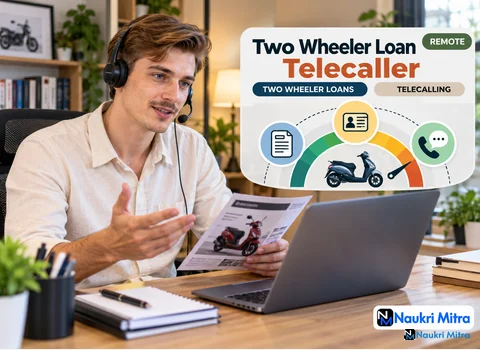
First-time scooter buyers usually want two answers: how much goes upfront, and how much leaves their account every month. Many have saved a little from a part-time job and sound slightly nervous asking. In remote two wheeler loan telecaller jobs, your work is to answer it honestly. You do not say "your loan is approved, don't worry." You say something closer to: "Let me show you how the numbers work, and then the lender will check your details and decide." That small difference, explaining clearly without promising, is the heart of this full-time role.
A lead may already have seen a bike or scooter, filled in an enquiry and noted the on-road price. What they do not understand is how a loan splits that price into pieces. So you explain it the way an older cousin would: some money goes now, the rest is borrowed, and the borrowed part comes back in equal monthly instalments, with interest as the cost of borrowing.
The two wheeler loan telecaller job description is simple to read. You phone loan leads and explain down payment, interest rates and EMI options. You check basic eligibility and documents, coordinate with dealers for bike delivery, and update each application's status in the CRM. You sit in the middle, so accuracy matters more than speed.
Explaining down payment and EMI for bike loans on calls starts with one plain idea. The down payment is the part of the vehicle price the buyer pays from their own pocket on day one. The loan covers the remaining amount. A bigger down payment means a smaller loan, and a smaller loan usually means a lighter monthly EMI or a shorter repayment period.
Buyers often ask, "What is the minimum I can pay?" The right answer is that the lender sets this, based on its own policy and the buyer's profile. You can tell them what the scheme in front of you shows, but never make up a figure to close the call. If you are not sure, say you will check and call back. People remember the caller who told them the truth.
Tenure is the number of months the buyer takes to repay. Here is how you can put it: a longer tenure spreads the loan thinner, so each EMI is smaller, but the buyer pays interest for more months, so the total paid over the loan goes up. A shorter tenure means a bigger EMI but less interest overall.
This is where the EMI calculator earns its place. You enter three things: the loan amount, the interest rate the lender has quoted, and the tenure. The calculator gives the monthly instalment. Then you can change the tenure while the buyer listens and show how the EMI moves. Good two wheeler loan telecaller skills include doing this calmly, reading the result aloud slowly, and reminding the buyer that the final rate and amount come from the lender's sanction, not from the call.
Choosing the EMI is the buyer's decision, not yours. Telling a young earner "go for the smaller EMI, stretch it out" without explaining the extra interest is not kind. Showing both sides and letting them decide is.
You ask about documents in general terms: proof of identity, proof of address, some proof of income or bank history, and whatever else the lender's checklist names. Follow the list you are given, and collect details only through channels your employer approves.
Your eligibility check on the call is basic and follows the checklist you are given, which may cover points such as age, income source, location and papers. The real decision comes from the lender's credit process, which may look at income, existing loans and credit history. So the honest line is: "From what you have told me, you can apply. The lender will verify and confirm." Never say "approved" or "sure shot."
EMI calculator and CRM skills for two wheeler loan telecalling go together. Your leads arrive as a list inside the CRM or a dialer linked to it. After each call, you log the outcome: interested, documents pending, sent to the lender, waiting on the dealer, delivered, or not interested. Short, clear notes save everyone time.
For lead lists and dialer setup on remote calls, your employer will tell you which software to use and give you a login. Your job is to keep it updated the same day, not the next morning. When the dealer rings to ask whether a buyer's file has moved, the answer should already be sitting in the CRM.
This listing asks for clear Hindi and English, or a regional language. A scooter buyer in a small town may follow the whole idea of tenure much better in Marathi, Tamil, Bengali or Telugu than in English. If you can explain money matters smoothly in a regional language, mention it on your two wheeler loan telecaller resume. It is a real strength for this work rather than a line to fill space.
The qualification needed for a two wheeler loan telecaller job here is at least a 12th pass. Freshers are welcome. Loan or vehicle sales calling experience helps, and anyone searching for two wheeler loan telecaller jobs no experience can apply here, provided they can learn the basics: down payment, tenure, EMI calculator use and CRM entries.
As for how to become a two wheeler loan telecaller, practice comes first. Open any free EMI calculator, plug in made-up amounts, and explain the result out loud to a friend as if they were the buyer. Neither a two wheeler loan telecaller course nor a two wheeler loan telecaller certification is required here, though a short one in sales or basic finance may build confidence. For two wheeler loan telecaller interview questions, expect to be asked to explain EMI simply and to show how you would handle a buyer who wants a promise of approval.
Employers for this work are usually NBFCs that finance vehicles, banks with vehicle loan teams, dealer showrooms with in-house finance desks, and outsourced calling teams working for them. This listing does not name a specific employer, so read each offer carefully and check who is actually hiring you.
People sometimes compare the two wheeler loan telecaller role with car loan telecalling. The steps are similar, but bike loans are smaller and the buyers can be younger first-time borrowers, so you explain basics more often. Car loan calls generally involve larger amounts and more paperwork. Career growth in vehicle loan telesales can move from calling into team lead, dealer coordination, credit support or field sales roles, depending on your performance and the employer's structure.
For two wheeler loan telecaller work from home jobs, you need a headset and stable internet, as this listing says. A laptop or desktop that runs the CRM, and a quiet corner where traffic and pressure cookers stay in the background, make the calls far easier. Since the country is listed as Worldwide, people outside India who meet the language needs can also apply for two wheeler loan telecaller jobs remote worldwide.
On money: the two wheeler loan telecaller salary per month for this full-time role is $300 per month (USD), and that is the only pay figure this listing states.
When you look for remote two wheeler loan telecaller jobs hiring now, you will meet a few fake offers. The common ones ask you to send money over UPI for an "ID card", a "joining kit", a "CRM licence" or a "loan agent code." A genuine lender or dealer does not charge a telecaller anything to start work. If someone asks, stop the chat, keep the screenshots, and do not share your own Aadhaar or bank details with them.