
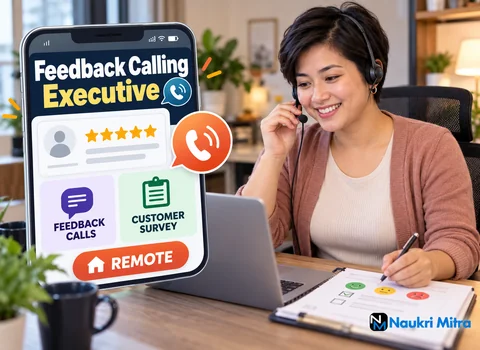
On my third day as a feedback caller, I rang a retired schoolteacher in Coimbatore to ask one question about her scooter service: how likely was she, on a scale of zero to ten, to recommend the workshop? She gave me a nine within five seconds. Then she spent eleven minutes telling me about her late husband's first ride on it, and why the washing bay had left water in the seat compartment. I typed every word. That is the work behind these remote feedback calling executive jobs hiring now: full-time, open to applicants worldwide, paying $300 per month (USD), and built on listening more than talking.
A feedback calling executive phones customers who have recently bought something or used a service, and asks how it went. If you read a feedback calling executive job description closely, it comes down to four duties: calling recent customers to collect ratings, NPS scores and comments, recording them accurately in Google Forms or the CRM, flagging unhappy customers for service recovery, and reporting your daily feedback counts to the supervisor.
The schoolteacher taught me that the reason matters more than the score. A nine with a complaint about a wet seat is a nine the workshop can lose.
Most calls follow a survey script. You introduce yourself, confirm you are speaking to the right person, mention the purchase or visit, and ask for permission to take two minutes. Then come the questions: a rating out of five for specific parts of the experience, and the Net Promoter Score question, which asks how likely the customer is to recommend the business on a zero to ten scale. Scores of nine or ten are usually counted as promoters, seven and eight as passives, and zero to six as detractors, though each client may define its own bands.
The last question is open: "Is there anything you would like us to improve?" This is where you slow down. Silence often means the customer is deciding whether to be honest, so I learnt to wait three beats.
The case below is made up, though I run it with every new batch.
You call Mr Rakesh, who had his car serviced at a dealership in Pune four days ago. He agrees to talk. He rates the service advisor 5, the waiting area 4, and the final bill 2. His NPS answer is 6. When you ask why, he says the estimate was lower than the invoice and nobody explained the extra charge for brake pads.
That last point matters. You record and escalate. You do not settle disputes.
My shifts ran around eight hours with breaks. I would log in, check the day's list in the CRM and read any script updates. Calls went in blocks with short gaps for notes. Numbers that did not pick up went to a retry slot later. At the end of the shift I sent my daily count: calls dialled, surveys completed, and customers flagged. A rhythm like that is common in feedback calling executive work from home jobs, though each campaign sets its own targets.
Candidates who have passed 12th can apply, and no prior experience is needed. If you have been searching for feedback calling executive jobs with no experience required, this one fits. The core feedback calling executive skills are:
Customer names, numbers and purchase details are private. Do not copy them into notebooks, take screenshots or discuss them at home, and lock the screen each time you get up.
For this listing the feedback calling executive salary is $300 per month (USD), for full-time remote work. Any incentives depend on the employer and the campaign, and none are promised here. If you search for the feedback calling executive salary per month in other listings, you will see it varies by language, shift and client, so always read the offer letter.
Feedback callers are hired across many sectors. Hospitals and diagnostic labs ask patients about discharge or test experiences. Car and two-wheeler dealerships check on sales and service visits. E-commerce brands call buyers after delivery or a return. Many openings for feedback calling executive jobs remote worldwide come through BPO partners.
A survey calling executive usually reaches a wider sample, sometimes people who were never customers, for market or opinion research with longer questionnaires. A feedback caller speaks only to existing customers about a recent experience, and the goal is to fix problems for that business.
Is it less stressful than sales calling? For most people I trained, yes. Nobody expects you to close a deal, and customers relax when you ask for their view. The stress is of a different kind: angry detractors and a daily count to meet. It is calmer, not effortless.
Wondering how to become a feedback calling executive with no background? Start with your voice. Most screenings include a short call or voice test, a typing check, and a mock survey where the recruiter plays a difficult customer.
Common feedback calling executive interview questions I have heard: How would you handle a customer who refuses to give a score? What would you do if someone starts shouting about a refund? Can you read this script aloud? Practise by recording yourself reading a script in both languages and listening for filler words.
Neither a feedback calling executive course nor a feedback calling executive certification is required here. A short customer service course can help, but a clean, honest one-page resume usually does more. On your feedback calling executive resume, list your languages and how well you speak each, typing speed, any customer-facing work (shop counter, tuition, event volunteering), and your home setup.
I moved from caller to quality reviewer, listening to recorded calls and scoring them, and then to training new joiners. Others I worked with became team leaders, customer experience analysts who study detractor trends, or service recovery executives. Listening and calm complaint handling carry into most support roles.
Real employers do not charge you to work. Treat an offer as fake if it:
Report such messages to the cybercrime authority in your country.
Applying is free. Send your resume with your languages, typing speed, and a line about your headset and internet setup. If you are shortlisted, expect a voice test and a short mock call. The schoolteacher in Coimbatore would tell you the same thing she told me: people will talk if you let them, so learn to listen and write it all down.