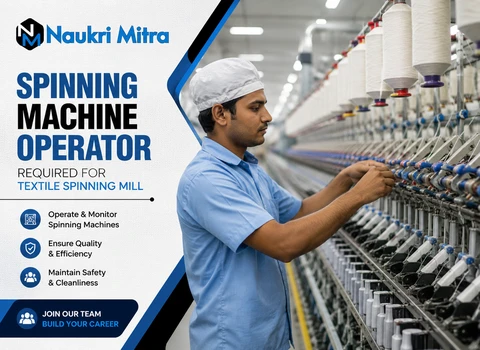
What a Spinning Machine Operator Actually Does
Walk onto the floor of a spinning mill in Coimbatore, and the first thing you notice is the sound — hundreds of spindles turning at once, a constant hum broken only by the occasional snap of a yarn end. That's the world a Spinning Machine Operator works in. The job, based in Coimbatore, Tamil Nadu, India, and offered on a Full-time basis, centers on operating machines that convert raw fiber into finished yarn, monitoring for breaks, and keeping production running without interruption.
Tamil Nadu's textile belt, especially around Coimbatore, has built its reputation on this exact kind of work. Mills here have been spinning cotton and blended yarns for decades, and the demand for reliable operators hasn't slowed down much.
Why This Job Exists in the First Place
Yarn quality isn't something a machine guarantees on its own. A spinning frame left unattended for even a short stretch can produce weak, uneven, or broken yarn, and that ripples through everything downstream — weaving, knitting, garment stitching. So mills keep operators on the floor specifically to catch problems early: a snapped end, a jammed bobbin, a machine running slightly off its normal rhythm. Catching these things quickly is really the whole job in a nutshell.
A Shift, Start to Finish
Most shifts begin with a quick walk-through — checking that assigned frames are running clean, spindles are turning properly, nothing looks obviously wrong. From there it's a cycle: patrol the machines, piece together any broken ends by hand, pull off full bobbins and load empty ones, note down production numbers. It sounds repetitive on paper, and honestly, a lot of it is. But the pace picks up fast, and operators who've been at it a while develop a kind of muscle memory for spotting trouble before it becomes a real problem.
Some of the day-to-day tasks include:
- Starting and monitoring ring frames or open-end (rotor) spinning machines
- Piecing broken yarn ends by hand, quickly and cleanly
- Doffing full bobbins and replacing them on schedule
- Spotting visible yarn defects and flagging them
- Wiping down machines and clearing lint or waste from the work area
- Following the mill's set procedure for each machine type
The Kind of Places That Hire for This Role
You'll find this work mainly in textile spinning mills and yarn manufacturing units — some standalone, some part of larger composite textile plants that handle spinning through to fabric production under one roof. Coimbatore's cluster of mills makes it a fairly practical base for anyone looking to build a long-term career in spinning without relocating often.
Machines and Instruments on the Floor
Ring frames are the most common machine you'll operate, though some mills run open-end or rotor spinning setups instead — the basic goal is the same, but the mechanics differ slightly. Alongside the frames themselves, operators handle doffing trolleys and bobbin carriers daily. Anyone moving into quality-related tasks might also work with yarn count testers, twist testers, or lea strength testers — instruments used to check whether the yarn meets the required specifications.
What Separates a Good Operator from an Average One
Fast hands help. Piecing a broken yarn end takes speed and a light touch — too rough and you create another break further down. Beyond that, a basic mechanical sense goes a long way: knowing the difference between something you can fix on the spot and something that needs a technician's attention saves everyone time. Attention span matters too. The work is repetitive by nature, and staying sharp through an eight-hour shift, hour after hour, is its own kind of skill.
Getting In: What Employers Look For
This is a good entry point for freshers, ITI candidates, and diploma holders, particularly those with a background in textile technology or a general mechanical trade. That said, formal education isn't the only path in. Mills often care just as much about hands-on exposure — someone who's spent time on an actual spinning floor, even briefly, tends to pick up the rhythm of the job faster than someone coming in with only classroom knowledge.
On Your Feet, On the Clock
Expect to be standing and moving for most of the shift — walking between frames, bending to check bobbins, reaching to piece a break. It's physical work, not heavy lifting exactly, but constant motion. Mills typically run rotating shifts to keep production going around the clock, so operators should be ready for schedules that don't always fall during regular daytime hours.
The floor itself is noisy, and airborne fiber dust is part of the environment — most mills work to keep ventilation and cleanliness up to standard, but it's still something to be aware of going in.
Staying Safe Around the Machines
PPE on a spinning floor usually includes a dust mask, ear protection given the noise levels, and proper footwear. Loose clothing and untied hair are genuine hazards around moving parts, so tying things back isn't optional; it's basic safety. During maintenance work, lockout procedures matter — machines should never be worked on while running. None of this is complicated, but it has to become habit fast.
What Trips Up New Operators
Speed is usually the first hurdle. Piecing yarn ends quickly takes practice, and it's normal to feel slow during the first few weeks. Fatigue is the second — long shifts with repetitive motion wear on you differently than physically demanding but varied work does. The operators who settle in well tend to be the ones who pace themselves, take breaks when they're allowed, and flag machine issues right away instead of trying to push through them alone.
Moving Up Within the Department
There's a real path forward here for someone who sticks with it. Operators who show up consistently and understand their machines well can move into senior operator roles, take on shift supervision, or shift toward quality-checking work within the spinning section. It's not a fast climb, but mills tend to promote from within rather than bring in outsiders for these positions.
Pay and What Else Might Come With It
The salary for this role is ₹27,500 per month. Beyond that base pay, some mills offer extras — overtime pay, PF and ESI coverage, bonuses, uniforms, transport, or canteen access — though what's actually provided varies from one employer to another and shouldn't be assumed before joining.