What Happens Inside a Rolling Mill
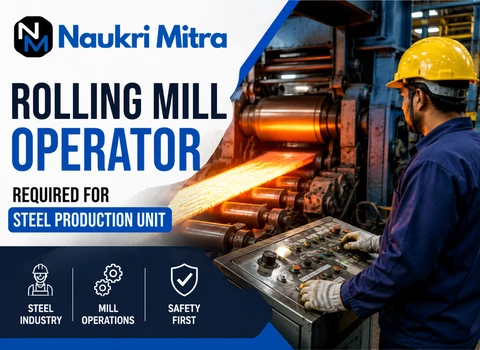
Steel doesn't come out of a furnace ready to use. It comes out glowing, shapeless, and far too thick for anything practical. Getting it into a usable rod, bar, or sheet means pushing it through a series of heavy rollers, again and again, until the dimensions match the customer's order. The person running that process is the rolling mill operator. A steel production unit in Rourkela, Odisha, is currently hiring for this position on a full-time basis, at a monthly salary of ₹40,800.
Why This Job Exists in the First Place
Rolling stands don't run themselves. A roll gap set half a millimeter off can result in steel being rejected at quality checks, or worse, damage the machine itself. That's the real reason plants keep experienced operators on the floor round the clock — someone has to notice when the sound changes, when a strip starts feeding unevenly, or when temperature drifts outside the safe range. Get it wrong, and you lose an entire batch. Get it right for a few years, and you become the person new hires are told to watch and learn from.
A Shift, Start to Finish
Before any steel touches the rollers, there's a walk-around. Check the motors. Check the cooling lines. Check that nothing was left loose from the previous shift. Once the mill starts up, the job becomes a back-and-forth between the control panel and the physical line — watching gauges, listening for anything off, and adjusting roll gaps as the material moves through each stand. Toward the end of the shift, there's paperwork: production counts, any defects spotted, and anything the next crew needs to know.
The Equipment You'll Actually Touch
A rolling mill isn't one machine — it's a chain of them. Roughing stands do the first heavy reduction, finishing stands bring the steel down to final size, and shears and coilers handle it once it's rolled. Operators also work with hand tools that don't get much attention in job ads but matter a lot day-to-day: calipers and micrometers for checking dimensions, and pyrometers for measuring surface temperature before steel enters the rolls. Feed it in too cold, and it cracks. Too hot and the steel comes out soft and out of spec.
Where You'd Actually Work
This kind of role is mostly found in integrated steel plants and re-rolling mills. Rourkela has a long history as a steel town, so there's consistent demand here for operators and the technicians who support them — it's one of the reasons Odisha remains a steady hiring ground for this trade.
What Employers Actually Check For
Nobody expects a new operator to know everything on day one, but a few things matter more than others when hiring:
- Some grounding in how steel reacts to heat — enough to understand why temperature control isn't optional
- No fear of hydraulic or electrical control panels
- Steady hands with a caliper or micrometer
- The instinct to notice when something sounds wrong, before a gauge confirms it
Working well with a crew matters too. Rolling isn't a solo job — helpers, crane operators, and quality inspectors are all moving along the same line, and a good operator keeps that coordination running smoothly.
What's on Your Certificate Helps, But Isn't Everything
Most plants prefer an ITI certificate in a mechanical or electrical trade, or a Diploma in Mechanical Engineering. That said, plenty of operators get hired on the strength of hands-on experience alone — someone who's spent time around furnaces or heavy rolling equipment, even informally, often knows more than a fresh diploma holder standing at a control panel for the first time.
What the Work Does to Your Body
Be honest with yourself about this part. You're on your feet for long stretches, close to equipment that runs hot, in a mill that's loud enough that ear protection isn't optional. Shift rotation is standard in this line of work, since most rolling mills don't stop running just because it's midnight. Some operators adjust to it quickly; others take months to get their sleep schedule sorted.
Staying Safe Around Moving Steel
Steel moving through a rolling stand doesn't slow down for anyone. Lockout procedures before maintenance aren't a formality — they're the difference between a routine repair and a serious injury. Standard protective gear on the floor includes:
- Heat-resistant gloves and aprons
- Safety goggles or a face shield
- Steel-toe boots
- Ear protection near the stands
- A helmet wherever overhead cranes are running
Where New Operators Usually Struggle
Timing is the hard part to learn. Knowing exactly when to adjust a roll gap — not a second too early, not too late — takes real hours on the floor, not a manual. Long shifts wear people down too, and a sudden change in the production schedule can throw off even someone who's been doing this for years. Most operators say the first six months are the roughest, and it gets noticeably easier after that.
A Few Things That Actually Help
Slow down before you speed up. Watch a senior operator for longer than feels necessary before you start making your own calls on roll adjustments. Keep a small notebook — recurring problems and what fixed them last time save you from repeating mistakes. And always double-check a gauge reading before making a major adjustment; the ten seconds it costs you is nothing compared to what a bad batch costs the plant.
Where This Job Can Lead
Operators who stick with it and perform reliably often move up to senior operator roles, or into shift-in-charge positions overseeing an entire crew. Some specialize further, taking charge of a specific section, such as the finishing stand or the coiler unit. A number of experienced operators eventually move into production supervision within the same plant — training new recruits and managing daily output targets.
Pay and What Comes With It
This position is full-time, based in Rourkela, Odisha, India, and pays ₹40,800 a month. Depending on the employer, there may also be overtime pay, PF and ESI coverage, bonuses, uniforms, or transport and canteen facilities — none of these are guaranteed, and they vary from one plant to another.
If you're weighing up whether this is worth pursuing long-term: steel manufacturing isn't going anywhere in a place like Rourkela, and operators who put in the time on the floor tend to find their skills stay in demand for years.