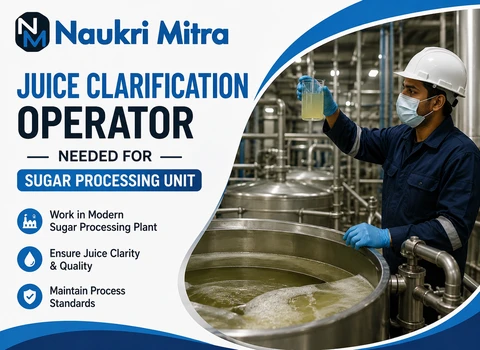
What a Juice Clarification Operator Actually Does in a Sugar Mill
Walk into any working sugar mill during the crushing season, and you'll notice the noise first, then the heat, then the smell of boiling cane juice. Somewhere in the middle of that process sits juice clarification, the stage where raw, muddy cane juice gets treated and cleaned up before it moves ahead to boiling and crystallization. The person handling this stage is called a Juice Clarification Operator, and that's the position currently open at a sugar processing unit in Nizamabad, Telangana. It's a full-time role, and the job itself is far more technical than the name might suggest to someone outside the industry.
Why This Position Matters to a Sugar Mill
Freshly extracted cane juice is not clean. It carries suspended solids, waxes, coloring compounds, and other organic material that has to be removed before the sugar underneath can be crystallized properly. Skip this step, or get it wrong, and the final sugar comes out darker, less pure, and harder to store. That's the reason mills don't leave clarification to guesswork. They want someone on the floor who can read pH values correctly, dose lime and sulfur dioxide without overdoing it, and catch a problem in the juice before it travels further down the line and ruins an entire batch.
How the Shift Actually Runs
Most days start with a check of the clarifier tanks, the juice heaters, and the flow meters. From there, the operator begins dosing chemicals in measured amounts, adjusting the dosing based on how the juice is behaving that day, since cane quality varies from batch to batch. pH readings get taken repeatedly through the shift. So does temperature. A sample might be pulled every hour, sometimes more often if something looks off. When the mud settling tank starts separating cleanly and the juice on top runs clear, that's usually a sign the process is on track.
What the Job Involves Day to Day
- Running and watching over clarifiers, juice heaters, and mud settling equipment
- Measuring out lime, sulfur dioxide, and other clarifying chemicals accurately
- Checking juice pH, clarity, and temperature at set intervals
- Logging readings and flagging anything unusual to the shift supervisor
- Working alongside the boiling house team to keep juice transfer smooth
- Doing basic housekeeping and small maintenance jobs around the clarification section
The Kind of Facility Where This Work Happens
This job is based inside a sugar processing unit, not an office or a workshop in the usual sense. These units crush sugarcane, extract the juice, clarify it, boil it down, and turn it into crystallized sugar, often running continuously once the crushing season starts. An operator here works as part of a larger production team, alongside cane extraction staff, boiling house technicians, and quality checkers, all of whom move the same batch of juice forward one stage at a time.
Equipment You'll Be Working With
Expect to spend time around clarifiers, sulphitation towers, lime slaking tanks, juice heaters, and mud settling tanks. For measurement, pH meters, Brix hydrometers, and thermometers come up constantly, since almost every decision in this job depends on a reading rather than a guess. Some units still use older, manually operated valves; others have semi-automated control panels to regulate flow and dosing. Either way, comfort with reading gauges and interpreting numbers quickly matters more than any single machine.
Skills That Actually Help on This Job
A working knowledge of basic chemistry goes a long way here, particularly around pH and how chemical dosing affects it. Precision matters too. Add too much lime or too little sulfur dioxide, and the juice quality drifts off target fast. On the qualification side, employers tend to prefer candidates with an ITI certificate in a relevant trade, or a diploma in chemical, mechanical, or sugar technology. That said, plenty of experienced operators without formal diplomas do this work well because much of it comes down to time spent on the floor and getting a feel for how the juice behaves.
Skills That Come From Experience, Not a Classroom
- Staying steady in a hot, humid processing environment for a full shift
- Spotting and correcting flow or dosing problems before they escalate
- Coordinating smoothly with extraction and boiling house staff
- Sticking to standard procedures even when the shift gets hectic
Physical Side of the Job
This isn't a desk job. Operators are on their feet most of the shift, moving between tanks, valves, and control points. Sugar mills usually run rotational shifts, and during peak crushing season, that includes night duty. Expect heat from the juice heaters, steam in the air, and occasional chemical smell from the lime and sulfur dioxide used in dosing. It's not an unmanageable environment, but it's not a cool, quiet one either.
Safety on the Clarification Floor
Because chemicals and hot juice are both part of daily work, safety gets taken seriously. PPE typically includes gloves, safety goggles, an apron, and closed safety shoes. Good ventilation checks, careful handling of lime and sulfur dioxide, and awareness around hot surfaces are all part of the routine. During maintenance, lockout procedures are followed, and any leak or spill gets reported immediately rather than left for later.
Where New Operators Tend to Struggle
Getting the dosing right when juice flow rates are changing quickly is probably the toughest part for someone new to this. It's as much a judgment call as a technical one, and it takes a few seasons to build real confidence. Long shifts during peak crushing season add to the pressure. Handling chemicals safely while still keeping pace with production is another thing that gets easier with time, but is genuinely difficult in the first few months.
Where This Role Can Lead
Operators who consistently handle this work well often move up to senior clarification technician positions, and from there to shift-in-charge or process supervisor roles within the clarification or boiling house sections. Some operators also branch into other stages of sugar processing over time, like evaporation or crystallization, picking up broader plant knowledge as they go. Growth here tends to come from experience and reliability more than from formal promotions on a fixed timeline.
Pay and What Else Might Come With It
This position pays ₹33,400 per month, for a full-time role at a sugar processing unit in Nizamabad, Telangana, India. Beyond the base salary, some employers offer overtime pay, PF, ESI coverage, bonuses, uniforms, and transport or canteen facilities, though these depend entirely on the individual employer's policy and shouldn't be assumed as guaranteed.