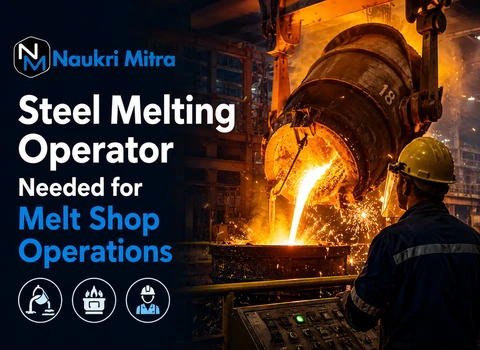
What Goes On Inside a Melt Shop
Every steel product starts somewhere, and for a lot of the steel made in India, that starting point is a melt shop. A Steel Melting Operator is the person standing at the furnace controls, turning scrap metal and sponge iron into liquid steel that eventually becomes rods, sheets, or beams. It's physically demanding work, done in close proximity to intense heat, and it forms the backbone of production at any integrated steel plant.
Durgapur, in West Bengal, has had a steel and heavy engineering identity for decades, so roles like this one keep coming up in the local job market. This opening is for a Full-time position paying ₹40,200 per month.
Why This Role Exists in the First Place
Furnaces don't run themselves, even the automated ones. Someone has to decide when to charge more scrap, when to add lime or other additives, and when the temperature readings mean something has gone wrong. Get the charge mix wrong, or miss a temperature spike, and you can lose an entire heat of steel. That's a costly mistake, which is exactly why plants invest in training operators rather than treating the job as unskilled labor.
An Electric Arc Furnace (EAF) or an induction furnace melts raw material in cycles known as heats. One shift might involve managing three or four heats back-to-back, each requiring its own attention to charging, power input, and sampling.
A Shift on the Floor
Ask anyone who's worked a furnace shift, and they'll tell you the pace changes constantly. Scrap quality varies from batch to batch, so an operator can't just follow a script.
- Furnace and safety system checks before the heat starts
- Charging scrap, sponge iron, and additives in the right sequence
- Watching temperature gauges and power draw throughout the melt
- Pulling metal samples and sending them for lab testing
- Signaling the crane operator when the ladle needs moving
- Logging heat data and flagging anything unusual to the supervisor
Because furnaces lose efficiency if they're allowed to cool, melt shops typically run round the clock. Shift rotation comes with the territory in this line of work.
The Instruments and Machinery You'll Work Around
Furnace control panels are only part of the picture. An operator also relies on pyrometers and thermocouples to check temperature, oxygen lances for refining, and testing molds for the samples pulled mid-heat. Crane coordination is another piece of it, since ladles carrying molten metal need to move safely between the furnace and the casting area.
None of this equipment forgives carelessness. An incorrect temperature reading, ignored or misread, can mean steel that doesn't meet spec, and that's an expensive problem to trace after the fact.
What Employers Actually Look For
Technical grounding matters here, but so does judgment under pressure. When a furnace trips or power fluctuates mid-heat, there isn't time to look up a manual. The operators who last in this field are usually the ones who stay calm, communicate clearly with the rest of the shift, and know when to escalate a problem instead of guessing.
On the qualification side, an ITI in the Electrician or Fitter trade is commonly preferred, and a Diploma in Metallurgy or Mechanical Engineering is well regarded as well. Freshers with solid theory behind them get considered, as do diploma holders trying to break into core steel manufacturing. Experienced hands who already understand heat management in practice tend to have an edge, naturally, but this role isn't closed off to newcomers.
The Physical Side of the Job
You're on your feet for long stretches, moving around the furnace bay, occasionally lifting sampling tools or minor equipment. Heat radiation, noise, and the odd spark are part of daily life near a working furnace. Stamina and heat tolerance aren't optional extras here — they're baseline requirements for anyone considering this work.
Safety Isn't a Checkbox — It's How You Stay Employed
Heat-resistant suits, face shields, safety goggles, gloves, and steel-toe boots are standard PPE in this environment, and wearing them properly is non-negotiable. Lockout-tagout procedures during maintenance windows, keeping clear of splash zones near molten metal, and reporting faulty equipment the moment it's noticed — these aren't formalities; they're what keeps people alive on a melt shop floor.
Where the First Few Months Get Difficult
New operators often struggle at first to read furnace readiness from sight and instrument cues — it's a skill that takes repetition to build. Physically adjusting to rotating shifts can also take longer than expected. And when a furnace trips unexpectedly or power drops mid-heat, staying composed instead of panicking is something most people only learn by living through it once or twice.
How This Job Can Grow Over Time
Operators who consistently understand the metallurgical side of the process, not just the mechanical side, tend to get noticed for senior operator or shift-in-charge positions eventually. Gaining familiarity with different furnace types, along with quality control procedures, can also lead to specialized production or quality assurance work within the same plant over the years.
Pay and What Might Come Alongside It
The role pays ₹40,200 per month. Depending on the employer's policy, operators may also receive benefits such as overtime pay, PF, ESI coverage, an annual bonus, uniforms, or transport and canteen facilities — though none of these should be assumed guaranteed, since practices vary from plant to plant.
Deciding If This Work Suits You
If working near high heat doesn't bother you, and hands-on technical work appeals more than a desk job, this Full-time Steel Melting Operator position in Durgapur, West Bengal, is worth a serious look. It suits freshers coming in with technical training just as much as it suits experienced operators looking to keep building their careers in core steel manufacturing, right here in India's steel belt.