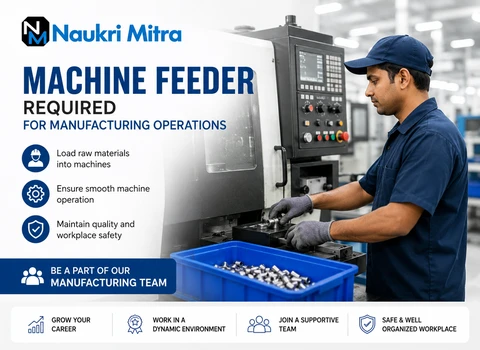
Loading the Line: What a Machine Feeder Really Handles
Walk onto any busy shop floor, and you'll notice someone standing near the machine mouth, constantly placing material in, pulling finished pieces out, watching the rhythm of the cycle. That's the Machine Feeder. It's a physically active job, and it sits closer to the heart of production than most people assume before they've actually worked one. The current opening for Machine Feeder Required for Manufacturing Operations is based in Faridabad, Haryana, India, and it's a Full-time position.
Why This Job Exists in the First Place
A machine doesn't stop needing material just because someone stepped away. If the feed runs dry, or comes in at the wrong angle, production halts, or worse, the machine jams and damages tooling. Companies bring on feeders specifically to prevent that gap. It sounds simple on paper. In practice, it takes a steady hand and constant attention.
How the Shift Actually Unfolds
Most shifts start with a quick look at the machine setup — is the material staged, is the feed path clear, is everything aligned the way the last operator left it. From there, it's a repeating loop: load, watch the cycle, check the output, clear anything that looks off, keep the pace. Faridabad's manufacturing units often run rotational shifts, so night duty comes up as often as day shifts. Some weeks you'll be on mornings, some weeks you won't be.
What the role generally involves
- Feeding raw material or components into the machine at the right pace
- Watching the machine cycle for anything unusual
- Pulling out defective pieces before they pile up
- Keeping the feeding station tidy and material within reach
- Flagging jams, noise, or shortages to the supervisor right away
- Noting down basic production counts when required
Machines You'll Be Standing Next To
Depending on which unit you land in, that could be a stamping press, an injection moulding machine, or a conveyor-linked assembly setup. Hand trolleys, weighing scales, and basic gauges also show up often. None of this requires an engineering degree, but understanding why the feed timing matters — why a half-second delay can throw off an entire cycle — makes a real difference between someone who's just filling a slot and someone who's actually good at the job.
Where This Kind of Work Is Common
Automobile parts units, plastic and rubber processing plants, metal fabrication shops, packaging lines — feeders show up in all of them. Faridabad has long been one of Haryana's stronger industrial belts, and that's part of why openings like this one keep coming up there.
What Gets You Noticed as a Candidate
Employers aren't usually looking for someone with years of theory behind them. They want someone who can follow a set process without cutting corners, stay alert through repetitive stretches, and not panic when a machine hiccups. Freshers get hired into this role fairly often. So do ITI pass-outs and diploma holders from mechanical or production backgrounds — and for slightly more technical feeding work, prior exposure to engineering drawings or precision components can tip things in your favor.
The Physical Side Nobody Mentions in Interviews
You'll be on your feet for most of the shift. Your hands will be doing the same motion, over and over. Some sections of the floor run hot, especially near molding or pressing stations, and the noise level isn't always low. It's not brutal work, but it does wear on you differently than a desk job would, and it helps to go in knowing that.
Staying Safe Around Moving Parts
Safety shoes, gloves, and safety glasses are standard here. Before clearing any jam, the machine should be properly locked out — skipping that step is how most feeder-related injuries happen. Loose sleeves, dangling ID cards, anything that could catch in a moving part- those get left at the door.
Where the Trouble Usually Starts
New feeders tend to struggle most when the line speeds up, and the feeding rhythm has to match it. The fix isn't rushing — it's staying ahead of the material supply before the pressure hits. Speaking up early about a shortage, rather than trying to stretch what's left, saves a lot of headaches later in the shift.
Moving Up From Here
Feeders who stick with it and learn the machine settings, not just the loading motion, often get pulled toward machine operator roles or quality-checking positions on the same line. It's not a fast climb, but it's a real one, and it happens within the same shop floor you start on.
Pay and What Else Might Come With It
This position pays ₹23,500 per month and is based in Faridabad, Haryana, India. Beyond the fixed salary, some units offer overtime pay, PF, ESI coverage, a festival bonus, uniforms, or transport and canteen access — though what's actually offered depends on the specific employer and isn't the same everywhere.