You've Seen What Good Preparation Actually Prevents
Somewhere, a scrub tech is walking into a procedure they've only read about, not practiced. A new OR nurse is second-guessing a step because nobody walked her through it clearly. You've been in rooms where the difference between a smooth case and a scramble came down to training someone got — or didn't. This role puts that experience to work, minus the twelve-hour shifts.
What This Role Actually Is
As a
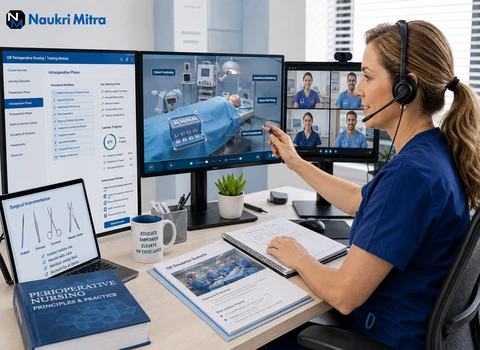
Remote Nurse Educator focused on OR procedures, you'll design and run perioperative training for surgical staff across several healthcare systems, all from home. It's not a desk job disguised as clinical work — you're still drawing on real surgical judgment, just applying it to how the next group of OR staff learns and performs. Expect actual influence here, not a supporting role on someone else's curriculum.
Building the Curriculum
You'll develop and keep updating perioperative training modules so they track with current clinical standards and certification requirements. A lot of this comes down to translation: taking OR workflows that are second nature to you and turning them into material that lands for someone who's never seen the procedure done. As new techniques or protocol changes come through, you'll fold them into existing content rather than letting materials go stale. Content also needs to flex — what works for a brand-new hire won't land the same way for someone five years into OR work.
Running the Training Itself
Live webinar sessions are part of the job, alongside self-paced eLearning programs that learners can work through on their own schedule. You'll lead case study walk-throughs, demonstrate skills, and build out decision-tree exercises that mirror real OR judgment calls. Assessments, quizzes, and simulation reviews give you a way to track whether the training is landing.
Working Across Teams
None of this happens in isolation. You'll work with surgical technologists, anesthesiologists, and nurse managers to make sure training reflects how things really run in the OR, not just how a manual says they should. Multidisciplinary case reviews are part of the rhythm too — they're often where you'll spot the gaps that actually need addressing. New OR staff onboarding runs through a structured virtual mentorship model, and you'll play a direct role in that.
Keeping Everything Compliant
Training content needs to stay current with AORN standards and infection control protocols, and you'll be the one making sure it does. That includes keeping documentation audit-ready and using learner feedback and performance data to sharpen materials over time rather than letting them run on autopilot.
What You'll Need
An
Associate degree is the minimum education requirement here, in line with RN licensure, and you'll need an active RN license in good standing. Beyond that, we're looking for at least
5 years of clinical experience in a perioperative or OR setting, plus
at least 2 years of clinical education or a nurse preceptor role in surgical environments. A working knowledge of AORN, Joint Commission, and CMS standards should already be second nature by this point in your career.
Also Worth Having
- CNOR certification or an equivalent credential
- Time spent with remote education platforms or virtual training tools
- A history of building curriculum and measuring whether it actually worked
- Coaching instincts that hold up across different personalities and experience levels
- Some grounding in instructional design or adult learning principles
What You'll Work In
Content is delivered through Learning Management Systems such as Moodle or Blackboard, with built-in video libraries, quizzes, and mobile-friendly formats. For anything hands-on, you'll lean on 3D procedural simulators and animation tools such as Touch Surgery and Visible Body. Communication runs through HIPAA-compliant platforms — Zoom for Healthcare, Microsoft Teams, and secure EMR-integrated messaging.
Remote, But Not Disconnected
Your schedule is largely your own to structure, though you'll still need to show up for strategy calls, live sessions, and coordination across time zones. Job listings like this sometimes get filed on general boards or portals such as Naukri Mitra under a broad "healthcare education" label, which undersells what the role actually involves — this one comes with real say in how education gets shaped across an entire system, not just a slice of it.
Pay and What's Included
The role pays
$109,263 annually. On top of that, you can expect full control over your daily schedule, ongoing mentorship, and access to industry workshops, certification support, and a team that's genuinely focused on surgical safety rather than just hitting training quotas.
What Comes Next
This role tends to lead somewhere — Director of Nursing Education, Surgical Program Coordinator, Learning and Development Strategist, depending on where your interests take you. The mentorship and certification support along the way are meant to get you there, not just fill out a benefits list.
How to Apply
If years of OR judgment have you ready to teach rather than just perform, this is where that experience is put to wider use. We're reviewing applications from qualified candidates across the USA, Canada, the UK, the European Union, Australia, India, and other international markets.