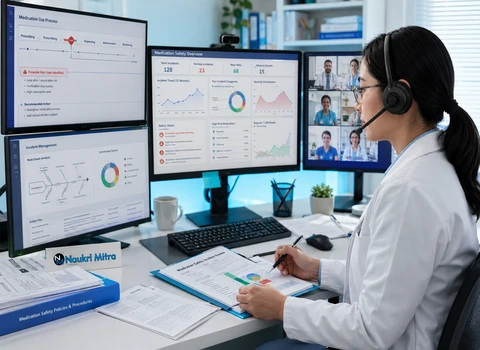
Somebody has to catch the medication error before it reaches a patient, not after. That's the job, in one sentence — except it's rarely one moment of catching, more often a slow rebuild of the process that let the error happen in the first place. We're hiring a licensed pharmacist to do exactly that, fully remote.
You won't be counting pills or standing behind a counter. Instead, you'll be pulling apart incident reports, rewriting policies that don't hold up under pressure, and training clinical staff who need to understand why a protocol changed, not just that it did. It's slower work than retail pharmacy in some ways. It's also the kind of work that prevents the next 10 errors rather than just fixing the last one.
Day to Day
No two weeks look identical, but a few things come up constantly.
- Reviewing adverse drug events and incident reports, then tracing the root cause rather than stopping at the surface symptom
- Auditing medication workflows across departments to find where risk is hiding
- Writing and updating pharmacy safety policy so it actually matches national safety standards
- Sitting in on safety committee meetings, audits, and regulatory surveys as the pharmacist voice in the room
- Running virtual training sessions — sometimes a formal workshop, sometimes a quick Q&A after a policy change
- Working alongside nursing, physicians, quality assurance, and clinical informatics on shared safety projects
- Tracking error trends inside incident management software so patterns get flagged before they repeat
What You'll Need to Bring
This isn't an entry-level position, and the qualifications reflect that.
- Education: Doctoral degree (PharmD or equivalent), current pharmacist license in good standing
- Experience: At least 3 years in clinical pharmacy, with some exposure to safety monitoring, incident review, or policy writing along the way
- A real understanding of current regulatory guidelines and clinical quality benchmarks — not just familiarity, working knowledge
- Comfort inside EHR systems like Epic or Cerner
- The ability to communicate clearly in writing and over video calls, since that's most of how this team talks to each other
Nice to Have, Not Required
- A PGY1 or PGY2 residency, especially one focused on medication safety or informatics
- Experience presenting to a safety committee or leading a clinical training session
- Some background with pharmacovigilance databases or virtual training tools
- Prior remote clinical work, so the transition isn't a learning curve on its own
The Systems You'll Actually Use
Electronic Health Record platforms for pulling real-time medication data. National and international pharmacovigilance databases for checking safety signals against a wider dataset. Incident management software for the day-to-day tracking. Virtual training platforms for the workshops. None of this is exotic — if you've worked in a health system in the last few years, you've likely touched most of it already.
If you're comparing openings on Naukri Mitra or elsewhere, this one stands out mainly because the work sits upstream of the dispensing counter — you're shaping the process, not executing it one prescription at a time.
How the Team Actually Works
Remote doesn't mean isolated here, though it does mean the rhythm is different from a hospital floor. There's a weekly sync, plenty of async updates, and meetings that tend to function as working sessions rather than status check-ins. People push back on each other's ideas fairly openly. If a policy draft has a hole in it, someone will say so before it goes live, not after.
Pay and Benefits
- $135,701 annual salary
- Fully remote, with flexible hours built around a handful of core meetings
- Health, dental, and mental wellness coverage
- Paid time off, plus floating holidays for whatever matters to you personally or culturally
- A yearly stipend for continuing education and journal access
- Support for attending industry conferences, in person or virtually
Where This Can Go
Some people in this role move toward safety leadership. Others lean into informatics or end up shaping policy across multiple facilities rather than one. There's a development plan built around whatever direction makes sense for you, plus ongoing education support — but the honest answer is that the path isn't fixed in advance. It follows wherever your interest and results take it.
Who Tends to Do Well Here
Pharmacists who read an incident report and immediately see the pattern behind it — not just the one mistake, but the process flaw that will produce the same mistake again next month. If that's how your brain already works, this role will feel less like a stretch and more like a better use of a skill you already have.
A Few Practical Details
Core meeting hours run in U.S. time zones, so some overlap is expected regardless of where you're based. Applicants from the United States, Canada, the UK, the EU, Australia, India, and several other regions are welcome to apply. Travel isn't a standard part of the job, though attending a safety symposium occasionally is sometimes an option, not an obligation.
Applying
Send a resume that shows your clinical pharmacy background clearly, along with any safety, informatics, or policy work you've done. If you make it to an interview, come ready to talk through one real safety issue you caught and fixed — specifics matter more here than a general pitch about being detail-oriented.
If the idea of preventing the next error rather than just responding to the last one sounds like the right shift, this is that role.