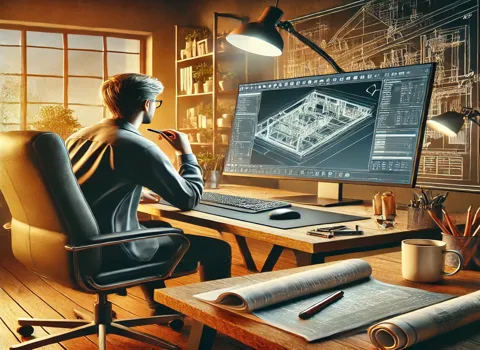
Somebody has to take a rough sketch, or sometimes just a verbal description over a call, and turn it into a drawing that a machinist or a builder can actually use without calling back three times to ask what you meant. That's most of this job in one sentence.
We're hiring a Remote CAD Designer. AutoCAD and SolidWorks are the main tools, and the models you build will end up on a shop floor or a job site, not sitting in a folder somewhere. It's a fully remote role, so it suits someone comfortable managing their own schedule, though you'll still be checking in with the team regularly.
What the role covers
Drafting takes up most of the week, but it's rarely just drafting in isolation. A lot of the actual skill here is making sure a drawing meets the needs of engineers and fabricators before it ever gets to them. Naukri Mitra treats that kind of accuracy as the core of the job, not an extra step tacked on at the end.
You'll touch mechanical parts sometimes, architectural layouts other times, occasionally an industrial component. There isn't much room to specialize narrowly in this role, at least not early on.
Day to day, roughly
- Sketches, briefs, sometimes just a phone call description turn into 2D drafts and 3D models
- Assemblies get built and reworked in SolidWorks before prototyping starts
- Technical drawings need to follow standard construction or engineering formats, no shortcuts there
- A colleague's draft has an error, you catch it before it goes further
- Engineers need confirmation a design meets safety or performance standards, so you loop in
- Version control matters more than people think, since nobody wants three "final" files floating around
- Specs change mid-project fairly often, and the drawing has to change with them
What you need to have
Minimum education required: an Associate degree.
Minimum experience: 2 years of hands-on CAD work, whatever the specific field.
Past that baseline, the things that actually matter once you're doing the job:
- AutoCAD skills that go beyond the basics
- SolidWorks, particularly comfort with more complex assemblies
- Documentation that would hold up if someone else had to pick up your file cold
- Reading a vague brief and figuring out what someone actually wants built
- Keeping files organized enough that remote teammates aren't guessing which version is current
- Writing clearly, because you'll be explaining technical calls to people who don't do CAD themselves
Nice to have, not required
Missing these won't rule you out. They just help.
- Cloud-based CAD or project tracking tools
- Some background in prototyping or product design engineering
- Comfort moving between architectural and mechanical drafting
- Having worked before on a team spread across time zones
- A knack for spotting a clash between parts before it reaches the workshop floor
Pay and the rest of it
$120,000 a year. A few other things that come with the role:
- Flexible hours built around shared collaboration windows, not a fixed shift
- Full health coverage, dependents included
- Paid time off that people are actually expected to use
- A yearly training budget for certifications or a new CAD platform, if you want one
- Bonus pay tied to how a project actually turns out
How the team operates
Time zones are scattered enough that daily overlap windows matter more than they would in any shared office. Expect async updates most days, occasional review calls, and direct feedback that doesn't turn into a blame session when something goes sideways. Specs will shift at inconvenient times. That's just how it goes here, and the expectation is to adjust to it rather than get rattled.
Some weeks are almost entirely heads-down drafting. Other weeks are half meetings and half small fires that need putting out. Both happen often enough that it helps to be able to move between the two without losing your place.
Where this tends to lead
People don't usually stay locked into one kind of project here for long. A few weeks on construction drawings for a building, then a shift toward helping an R&D team with a new product idea. If you want to learn a new platform or take on something more technically involved, that gets supported as a matter of course, not something you have to push for.
Who tends to do well in this seat?
People who like untangling a messy problem. People who ask what happens if a part fails before someone else has to ask it for them. If seeing a drawing turn into something physical actually means something to you, this role delivers that fairly often.
To apply
Send an application if you can draft with precision, adjust when a spec changes without much warning, and explain a technical decision to someone who's never touched AutoCAD in their life. Applicants from the United States, Canada, the United Kingdom, the European Union, Australia, India, and other eligible regions are all welcome, since the role is remote by design rather than by exception.