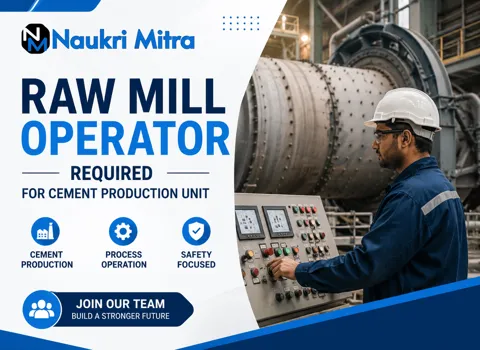
Understanding the Role of a Raw Mill Operator in Cement Manufacturing
A Raw Mill Operator is one of the key technical staff members inside a cement production unit. This role sits at the very beginning of the cement-making process, where limestone, clay, and other raw materials are ground into a fine powder called raw meal. Anyone researching this career for the first time should know that the job combines machine handling, quality monitoring, and basic mechanical troubleshooting into a single position. In Nimbahera, Rajasthan, a region known for its cement industry, this Full-time opening for a Raw Mill Operator Required for Cement Production Unit reflects the steady demand for trained plant staff in this sector.
Why Cement Plants Recruit for This Position
Cement production runs continuously, and the raw mill section directly affects the quality of the final product. If the raw meal is not ground and mixed correctly, the entire kiln process and clinker quality can suffer. That is why plants prefer to hire dedicated operators rather than rotating untrained staff through this section. Companies look for people who can read basic control panel data, respond quickly to unusual readings, and keep the mill running smoothly with minimal downtime.
What a Typical Working Day Looks Like
Work usually begins with a handover from the previous shift, during which the operator checks logbooks, alarm history, and material feed levels. During the shift, the operator monitors mill vibration, temperature, pressure, and material flow from a control room or a local panel. Regular rounds are conducted to inspect bearings, belts, and feeders for unusual noise, heat, or vibration. Minor adjustments to feed rate or airflow are common, and any major fault is reported immediately to the shift-in-charge or the maintenance team.
Core Responsibilities on the Floor
- Starting, monitoring and stopping the raw mill system as per production schedule
- Checking raw material proportioning and feed consistency
- Recording production data, downtime and abnormal readings
- Coordinating with the quality control lab for sample testing
- Reporting mechanical or electrical faults promptly
- Keeping the mill area clean and free of material spillage
Machines, Tools and Instruments Used
Operators work closely with vertical roller mills or ball mills, along with separators, bag filters and belt conveyors that move crushed limestone toward the grinding chamber. Control rooms typically have SCADA- or PLC-based screens displaying live temperature, pressure, and vibration data. Hand tools such as spanners, grease guns and vibration meters are used during routine checks, while weighing feeders and moisture analyzers help maintain correct raw meal composition.
Explaining the Process in Simple Terms
In simple words, the raw mill grinds raw materials into a powder fine enough to react properly inside the kiln later. Industries use this process because uneven or coarse particles would produce weak, inconsistent cement. This is different from a cement mill, which grinds clinker after burning rather than raw materials before burning.
Skills That Make an Operator Successful
Technical understanding of mechanical systems, basic electrical awareness, and comfort with control panel readings are valuable. Equally important are practical skills such as staying alert during long shifts, communicating clearly with teammates, and following standard operating procedures without shortcuts. Problem-solving under pressure is often what separates an average operator from a dependable one.
Educational Background Employers Usually Prefer
Employers may prefer candidates with relevant machining or tool room training. Depending on the complexity of the work, an ITI in a machining-related trade, a Diploma in Mechanical or Tool and Die Engineering, or equivalent vocational training may be considered suitable. Practical experience with EDM machines, engineering drawings, and precision measuring instruments is often valued as much as formal education, since it builds the foundation needed to understand mill mechanisms.
Physical Demands and Shift Patterns
This work involves standing, walking across plant areas, and occasional climbing to inspect equipment at height. Since cement plants operate round the clock, shift work is common, and operators should be prepared for rotating schedules including night duty.
The Working Environment Inside the Plant
The raw mill section can be dusty, noisy, and warm, especially near grinding and conveyor areas. Good housekeeping and ventilation systems help, but operators still need to stay alert to environmental conditions throughout their shift.
Safety Practices and Protective Equipment
Safety is treated seriously in cement plants due to dust, moving machinery and heavy material handling. Operators are generally expected to wear helmets, safety shoes, dust masks, ear protection and gloves. Lockout-tagout procedures are followed before any maintenance work, and the immediate reporting of unsafe conditions is part of daily practice.
Common Challenges on the Job
New operators often find it challenging to quickly interpret abnormal readings or diagnose the exact cause of a mill trip. Dust exposure and continuous noise can also take time to adjust to. Building familiarity with the equipment through consistent practice gradually reduces these difficulties.
Growing Within This Career
With experience, a Raw Mill Operator can progress toward senior operator roles, shift-in-charge positions, or specialized maintenance responsibilities within the same plant. Consistent performance, willingness to learn new equipment, and a clean safety record are usually the deciding factors for such advancement.
Salary Expectations and Possible Benefits
For this Full-time position based in Nimbahera, Rajasthan, India, the monthly salary is ₹37,200. Along with the fixed salary, employees in this industry may also receive benefits such as overtime pay, Provident Fund (PF), ESI coverage, bonus, uniforms, transport or canteen facilities, depending on the employer's policy. These should be considered possibilities rather than guaranteed inclusions.