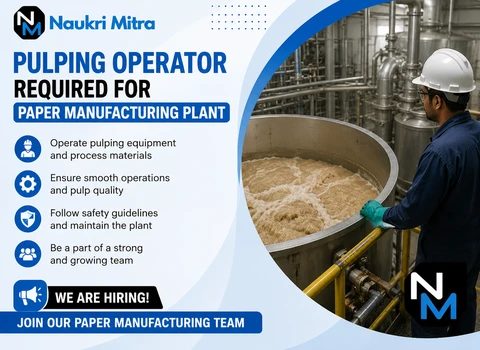
Pulping Operator Required for Paper Manufacturing Plant
Paper doesn't start out as paper. It starts as wood chips, waste paper bales, or agricultural fiber that has to be broken down, soaked, and beaten into a wet, soupy mass called pulp. Someone has to run that first stage. That's what a Pulping Operator does, and it's the job on offer at a paper manufacturing plant in Yamunanagar, Haryana, on a full-time basis, with a salary of ₹34,800 per month.
The First Stage Everything Else Depends On
Get the pulp wrong, and everything downstream suffers. Paper comes out patchy, weak, or the wrong color. So plants put real weight on this stage, and on the person controlling it. The operator's job is to keep fiber consistency, water ratio, and chemical dosing inside a fairly narrow band, cycle after cycle, shift after shift.
What the Shift Actually Looks Like
Most shifts start with a walk-around: checking the pulper, the digester, the pipelines feeding in and out. Then it's a matter of loading raw material, watching consistency readings, adjusting valves and dosing pumps, and keeping an eye on pressure and temperature gauges. There's also a fair bit of talking involved — checking in with the supervisor, coordinating with whoever runs the next stage, usually screening or bleaching.
Daily Responsibilities
- Loading the pulper or digester with raw fiber
- Tracking consistency, temperature and pressure
- Running valves, pumps and the control panel
- Handling routine cleaning and small maintenance jobs
- Flagging faults to the maintenance crew early
- Filling in production logs before handover
Where Operators Like This Actually Work
These roles sit inside paper mills and pulp processing units — not office buildings, not corporate parks. Yamunanagar has had a paper and allied-industries presence for a long time, so this kind of plant work is fairly established in the region. Some units run on recycled waste paper rather than fresh wood fiber, and the pulping approach varies slightly depending on which one a plant uses.
The Equipment You'll Be Standing Next To
Expect to work around hydrapulpers, digesters, refiners, and screens, along with consistency transmitters, flow meters, and pressure gauges for monitoring the process as it runs. Plants are increasingly fitting PLC-based control panels alongside the older manual ones, so a bit of comfort with digital controls goes a long way now, even if the plant still has manual backups.
Training That Actually Helps
Formal qualifications matter, but they're not the whole story. Employers tend to prefer candidates who've completed machining or tool room training — an ITI in a machining trade, a Diploma in Mechanical or Tool and Die Engineering, or something similar. What often counts just as much is hands-on exposure: reading engineering drawings, working with precision measuring instruments, or having spent time around EDM machines. A candidate who can read a spec sheet correctly and hold a tight tolerance tends to stand out, degree or no degree.
Skills That Show Up on the Floor, Not on Paper
- Reading gauges and panel data without hesitation
- Basic troubleshooting on pumps and valves
- Sticking to SOPs even under supervision pressure
- Staying alert through long stretches on the floor
The Physical Side of It
You'll be on your feet for most of the shift. There's lifting involved from time to time, and the area around the pulping section tends to be damp, loud, and warm. Paper plants generally run round the clock, so rotational shifts — including nights — come with the territory for this full-time position.
Staying Safe Around Moving Machinery
There's rotating equipment, chemicals, and hot surfaces nearby, so safety isn't optional here. Operators are usually required to wear safety shoes, gloves, and ear and eye protection. Lockout-tagout procedures during maintenance work, and just staying aware of what's moving around you, cut down the chances of an accident considerably.
What Trips Up New Operators
Judging pulp consistency by look and feel takes time to learn — most new operators get it wrong a few times before it clicks. Breakdowns during a busy production run can also add pressure fast. The operators who do well tend to be the calm ones, the kind who troubleshoot step by step rather than panic when a reading goes off.
Where This Can Lead
Operators who perform consistently often move up to senior operator roles, shift-in-charge positions, or quality-focused roles within the pulping section itself. Spending time across different machines in the plant tends to open up broader technical responsibilities down the line.
Pay and What Might Come With It
This position pays ₹34,800 per month. Beyond the base salary, some employers add extras like overtime pay, PF, ESI, bonuses, uniforms, transport, or canteen access — though this varies plant to plant and shouldn't be assumed going in.
For someone looking to build a hands-on career in India's manufacturing sector, this Pulping Operator opening in Yamunanagar, Haryana offers a real entry point into a core industrial process, steady full-time work, and a realistic path toward more senior technical roles over time.