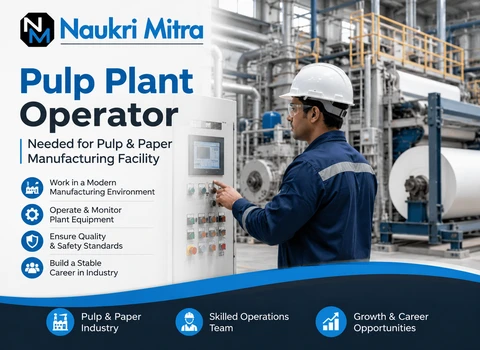
What It's Really Like to Run a Pulp Machine for a Living
Say the words "Pulp Plant Operator" to someone outside the paper industry, and most will picture a factory worker doing something vague with wood. The actual job is more specific than that. This is a Full-time position based in Dandeli, Karnataka, India, and it focuses on operating the machinery that turns raw fiber into pulp, one of the earliest and most critical stages in making paper. If you're looking into this line of work for the first time, here's what the role actually involves, day to day.
The Reason Mills Keep This Position Open
Pulp mills don't stop. Digesters keep cooking, washers keep turning, bleaching lines keep running — around the clock, in most cases. That kind of process can't be left unattended, because a small slip in temperature or chemical dosing can ruin a batch or, worse, damage equipment. So mills need someone physically present to read the gauges, catch problems early, and act on them before they lead to a shutdown. That's the operator's job, in short.
A Shift, Start to Finish
The day usually begins with a handover — the outgoing operator talks you through anything unusual from the last shift. Then comes a walk around the section: checking pipelines, listening for odd sounds, glancing at pressure and flow readings. Throughout the shift, you're adjusting consistency levels, monitoring chemical dosing, and keeping temperatures where they need to be. Some of this happens through a control panel; a fair bit still happens by hand, turning a valve or taking a manual sample. Log sheets get filled in throughout, and the supervisor gets updated whenever something's off.
Where the Job Actually Takes You Each Day
- Running and watching over pulping, washing and bleaching equipment
- Tracking chemical levels, steam pressure and flow rates
- Catching leaks, strange vibrations or unusual noise early
- Helping with cleaning and basic preventive maintenance
- Sticking to the standard procedure for each stage of production
- Keeping shift logs and production records up to date
The Kind of Facility You'd Be Working In
This work exists in pulp and paper mills and integrated paper manufacturing units — places that process wood or agricultural fiber into paper. Dandeli, in Karnataka, has had a pulp and paper presence for years now, partly due to access to raw materials and the existing industrial base. Inside a facility like this, you might end up in the pulping section, the chemical recovery area, or somewhere closer to finishing and packing — it depends on how the plant is set up.
The Equipment You'll Have Your Hands On
Digesters, rotary washers, bleach towers, screens, pumps — these are the regulars. For measuring, you're looking at pressure gauges, flow meters, consistency meters, and temperature indicators. Newer plants run much of this through a DCS or SCADA screen, so several parameters appear in one place. Older sections still rely on manual valves and physical sample checks, and, honestly, many operators end up trusting both—the screen and their own eyes.
What Actually Gets You Hired
Technical knowledge matters, but so does judgment you can't really put on paper. Most employers look for an ITI in a relevant trade — such as fitter, mechanical, or process technology — or a Diploma in Mechanical, Chemical, or Paper Technology. Knowing how to read a process diagram, having some grounding in basic instrumentation, and being comfortable around industrial chemicals — these count for a lot. None of that replaces staying alert on a long night shift or being able to talk clearly with your team when something goes sideways, though.
On Your Feet, and Not Always in Daylight
Expect to be standing for long stretches, climbing platforms, working near steam, heat, and machinery noise. Production doesn't pause for the clock, so shifts rotate, and night duty comes with the territory. Reasonable fitness helps, but so does simply getting used to the rhythm of odd hours.
Staying Safe Around Steam, Chemicals and Moving Parts
Safety isn't an afterthought on this floor — it can't be, given what's involved. Lock-out/tag-out is followed during maintenance work, hand signals are used near machinery, and hazards are reported the moment they're spotted, not at the end of the shift. PPE is standard: helmet, industrial gloves, safety goggles, ear protection, chemical-resistant footwear. Wearing it isn't optional in the production areas.
What Trips Up Most Beginners
Judging pulp consistency by feel before instruments confirm it takes time to learn — most new operators get this wrong more than once before it clicks. The smell, the humidity, the heat — all of that takes some getting used to too. And when a machine stops without warning, staying calm rather than reacting in a panic is often what separates someone experienced from someone still learning the ropes.
Where This Can Lead Over Time
Most people start as helpers or trainees before they're trusted to run a machine on their own. Do that well for a while, and the next steps are usually senior operator, shift-in-charge, or process technician — all within the same plant. Time spent in washing, bleaching, or chemical recovery sections tends to count for something when a mill is looking to promote from within rather than hire outside, so the learning that happens on the floor really does add up.
What the Job Pays
This Full-time role in Dandeli, Karnataka, India comes with a monthly salary of ₹35,500. Beyond that, some employers may offer overtime pay, PF, ESI coverage, an annual bonus, uniforms, or canteen and transport facilities — none of this is guaranteed, and it varies quite a bit from one mill to another.
If You're Thinking of Applying
Get familiar with basic process flow diagrams before you walk into an interview, and spend some time around industrial equipment if you can, even informally. If you're a fresher with an ITI or Diploma background, talk about any hands-on workshop training you've had — it counts more than people expect. If you've already worked in a similar role, be ready to explain a time you handled a process upset or an equipment issue yourself. That kind of story tends to matter more here than a list of qualifications.