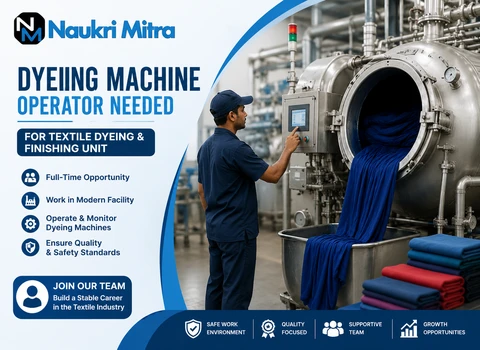
Understanding the Role of a Dyeing Machine Operator in Textile Processing
A Dyeing Machine Operator is a skilled production worker who handles the machines that add color and finish to fabric before it becomes ready-made cloth. Textile units across India rely on this role because dyeing is one of the most technical stages of fabric production, requiring precise control over temperature, chemical dosing, and timing. This particular opening is for a Dyeing Machine Operator position based in Jetpur, Gujarat, India, offered on a Full-time basis.
Jetpur is known for its textile printing and dyeing industry, and units in this region regularly require trained operators to manage fabric processing without compromising quality or consistency.
What Draws Companies to Hire for This Position
Dyeing is not a simple dipping process. It involves controlling water levels, chemical concentration, temperature curves, and machine speed together. A small error can spoil an entire batch of fabric, so companies prefer operators who understand both the machine and the chemistry behind it. This is why textile finishing units continuously look for dependable machine operators, technicians, and production workers who can be trained on their specific equipment and processes.
A Typical Day on the Production Floor
An operator's day usually begins with checking the machine, inspecting fabric batches, and confirming the dye recipe given by the supervisor or quality team. Once the shift starts, the operator loads fabric into the dyeing unit, sets parameters, and monitors the process closely until completion.
- Loading and unloading fabric rolls or ropes into the dyeing chamber
- Measuring and adding dyes, salts, and chemical auxiliaries as instructed
- Monitoring temperature, pressure, and cycle time on control panels
- Checking shade consistency during and after the process
- Recording batch details for quality tracking
- Cleaning and maintaining the machine between cycles
Machines, Tools and Instruments Used on the Job
Depending on the unit, an operator may work with jet dyeing machines, jigger machines, soft-flow machines, or padding mangles. Alongside the main machine, operators use dosing pumps, pH meters, thermometers, and sample-cutting tools to verify the color match before releasing a batch. Some units also use computerized control panels where the operator enters recipe parameters instead of adjusting valves manually.
Skills That Make an Operator Successful
Technical understanding is important, but so is attention to detail. An operator needs to read simple process sheets, follow safety instructions, and react quickly if a machine shows unusual readings. Basic knowledge of fabric types, dye classes, and water chemistry is an advantage, though many units train freshers on the job.
Candidates who have completed an ITI in a relevant trade, a diploma in textile or chemical processing, or similar vocational training are often preferred, since this background makes it easier to understand machine settings and process instructions. That said, hands-on experience with dyeing equipment is valued just as much as formal education.
Working Environment and Physical Demands
Textile dyeing units are humid and warm due to the use of steam and hot water. Operators need to stand for long hours, lift fabric rolls, and work near hot surfaces and chemical tanks. Shift work is common in this industry, since dyeing machines often run in continuous cycles.
Safety Practices Every Operator Should Follow
Handling chemicals and hot water requires discipline. Workers are generally expected to wear PPE such as gloves, aprons, gumboots, and safety goggles. Following lockout procedures before machine maintenance and reporting leaks or unusual smells immediately are basic safety habits every operator should build early in their career.
Common Challenges on the Shop Floor
Shade mismatches, machine breakdowns, and time pressure during bulk orders are common challenges. Experienced operators learn to anticipate these issues by double-checking recipes and keeping the machine well maintained.
Growing Within the Dyeing and Finishing Trade
With experience, an operator can move toward shift supervisor or senior technician roles, eventually overseeing quality checks and training newer workers. Strong knowledge of dyeing chemistry can also open opportunities in process improvement roles within the same unit.
Salary and Employment Details
This Full-time Dyeing Machine Operator role in Jetpur, Gujarat, India offers a monthly salary of ₹31,500. Depending on the employer, workers may also be eligible for benefits such as overtime pay, PF, ESI, bonus, uniforms, or transport and canteen facilities, though these vary by unit and are not guaranteed.