
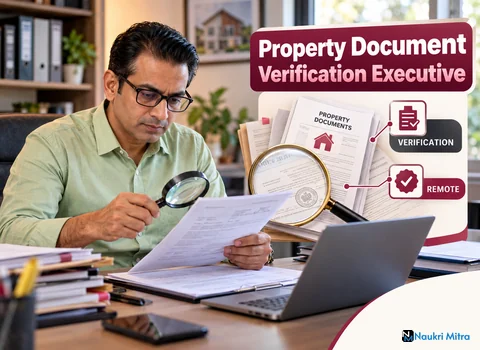
On the first pass, the file looked clean. The latest sale deed showed Mr. A selling a residential plot to Mr. B, the stamp duty was paid, and the registration details were legible. Then the earlier deed came out of the bundle, and the person who had bought that plot ten years before was not Mr. A at all. Somewhere between the two documents, ownership had moved without any paper to show it. Catching gaps like that, before a lender releases money against the property, is the daily work behind these remote property document verification executive jobs. The position is full-time, fully remote, open to applicants anywhere in the world, and pays 400 USD per month.
If you have wondered what a property document verification executive does, the short answer is that you read ownership papers the way an auditor reads accounts. You take a set of scanned documents for one property and confirm that each owner received the title from the person before them, that nothing is mortgaged or disputed without being disclosed, and that the approvals match what is being sold.
The property document verification executive job description for this opening covers these tasks:
Checking sale deeds, the title chain and encumbrance certificates is the core of the job. A title chain is the sequence of transfers that brings a property from an earlier owner to the current seller. Each deed should name as seller the person who appeared as buyer in the deed before it. When the names do not line up, you look for the missing document: a gift deed, a partition, a will, a release, or a court order. If none turns up, the file goes back with a query.
You also watch for smaller mismatches, such as a survey number written differently on two pages or an area that grows without explanation. Each one gets a note in your report, along with the page where you found it.
An encumbrance certificate lists registered transactions against a property for a stated period. You read it for mortgages that were never closed, sales not disclosed by the seller, and gaps in the period covered. Mutation entries in the revenue records should show the current owner; if the land record still shows a previous holder, that is worth raising. Approvals need to match the actual construction and the extent being sold.
Portals and spreadsheets go hand in hand in this job. Much of the cross-checking happens on online land records portals, where you search by survey number, owner name or registration details and compare what the portal shows with the scanned papers. Online land record access and reporting is what makes remote verification workable: if the official record can be pulled up from anywhere, the checker does not need to sit in the registry office.
Excel is where you keep the tracker. Each file gets a row with its status, the defects found, the documents still awaited and the date of your last follow-up. Many records are written in regional languages, so the ability to read the local script used in the documents you are assigned is expected.
The skills this role relies on are mostly about patience and precision:
Candidates with an LLB, or with a real estate law course, are preferred. Does an LLB or real estate law course matter for document verification? Yes, because either gives you the vocabulary of transfer, title and encumbrance that the job uses every day. A property document verification executive course or a property document verification executive certification in title search or real estate documentation can help a non-law graduate show they understand the material.
Two to four years of property title verification at banks, NBFCs or law firms is preferred. Familiarity with online land records portals, encumbrance certificates, Excel reporting and regional-language documents is expected.
People often ask how to become a property document verification executive without any title-checking background. The usual route is a law degree or property law course, followed by work as a junior at a law firm, a legal vendor to lenders, or a loan processing team where you see deeds and certificates every week. Searches for property document verification executive jobs no experience and entry level remote property document verification executive jobs are common, and this listing prefers candidates with prior title work, so freshers should know the bar going in.
To get a property verification job as a fresher, build familiarity with your state's land records portal, practise reading sample deeds and encumbrance certificates, and be ready to explain a title chain out loud. A property document verification executive resume should list the document types you have handled, the portals you know, the languages you read, and any law course or internship.
The property document verification executive salary for this opening is 400 USD, paid monthly. If you are comparing property document verification executive salary per month across listings, that is the single figure stated here, in US dollars. The role is full-time. For anyone searching property document verification executive jobs remote worldwide, this one does not tie you to a city or country, and it fits people looking for property document verification executive work from home jobs, given a reliable connection.
The employers who typically hire for this kind of work include banks and NBFCs that lend against property, and proptech firms that verify listings or support buyers.
Property document verification and a legal title search overlap, but they are not identical. A title search, usually done by an advocate, results in a legal opinion on whether the title is clear and marketable, often covering a long period. Verification, as described here, is the disciplined review of the documents supplied: confirming they are complete, consistent and match the records, and flagging what is missing. Your report often feeds into the legal opinion rather than replacing it.
Career growth in property legal due diligence tends to follow depth. With experience, verifiers move into reviewing other people's reports, handling complex files with inheritance or partition issues, or supervising a regional queue. Those who complete a law degree can move toward drafting title opinions. Preparation for property document verification executive interview questions usually centres on scenarios: what you would do if the encumbrance certificate shows an unclosed mortgage, or if a mutation entry names someone outside the chain. Openings marked as remote property document verification executive jobs hiring now will often test you with a sample file, so practise explaining your reasoning step by step.
Go back to that file with the mismatched seller. If your instinct was to ask which document was missing, and where it might have been registered, you already think the way this work requires. Apply with a resume that shows the documents you know, the records you can search, and the languages you read.